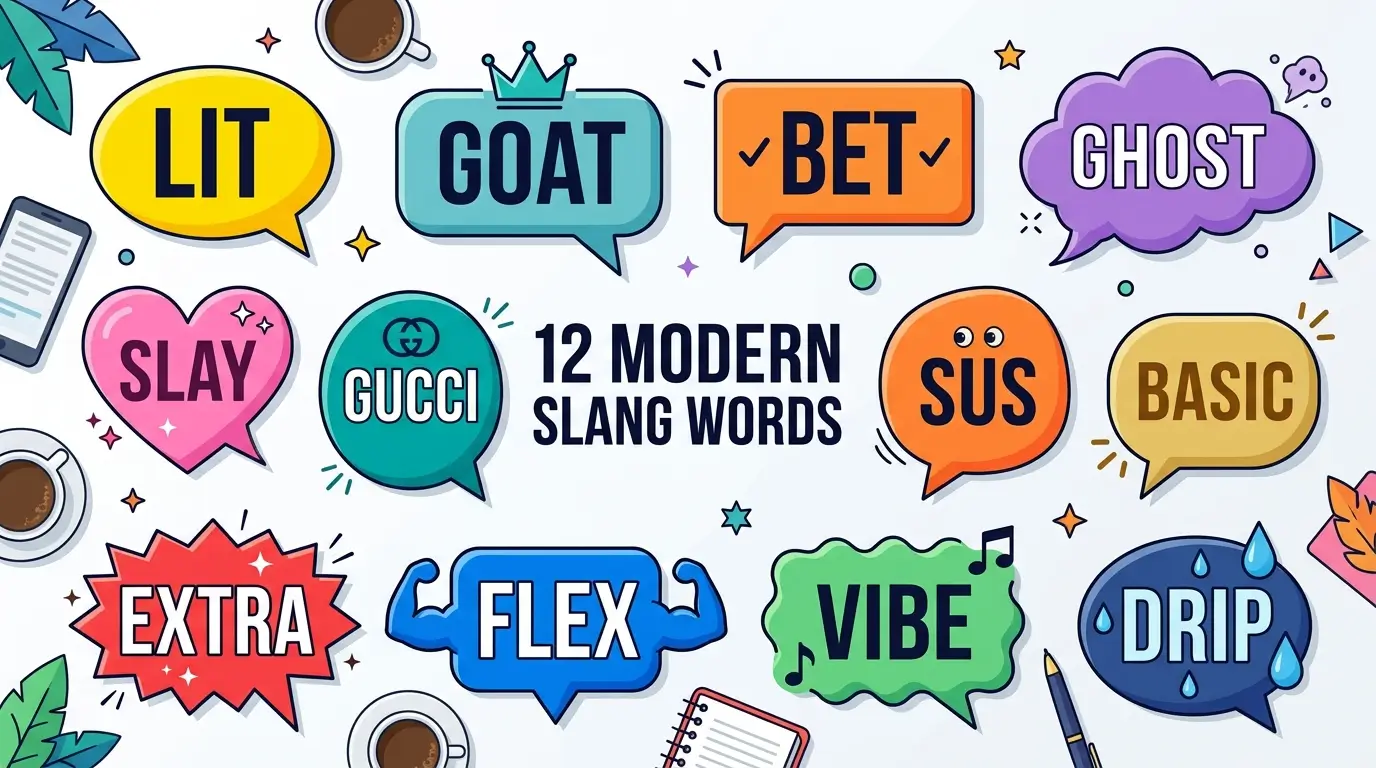
12 powerful slang words like “GOAT,” “slay,” “rizz,” and “no cap” are terms people use to sound confident, expressive, or in-the-know. They cover everything from praise and confidence to calling out lies, and most come from hip-hop, gaming, or online culture before spreading across social media.
Key Takeaways
- These 12 powerful slang words are used to express confidence, praise, honesty, or emotion in a short, punchy way.
- Many trace back to Black culture, AAVE, hip-hop, or gaming communities before going mainstream.
- Most are still actively used today, especially by teens and young adults on TikTok, Instagram, and in texting.
- Tone varies by word; some are purely positive (“slay,” “GOAT”), while others can sound playful or blunt (“sus,” “salty”).
- Meanings can shift fast, so context always matters more than the dictionary definition.
Slang moves fast. A word that’s everywhere on TikTok this month might sound outdated in a year, but some terms stick around for decades.
This guide breaks down 12 powerful slang words that show up constantly in conversations, captions, and comment sections. You’ll get the real meaning behind each one, where it likely came from, and how to actually use it without sounding out of touch.
Some of these words started in music and gaming communities. Others grew out of everyday Black English before spreading through mainstream media. A few are simply short, catchy ways to say something that used to take a whole sentence. Although the source, they all share one thing: people use them because they’re quick, expressive, and fun to say.
At the end, you’ll know exactly what each term means, when it’s appropriate to use, and when it might land the wrong way.
What Do These Slang Words Mean?
Each of these 12 powerful slang words has its own specific meaning, but most fall into a few categories: praise, honesty, confidence, or calling something out. Here’s a breakdown of each term.
- GOAT: Short for “Greatest Of All Time.” Used to praise someone as the best at something.
- Slay: To do something extremely well or look amazing.
- Rizz: Charisma, especially the ability to flirt smoothly.
- No cap: Not lying, telling the truth.
- Cap: A lie or exaggeration.
- Sus: Suspicious or questionable.
- Bet: Agreement, like saying “okay” or “deal.”
- Salty: Bitter or annoyed, often over something small.
- Flex: To show off, usually something you’re proud of.
- Vibe: The overall feeling or mood of a person, place, or moment.
- Ick: A sudden feeling of being turned off by someone.
- Ghosting: Suddenly cutting off all communication with someone.
Quick Meaning Box
| Slang Word | Simple Explanation |
| GOAT | The best of all time |
| Slay | Did something impressively well |
| Rizz | Charm or flirting skill |
| No cap | Being honest |
| Cap | A lie |
| Sus | Suspicious |
| Bet | Agreed, sounds good |
| Salty | Annoyed or bitter |
| Flex | Showing off |
| Vibe | A mood or feeling |
| Ick | Sudden turn-off |
| Ghosting | Cutting off contact suddenly |
Pronunciation
Most of these words are pronounced exactly as spelled, but a few trip people up. “Rizz” rhymes with “quiz.” “Sus” rhymes with “fuss.” “Cap” and “no cap” are pronounced normally, like the hat, but mean something completely different in slang.
Where Do These Slang Words Come From?
Most of these terms come from hip-hop culture, Black English, or gaming communities before spreading through social media. The exact origin of several individual words is unclear, but their cultural roots are well documented.
“GOAT” grew popular through sports and hip-hop, often linked to praise for athletes and rappers. “Cap” and “no cap” have roots in African American Vernacular English (AAVE), where “cap” has long meant lying or exaggerating.
“Rizz” is newer and gained mainstream attention through online video culture. “Sus” became popular partly through the game Among Us, though shortened slang like this existed before the game too.
The exact path each word took to go viral isn’t always traceable, and claiming a single inventor for any of them would be misleading.
History of the Term
Slang like this doesn’t appear overnight. Many of these words existed in smaller communities for years before a viral moment pushed them into everyday use. “Flex” and “salty” have been part of hip-hop and youth slang since at least the 1990s and 2000s.
“Ghosting” became widely recognized in the early 2010s alongside the rise of dating apps. “No cap” moved from AAVE into wider pop culture through music and social media in the late 2010s.
Newer entries like “rizz” and “ick” spread rapidly because of short-form video platforms, where a single clip can push a word to millions of viewers in days. This is part of why slang cycles feel faster now than they did twenty years ago.
How People Use It Today
These words show up constantly in texting, TikTok captions, Instagram comments, and casual conversation. Gaming and Discord communities also use terms like “sus” heavily, thanks to their gaming-adjacent popularity.
On X (formerly Twitter), short slang like “bet,” “cap,” and “sus” fits naturally into quick replies and jokes.
Slang Words and Meanings in English
Slang is an informal type of language that native and non-native speakers alike pick up through exposure rather than textbooks. These 12 powerful slang words are a good entry point for understanding how English slang works, since they show clear patterns: shortening phrases (“GOAT”), flipping a word’s meaning (“cap”), or borrowing terms from a specific community and giving them broader use (“rizz,” “sus”).
Powerful Slang Words for Everyday Confidence
Words like “slay,” “flex,” and “GOAT” are considered powerful because they pack a strong emotional punch into one syllable or short phrase. Instead of saying “you did an amazing job,” someone can simply say “you slayed.” This efficiency is part of why these terms spread so fast.
Amazing Slangs That Changed How People Talk
Terms like “no cap” and “rizz” changed casual conversation by giving people a quick way to express honesty or charm without over-explaining. Once a term like this catches on, it often replaces longer phrases people used before.
Slang with Examples for Better Understanding
Seeing a word used in context makes it far easier to understand than reading a dry definition. That’s why the examples further down this article show each term in real conversations, texts, and captions rather than just listing definitions.
Slang Words in English and Their Everyday Use
Many of these words aren’t limited to teens. Adults use “bet,” “vibe,” and “flex” regularly in casual settings, work chats among friends, and social posts. Slang isn’t only a youth phenomenon anymore; it moves across age groups fast.
Slang for Daily Life and Casual Conversation
These words work well in daily life because they’re short and expressive. “Bet” replaces “okay, sounds good.” “Vibe” replaces a whole sentence about mood or atmosphere. That convenience is exactly why people reach for slang instead of formal language in casual chats.
Definition of Slang Words with Real Examples
A clear definition paired with a natural example helps the meaning stick. For instance: “Cap” means a lie. Example: “He said he ran a mile in five minutes? That’s cap.” Seeing the word in a sentence makes the definition click faster than a dictionary entry alone.
Examples in Everyday Conversation
- “That new song is fire, honestly he’s the GOAT right now.”
- “You slayed that presentation, seriously.”
- “Bro has rizz, he got her number in two minutes.”
- “I’m not mad, no cap, I just need space.”
- “Stop capping, you weren’t even there.”
- “That text felt kind of sus.”
- “Bet, I’ll meet you at seven.”
- “Why are you salty about a video game?”
- “He’s flexing his new car again.”
- “This café has a really chill vibe.”
Text Message Examples
- “omg you slayed today fr fr”
- “no cap that test was so hard”
- “bet, see u at 6”
- “he’s capping, ignore him”
- “kinda sus that he left early ngl”
- “the vibe at the party was immaculate”
- “she got the ick after he chewed loud”
- “he’s got rizz ngl”
- “why u salty rn”
- “he’s flexing his new kicks again”
Social Media Caption Examples
- Instagram: “GOAT status, no debate.”
- TikTok: “The rizz was unmatched today 😭”
- X: “no cap this was the best show ever”
- Instagram: “vibe check: passed ✅”
- TikTok: “caught the ick and I can’t unsee it”
- Threads: “bet, let’s run it back”
- Facebook: “so proud, she slayed this event”
- X: “why is everyone so sus lately”
- Instagram: “flexing this new setup, finally”
- TikTok: “he’s capping, and we all know it”
Is It Positive or Negative?
Most of these words are neutral or positive, but tone depends heavily on context. “Slay,” “GOAT,” “rizz,” and “bet” are almost always positive or friendly. “Cap,” “sus,” and “salty” carry a slightly negative or accusatory tone, though usually playful rather than harsh.
“Ghosting” describes a negative social behavior, and calling someone out for it is rarely lighthearted. Misunderstandings usually happen when someone takes a playful jab, like being called “sus,” too seriously.
Who Uses This Slang?
Teens and young adults use these words the most, especially on TikTok and Instagram. Gamers commonly use “sus,” particularly in multiplayer or competitive settings. Millennials use many of these terms too, especially “flex,” “salty,” and “ghosting,” since those have been around long enough to cross generational lines.
Adults in casual workplaces sometimes use “vibe” or “bet” in relaxed team chats, though rarely in formal settings.
Similar Slang Words
| Slang | Meaning |
| Lit | Exciting or excellent |
| Fire | Really good or impressive |
| Mid | Average, unimpressive |
| Extra | Over-the-top or dramatic |
| Basic | Predictable or unoriginal |
Opposite Words
- Mid: the opposite of GOAT or fire, meaning average or unimpressive.
- Cringe: the opposite of slay, describing something embarrassing rather than impressive.
- Real talk: similar meaning to “no cap,” but “cap” itself is the direct opposite, meaning a lie instead of the truth.
- Chill: the opposite of salty, meaning calm and unbothered.
Common Mistakes
People often misspell “rizz” as “riz” or “sus” as “suss” in casual writing, though “suss” is also used correctly as a verb meaning to figure something out.
Another common mistake is using “cap” and “no cap” backward, forgetting that “cap” means a lie while “no cap” means the truth. Some people also overuse “vibe” as a filler word, which can weaken its meaning in a sentence.
When NOT to Use It
Avoid these slang words in professional emails, school essays, resumes, or formal presentations. Words like “cap,” “sus,” or “rizz” can come across as unprofessional or confusing to readers unfamiliar with them.
In business communication, clarity matters more than sounding trendy, and formal writing expects standard English rather than casual slang.
Fun Facts
- “GOAT” became widely associated with Muhammad Ali before spreading into general use for any top performer.
- “Sus” got a major popularity boost from the game Among Us, though shortened slang existed before the game.
- “Cap” meaning a lie has roots in AAVE and has been used this way for decades.
- “Ghosting” became a commonly recognized term alongside the growth of online dating.
- Slang like “rizz” and “ick” spread largely through short-form video, showing how fast platforms can push new words into mainstream use.
- Many slang terms shift meaning slightly depending on tone of voice or context, which dictionaries can’t fully capture.
Frequently Asked Questions
What are famous slang words?
Some of the most famous slang words include “cool,” “lit,” “GOAT,” “salty,” and “no cap.” These terms became famous because they spread beyond their original communities into mainstream media, music, and everyday conversation. Famous slang usually has staying power, meaning it survives for years instead of fading after one trend cycle. Words tied to music, sports, or major online moments tend to become the most widely recognized over time.
What are Gen Z slang words?
Gen Z slang includes newer terms like “rizz,” “ick,” “no cap,” and “sus,” which spread mainly through TikTok and short-form video. These words tend to change quickly, with new ones replacing older favorites every year or two. Gen Z slang often blends gaming culture, music culture, and internet humor into short, punchy phrases. Compared to older slang, it spreads faster because of how quickly videos and trends circulate online today.
What are some hood phrases?
Many widely used slang terms, including “cap,” “no cap,” and “flex,” have roots in African American Vernacular English and hip-hop culture before becoming mainstream. These phrases carry real cultural history, and using them respectfully means recognizing where they came from rather than treating them as random internet trends. Over time, mainstream media adopted many of these phrases, which is part of why they’re now used far beyond their original communities.
What are 5 slang words?
Five commonly used slang words are “GOAT,” “cap,” “sus,” “vibe,” and “flex.” Each has a distinct meaning: GOAT means the best, cap means a lie, sus means suspicious, vibe means a mood or feeling, and flex means showing off. These five cover a range of everyday situations, from praising someone to calling out dishonesty, which is part of why they remain popular across different age groups.
Is slang appropriate in professional settings?
Generally, no. Slang works well in casual conversation, texting, and social media, but professional settings usually call for clear, standard language. Using slang in an email or meeting can come across as unprofessional or unclear, especially with people from different age groups or backgrounds who may not know the terms.
Final Thoughts
Slang changes fast, but these 12 powerful slang words give you a solid foundation for understanding how casual English works right now. If you’re decoding a text, a caption, or a conversation, knowing terms like “no cap,” “rizz,” and “GOAT” helps you keep up without feeling lost.
Not every word here will stick around forever. Some may fade, while others might stay part of everyday language for years to come.
Either way, understanding the meaning, tone, and origin behind each term helps you use slang naturally instead of forcing it into a sentence where it doesn’t fit.
Keep an eye on how these words shift over time. Slang is always evolving, and staying curious about it is the best way to keep up.

James Carter is a slang researcher and writer at Slang Insight, dedicated to exploring the origins and meanings behind today’s most popular internet expressions. With a background in linguistics and a love for pop culture, James brings a unique perspective to every article, making slang easy to understand for everyone.