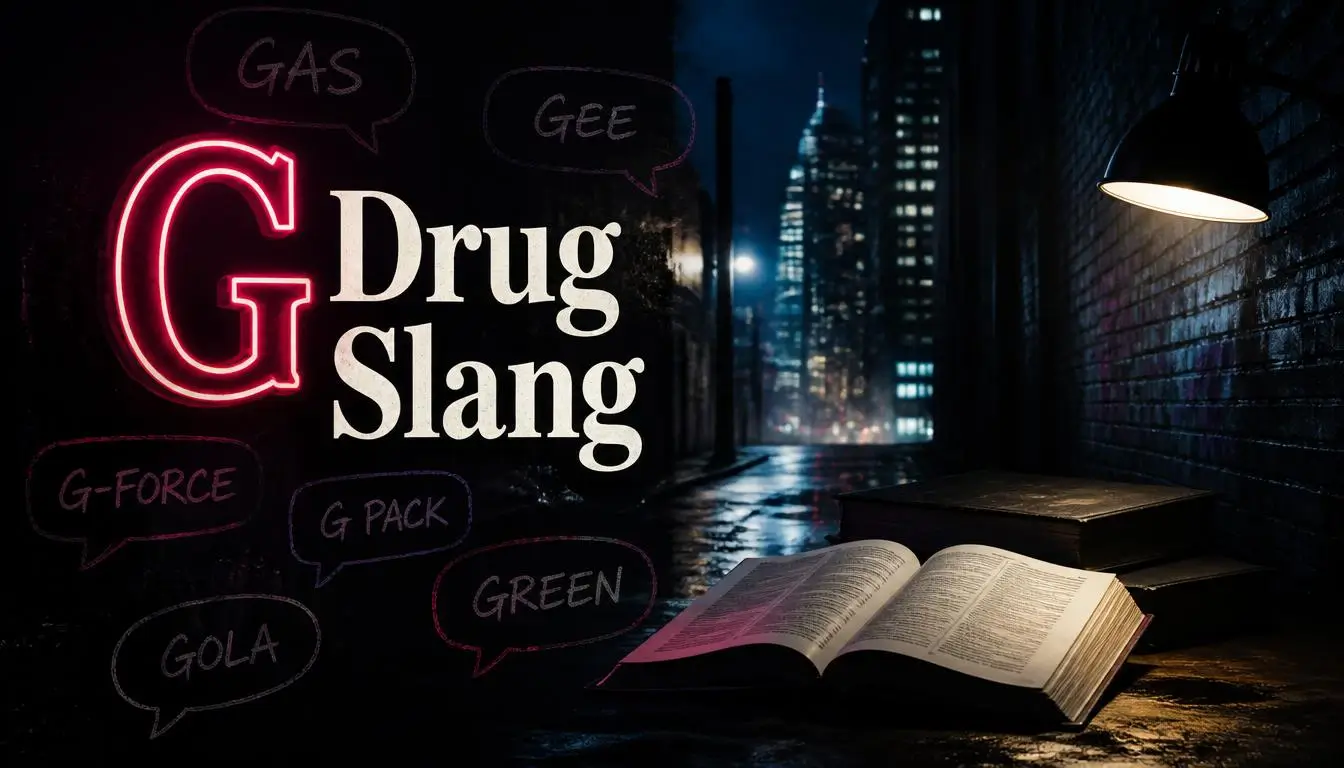
In drug slang, “G” most often refers to GHB (gamma-hydroxybutyrate), a depressant sometimes called “liquid ecstasy.” It can also mean a gram of a substance, or a thousand dollars (“a G”). Context always decides which meaning applies.
Key Takeaways
- “G” most commonly means GHB, a controlled depressant drug.
- It can also mean a gram of a substance or a grand ($1,000), depending on context.
- The GHB sense grew out of 1990s club and rave culture.
- GHB is linked to serious health risks, including overdose and its use as a drug-facilitated assault substance.
- The term is still used today, mostly in nightlife, chemsex, and party contexts.
- Tone is neutral in casual slang use but carries heavy warning weight in health and safety contexts.
People search “g drug slang” for a few different reasons. Some hear the letter “G” in a song, a text, or a conversation and want to know what it means. Others are parents or partners who spotted the word somewhere and got worried. Some are just curious about slang and word origins.
The short answer is that G is one of the most common street names for GHB, a depressant drug tied to club culture, chemsex parties, and unfortunately, drug-facilitated sexual assault cases. But “G” isn’t a one-note word. Depending on who’s talking, it can also mean a gram of a drug, or a thousand dollars in cash.
This guide breaks down every common meaning of “g drug slang,” where the term came from, how people use it today, and how to avoid mixing it up with similar-sounding words. It also covers real search questions people ask about the term, so you don’t need to check another site to get the full picture.
What Does G Drug Slang Mean?
In drug slang, “G” most often refers to GHB, although people in drug culture also use the letter as shorthand for other terms. The surrounding sentence, the setting, and nearby slang usually reveal the intended meaning.
The GHB meaning carries the most serious health and safety concerns. GHB acts as a central nervous system depressant. Some people take it recreationally for its relaxing and euphoric effects, while others use it to spike drinks without the victim’s knowledge, linking the drug to drug-facilitated assault.
GHB also has a narrow margin between a recreational dose and an overdose, and mixing it with alcohol can greatly increase the risk of serious harm.
In other contexts, “a G” can refer to one gram of a drug or to one thousand dollars, as in “stacked five Gs.” These meanings have no connection to GHB; they simply represent different slang uses of the same letter.
Quick Meaning Box
| Meaning | Simple Explanation |
| GHB (most common) | A depressant drug, also called “liquid ecstasy” or “Gina”. |
| A gram | A unit weight of a drug being bought, sold, or used. |
| A grand | Slang for $1,000, unrelated to drugs. |
| Gangster/G (general slang) | A term for a tough or respected person, unrelated to drugs. |
Pronunciation
“G” is pronounced just like the letter “jee.” There’s no special phonetic twist; it’s simply the letter said on its own.
Where Does G Drug Slang Come From?
The GHB meaning of “G” emerged from 1990s club, rave, and party culture, when people often used single letters to keep drug-related conversations vague. Researchers first synthesized GHB decades earlier while studying anesthesia and sleep, but recreational users later adopted the substance.
During the 1990s, GHB gained several nicknames, including “liquid ecstasy,” “Gina,” and “grievous bodily harm,” a play on the initials GBH. The simple single-letter term “G” also became part of this slang vocabulary.
Party and chemsex communities use similar letter-based naming patterns for other substances. For example, people have used “GMTV” as shorthand for a combination of GHB, mephedrone, Tina (methamphetamine), and Viagra, which sometimes appear together in the same social settings.
Origin of the Term
GHB has a documented history that predates its slang name becoming common. It was studied in the mid-20th century as a possible anesthetic and sleep aid. Its calming, sedative properties eventually caught on outside medical settings, and by the 1980s and 1990s, it had moved into gyms (briefly marketed as a bodybuilding supplement) and then into nightlife.
Once GHB use spread into club and rave scenes, the short, one-letter nickname “G” became a fast, low-key way to refer to it.
Around the same period, it also became infamous as a drug linked to sexual assault cases, since it’s easy to slip into a drink and can leave a person unable to resist or clearly remember what happened.
In more recent years, “G” has stayed in steady use within specific communities, especially in chemsex contexts, where it’s sometimes used alongside other drugs at private gatherings.
The word hasn’t faded; it’s simply stayed within somewhat narrower circles rather than becoming mainstream internet slang like other terms have.
How People Use It Today
“G” still shows up today mostly in spoken conversation, private messaging, and forums focused on nightlife, harm reduction, or sexual health rather than on mainstream platforms like TikTok or Instagram.
Because it’s tied to a controlled substance, it isn’t the kind of slang people post about openly the way they might joke about unrelated internet slang.
Harm-reduction organizations and sexual health services also use the term “G” directly in their own educational materials, since it’s the name people already recognize. That’s different from meme-style slang; this use is meant to warn and inform, not to joke around.
Blues and G Drug Slang
“Blues” is a separate slang term, usually referring to counterfeit blue pills made to look like prescription opioids. It isn’t directly related to “G,” but the two terms sometimes appear in the same conversations about party drugs, which is why people search them together.
Mixing up “blues” and “G” is a mistake worth avoiding, since they refer to completely different substances with different risks.
What Does G Stand For in Drug Slang
On its own, the letter “G” stands in for the word GHB, shortened down to its first letter. In some regional or dealer slang, “G” can also stand for “gram,” describing a small quantity of a drug rather than a specific substance.
G Pack Drug Slang
A “G pack” generally refers to a bundle or package of a drug, often described by weight or dollar value rather than by drug type. The term borrows from the money slang sense of “G” (a grand, or a gram) rather than from the GHB sense.
G Funk Drug Slang
G-funk is a hip-hop subgenre from the early 1990s associated with West Coast rap. While drug references appear throughout hip-hop lyrics generally, “G-funk” itself is a music term, not a drug name; its “G” ties back to “gangster,” not GHB.
G People Drug Slang
“G people” isn’t a standardized drug term. It sometimes shows up informally to describe people connected to a particular scene or group, but it doesn’t have one fixed, documented meaning the way “G” alone does for GHB.
What Drug Has the Slang Name G
The drug most consistently nicknamed simply “G” is GHB (gamma-hydroxybutyrate). Other drugs sometimes get G-related nicknames too, but none of them are called “G” as consistently or clearly as GHB is.
Gary Drug Slang
“Gary” has appeared in some slang lists as a nickname loosely connected to GHB, likely because it starts with the same letter.
Documented, reliable use of “Gary” this way is thin, so it’s best treated as a minor variant rather than a widely recognized term.
Glass Drug Slang
“Glass” is a well-known nickname for methamphetamine, especially the crystallized form, which can look like shards of glass. It isn’t related to GHB; it’s its own distinct slang term for a different drug entirely.
Gas Drug Slang
“Gas” is most often slang for high-potency marijuana, and in some regions it’s also used for marijuana laced with another substance. Like “glass,” it’s unrelated to the GHB meaning of “G,” even though both start with the same letter.
G6 Drug Slang
“G6” is best known as a reference to a 2010 pop culture hit song, not as a recognized drug slang term. People sometimes use “G6” in drug-related contexts, but the term lacks a consistent or widely accepted meaning, so you shouldn’t treat it as a standard drug term.
G&T Drug Slang (Urban Dictionary)
Outside of drug slang, “G&T” most commonly means the cocktail gin and tonic. Any drug-related definitions attached to “G&T” on crowdsourced sites are informal, unverified, and inconsistent, so they carry far less weight than the well-documented drink meaning.
Gummy Drug Slang
“Gummy” usually refers to a cannabis edible shaped like a gummy candy. It’s a distinct, well-known term in cannabis culture and isn’t connected to the GHB sense of “G.”
Greenies Drug Slang
“Greenies” has historically referred to certain stimulant pills, with the name coming from the pill’s color. It’s a separate, older slang term, distinct from GHB and from “green” as a general cannabis nickname.
Goober Drug Slang
“Goober” doesn’t have one fixed, widely documented drug meaning. In some casual or regional use, it’s been applied loosely to describe someone acting strangely, possibly under the influence, rather than naming a specific substance.
Gak Drug Slang
“Gak” is a well-documented slang term, most often used for cocaine, and less commonly for methamphetamine, depending on the region. The exact origin is unclear, though some sources connect it to the gagging or throat-clearing reflex sometimes triggered by snorting a drug.
Grass Drug Slang
“Grass” is a classic, long-running nickname for marijuana, in use since at least the mid-20th century. It’s one of the older, more universally recognized cannabis slang terms and isn’t connected to the GHB meaning of “G.”
Examples in Everyday Conversation
- “Is he on G? He’s acting way too mellow for a Tuesday.”
- “She said she doesn’t touch G anymore too many bad stories.”
- “They were talking about G at the party, and I had no idea what it meant until I looked it up.”
- “He mentioned picking up ‘a G’; turned out he meant a gram, not the drug.”
- “The clinic pamphlet used the word G right next to GHB so people would recognize it.”
- “My cousin said some guys at the club were passing around G, and it made her nervous.”
Text Message Examples
- “you good? you seemed kinda out of it, someone said there was G going around”
- “not doing G tonight, staying clear headed”
- “he’s been messing with G a lot lately, kinda worried tbh”
- “Just so you know, if anyone offers you G at that party, just say no and stick with us”
- “She panicked bc she thought her drink got spiked with G”
- “The flyer literally said ‘no G, no exceptions’ for the event”
Social Media Caption Examples
- Instagram: “Reminder: know what’s in your drink. G is odorless and easy to miss. Stay safe out there.”
- TikTok: “POV: explaining club drug slang so you know what to watch for #harmreduction”
- X (Twitter): “If someone says ‘G’ at a party and you don’t know what that means, it’s GHB. Look out for your friends.”
- Threads: “Nightlife safety 101: G isn’t a joke word, it’s a real depressant with real risks.”
- Facebook: “Our clinic put together a quick guide to slang terms like G so parents can recognize the warning signs.”
- Instagram: “Never leave your drink unattended. G can be colorless, odorless, and easy to slip in unnoticed.”
Is It Positive or Negative?
The GHB meaning of “G” carries a serious, cautionary tone almost everywhere it’s used, since the drug is tied to overdose risk and drug-facilitated assault. It’s rarely used casually or as a joke.
The non-drug meanings of “G” a gram, a grand, or general slang for a tough or respected person are much more neutral or even friendly in tone.
Misunderstandings usually happen when someone hears “G” in a money or general-slang context and mistakenly assumes a drug reference, or vice versa. Reading the surrounding conversation is the easiest way to tell them apart.
Who Uses This Slang?
The GHB sense of “G” is most common among adults in nightlife, rave, and chemsex-adjacent communities, along with health workers and harm-reduction educators who use the term to communicate clearly with the people they’re trying to help.
The money and general slang senses of “G” are far more widespread, showing up across hip-hop culture, everyday casual speech, and multiple generations.
Similar Slang Words
| Slang | Meaning |
| Gina | Another common nickname for GHB. |
| Liquid ecstasy | A nickname for GHB, despite having no chemical link to MDMA. |
| Fantasy | Another GHB street name. |
| Scoop | Slang referencing a dose of GHB, often liquid. |
| Blue nitro | A brand-related nickname once tied to GHB-like products. |
Opposite Words
There isn’t a true “opposite” of a drug slang term, but a few contrasting ideas are worth knowing:
- Sober/clean: the state of not using any substances, the direct contrast to being “on G.”
- Stimulant slang (like “gak” or “glass”) describes an upper, the rough opposite effect of a depressant like GHB.
- Dry event: an event or party explicitly free of drugs and alcohol, the opposite setting from where “G” slang typically comes up.
Common Mistakes
People often confuse “G” (GHB) with unrelated G-words like “gas” (marijuana) or “glass” (methamphetamine), simply because they share the same first letter. Others mistake “a G” meaning a gram or a grand for a drug reference when it isn’t one at all.
Misspellings are rare since it’s a single letter, but people sometimes wrongly assume “G” always refers to the same drug across every context, when it actually depends heavily on who’s speaking and where.
When Not to Use It
Avoid using “G” as drug slang in professional emails, school assignments, workplace messages, or other formal writing. People may interpret the term as a reference to illegal drug use, which could lead to serious personal or professional consequences.
It’s also worth avoiding in any writing meant for a general or younger audience unless the goal is specifically educational, like a health or safety resource.
Fun Facts
- GHB was originally studied for anesthetic and sleep-related uses before recreational use spread.
- “G” is one of several single-letter drug nicknames used in party and chemsex slang, alongside letters like “T” and “M” for other substances.
- GHB has no color or smell, which is part of why it can be added to drinks without detection.
- Some brand-related nicknames for GHB, like “blue nitro,” came from products once sold before stricter regulation.
- The term “G” is used directly in medical and harm-reduction materials, not just informally.
Frequently Asked Questions
What does g stand for in drug slang?
“G” commonly refers to GHB (gamma-hydroxybutyrate), a central nervous system depressant sometimes known as “liquid ecstasy.” People use the single letter as a shorter, more discreet way to refer to the substance instead of saying its full chemical name. In some contexts, “G” can also mean a gram of a substance, but drug slang lists and health resources most often associate the term with GHB.
What is a G pill?
There isn’t one single, standardized “G pill.” GHB is most commonly sold and used as a liquid rather than a pill. If someone says “G pill,” they may be referring to a different pill entirely, or using the term loosely. It’s worth asking directly what substance is meant rather than assuming, since mixing up pills and liquids can lead to real confusion about what’s actually being taken.
What is a drug that starts with G?
Several drugs and drug nicknames start with G. GHB is the most notable, but “glass” (methamphetamine), “gas” (potent marijuana), “gak” (cocaine), and “grass” (marijuana) all start with the same letter too. Each refers to a completely different substance, so the letter alone doesn’t tell you much; context always matters more than the first letter of a nickname.
What are G and t?
Outside of slang, “G&T” is simply short for gin and tonic, a classic cocktail. Any drug-related use of “G&T” you might see on crowdsourced slang sites is informal and inconsistent, without solid, reliable sourcing behind it. For nearly all everyday purposes, “G&T” safely refers to the drink, not a substance.
Final Thoughts
“G” is a small word carrying a lot of different meanings, and the stakes for getting it right are higher than with most slang. Most of the time, it points to GHB, a depressant with real health risks and a troubling history tied to drug-facilitated assault.
Other times, it’s just shorthand for a gram or a grand, with no drug connection at all.
The safest approach is to always read the full conversation before assuming which “G” is being used. If you’re ever unsure if someone is talking about a substance, it’s fine to just ask directly.
And if GHB or any other drug use is something you or someone you know is dealing with, reaching out to a doctor, counselor, or a substance use helpline is a solid first step.

Sarah Mitchell is a content writer at Slang Insight, passionate about internet culture, trending phrases, and the ever-changing world of digital communication. With a keen eye for spotting new slang before it goes viral, Sarah loves breaking down complex expressions into simple, relatable explanations for readers of all ages.