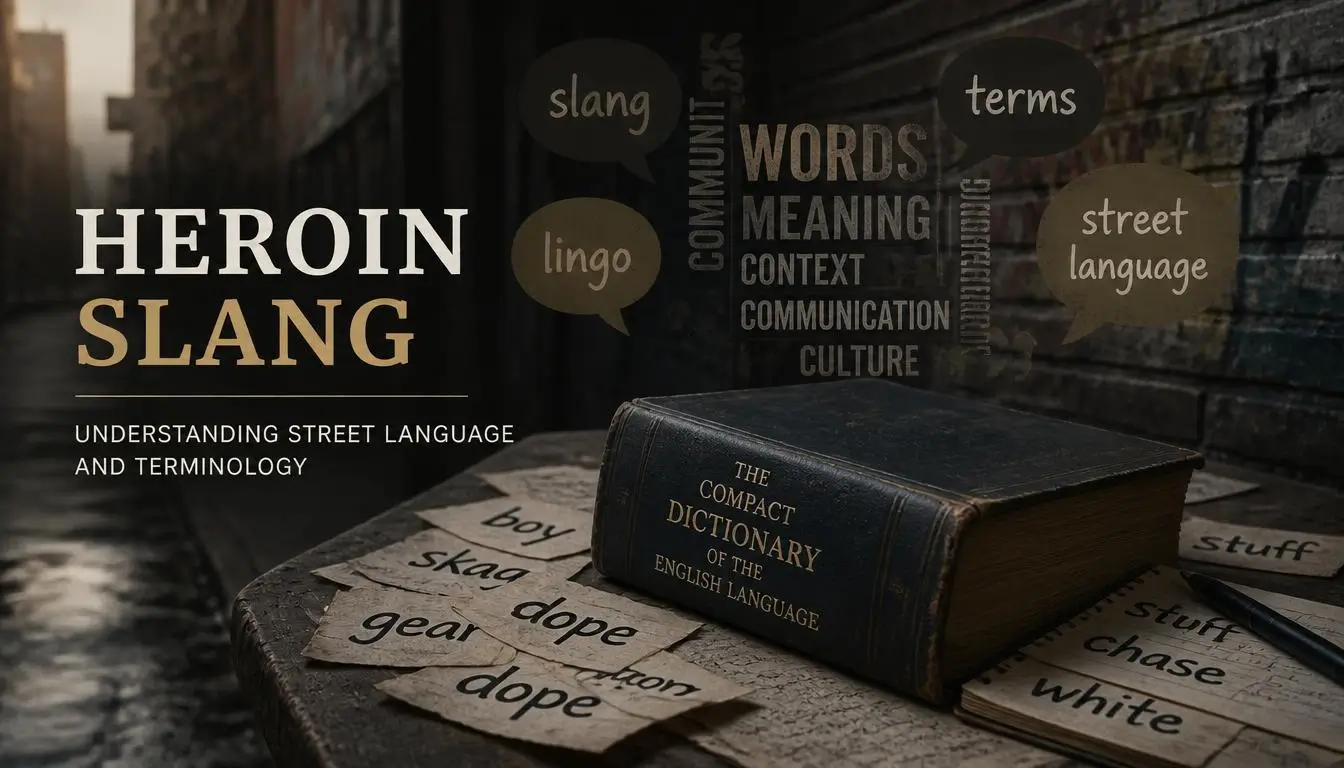
Heroin slang refers to the many street names used for heroin, including “smack,” “H,” “horse,” “junk,” “boy,” and “brown.”
These terms vary by region, and people use them as coded, discreet ways to discuss the drug and keep outsiders, including law enforcement and family members, from understanding.
Key Takeaways
- Heroin has dozens of documented street names, including smack, H, horse, junk, and boy.
- The word “heroin” itself comes from the German “heroisch,” coined by Bayer in 1898.
- Slang varies heavily by region; the UK, Australia, and Spanish-speaking countries each have their own common terms.
- Heroin slang has evolved for over a century, driven by the need for discreet communication.
- The tone around this term is always serious, tied to addiction and real health risks.
- It’s still widely used today, in conversation, online, and in coded texting.
Parents and caregivers often come across an unfamiliar word in a text message or overhear something confusing and want to understand what it really means. Others are students, writers, or researchers looking into how drug language evolves.
Some are simply curious after hearing a term in a movie, a song, or the news.
Heroin has one of the longest, most varied slang vocabularies of any illegal drug. That’s partly because it’s been around for over a century, and partly because people using or selling it have always needed discreet ways to talk about it.
Terms like “smack,” “H,” and “horse” go back decades, while others are newer or specific to a particular region.
This Conversation covers everything the term “heroin slang” includes: what the words mean, where they came from, how they differ across countries, and how to avoid common mix-ups, like confusing “heroin,” the drug, with “heroine,” the word for a female hero.
It also answers real, commonly searched questions about the topic, so there’s no need to check anywhere else.
What Does Heroin Slang Mean?
Heroin slang refers to the wide range of informal names people use instead of saying “heroin” directly. These terms are used in conversation, texting, and online to describe the drug without naming it outright.
Most heroin slang falls into a few categories. Some words describe how the drug looks, like “brown” or “white” for its powder color, or “tar” for the darker, sticky form.
Others are based on the word “heroin” itself, like “H,” “hero,” or “horse.” Some use unrelated imagery entirely, like “dog food” or “dragon,” and others come from other languages, especially Spanish.
Quick Meaning Box
| Meaning | Simple Explanation |
| Smack, H, junk | General, widely recognized U.S. slang terms for heroin. |
| Horse, boy | Older, well-established heroin nicknames. |
| Brown, tar, white | Terms based on the drug’s color or texture. |
| Gear, skag | Common heroin slang in the UK. |
Pronunciation
“Heroin” is pronounced “HAIR-oh-in.” It’s easy to mix up with “heroine” (a female hero), which is pronounced the same way but spelled differently and means something completely unrelated.
Where Does Heroin Slang Come From?
Heroin slang grew alongside the drug’s spread through the 20th century, as users and dealers needed discreet ways to talk about it without drawing attention.
Bayer, the German pharmaceutical company, coined the word “heroin” in 1898, likely deriving it from the German word “heroisch,” which means powerful or heroic and reflected how test subjects described its effects.
Slang terms like “smack” and “horse” became common by the mid-20th century as heroin use spread through American cities. The exact origin of many individual slang terms is unclear, since they often spread informally through specific communities before becoming widely recognized.
Origin Of the Heroin slang Term
Bayer introduced heroin in 1898 as a cough remedy and an alternative to morphine, but within about a decade, researchers recognized its addictive properties.
As recreational and illegal use spread through the early 20th century, terms like “dope” and “junk” became common general words for the drug, while “junkie” emerged in the 1920s to describe habitual users.
By the 1930s and 1940s, “smack” had become a widely used street term. Slang continued to expand through the following decades, picking up new words tied to appearance (like “black tar” and “brown sugar”), regional dialects, and even pop culture references.
Some terms, like “chasing the dragon” (referring to smoking heroin), trace back to early 20th-century Shanghai and later spread internationally.
There’s no single documented moment where heroin slang “resurged”; it has simply kept expanding and shifting over time, with new terms appearing alongside older ones that are still in use today.
How People Use It Today
Heroin slang still shows up constantly in conversation, texting, and some social media contexts, though people tend to avoid posting drug references outright on mainstream platforms.
Government agencies and addiction treatment resources also publish updated slang glossaries to help parents, educators, and healthcare workers recognize when heroin is being discussed in coded language.
Heroin Slang UK
In the UK, “gear” and “skag” are among the most recognized heroin slang terms, alongside “smack,” which is used on both sides of the Atlantic. British heroin slang has developed somewhat separately from American terms, reflecting the UK’s own drug culture and history.
Heroin Slang Australia
Heroin slang in Australia overlaps heavily with UK and U.S. terms, including “smack,” “H,” and “gear.” Documented sources don’t point to many uniquely Australian heroin terms beyond these shared, widely used words.
Heroin Slang Horse
“Horse” is one of the oldest and most recognized heroin nicknames, dating back to early-to-mid 20th-century urban slang. The exact reason behind the name is unclear, though some sources connect it to the powerful, intense effects of the drug.
Heroin Slang Reddit
Heroin slang shows up in harm-reduction and recovery-focused Reddit communities, where people often discuss terms to help identify risky substances or explain regional differences in language. These spaces tend to use the terminology for awareness and safety discussions rather than casual conversation.
Smack Heroin Slang
“Smack” is one of the most recognized heroin terms, in steady use since at least the 1930s and 1940s. The exact origin is unclear, though some sources connect it loosely to the physical act of injecting the drug or general urban slang of the era.
Boy Heroin Slang
“Boy” is a well-documented heroin nickname, often paired conceptually with “girl” (a slang term for cocaine) in broader drug culture. The pairing likely reflects an informal contrast between heroin’s sedating effects and cocaine’s stimulating ones.
Dog Food Heroin Slang
“Dog food” is documented slang for heroin, sometimes specifically referring to a lower-quality or non-black-tar form of the drug.
The name likely plays on the idea of something being poor in quality or unfit for its packaging, similar to how other drug slang uses everyday, harmless-sounding words to disguise conversation.
Heroin Slangily Crossword Clue
In crossword puzzles, “slangily” often appears in a clue to signal that the answer is an informal or slang term rather than a formal word. A clue like “heroin, slangily” would be asking solvers for one of heroin’s many street names, such as “smack” or “H,” depending on the number of letters needed.
Heroine Synonyms Slang
It’s easy to confuse “heroin” (the drug) with “heroine” (a female hero or main character in a story), since they’re pronounced identically. Slang synonyms for a “heroine” in the storytelling sense include words like “protagonist,” “lead,” or “main character,” which have nothing to do with drug slang at all.
Heroin Mexican Slang
Heroin has several documented Spanish-language slang terms used in Mexico and other Spanish-speaking regions, including “chiva,” “tecata,” and “caballo” (which translates directly to “horse”).
These terms reflect the same appearance – and effect-based naming patterns found in English slang, just in a different language.
Examples in Everyday Conversation
- “He’s been struggling with H for years now.”
- “The counselor explained what smack really does to the body.”
- “She said her brother finally got clean off horse.”
- “The documentary used old slang like junk and dope from the 70s.”
- “That article listed dozens of heroin street names I’d never heard before.”
- “He mentioned ‘boy,’ and I had no idea what it meant until I looked it up.”
Text Message Examples
- “Have you heard from him? someone mentioned he’s back on H”
- “the school sent home a list of drug slang parents should know”
- “she’s been really different lately, I think it might be smack”
- “he swears he’s done with it for good this time”
- “The counselor explained all the different heroin street names to us”
- “Not something to joke about; it’s taken a lot from our family”
Social Media Caption Examples
- Instagram: “Recovery isn’t a straight line, but every clean day counts. 🤍”
- TikTok: “Explaining common heroin street names so parents can recognize the warning signs”
- X (Twitter): “If you or someone you love is struggling with heroin, please reach out for help. You’re not alone.”
- Threads: “Our community center is holding a talk on recognizing drug slang and signs of use.”
- Facebook: “Sharing this because too many families don’t realize what these terms mean until it’s too late.”
- Instagram: “Two years clean today. Grateful doesn’t begin to cover it.”
Is It Positive or Negative?
Heroin slang carries a serious, heavy tone in nearly every context. It’s tied to addiction, health risks, and real personal loss, so it’s never used lightly or as a joke in genuine conversation.
Misunderstandings mostly happen around spelling and pronunciation, especially the mix-up between “heroin” and “heroine.”
Outside of that, context almost always makes the meaning clear, since heroin-related slang typically comes up in serious, concerned conversation rather than casual small talk.
Who Uses This Slang?
Heroin slang is used broadly across age groups, from healthcare workers and law enforcement to people directly affected by addiction and their families.
It shows up in news coverage, addiction recovery communities, crime fiction, and everyday conversation, without being tied to one specific platform or generation.
Similar Slang Words
| Slang | Meaning |
| Junk | General slang term for heroin. |
| China white | High-purity white heroin. |
| Black tar | Dark, sticky form of heroin common in parts of the U.S. |
| Brown sugar | Refers to less-refined brown powder heroin. |
| Skag | Common heroin slang, especially in the UK. |
Opposite Words
There isn’t a true opposite of heroin slang, but a few related contrasts are useful to know:
- Clean/sober: the state of not using heroin or any other drug, the direct opposite of active use.
- Stimulant slang: (like “girl” for cocaine) describes an upper, the rough opposite effect of a depressant like heroin.
- Recovery: the ongoing process of stopping heroin use, standing in contrast to active addiction.
Common Mistakes
People often confuse “heroin” with “heroine,” since the words sound identical but mean completely different things. Others assume all heroin slang is universal, when many terms are actually regional, like “gear” in the UK or “chiva” in Spanish-speaking countries.
It’s also a mistake to assume older slang, like “junk” or “smack,” has fallen out of use; much of it is still recognized and used today alongside newer terms.
When Not to Use It
Heroin slang has no place in professional emails, school assignments, or formal workplace writing, since it directly signals illegal drug use in a setting where that reference is inappropriate.
It should also be used carefully in casual conversation, since bringing it up lightly can come across as dismissive of how serious heroin addiction actually is for the people affected by it.
Fun Facts
- The word “heroin” was coined by Bayer in 1898, from the German word “heroisch.”
- Heroin was originally marketed as a non-addictive cough medicine before its risks became clear.
- “Junkie” as a term for a habitual drug user dates back to the 1920s.
- “Chasing the dragon,” a term for smoking heroin, is believed to have started in early 20th-century Shanghai.
- Heroin slang differs noticeably by country, with the UK favoring terms like “gear” and “skag.”
- Many heroin nicknames describe the drug’s appearance, like color (brown, white) or texture (tar).
Frequently Asked Questions
What are other names for heroin?
Heroin goes by dozens of names, including smack, H, junk, horse, boy, dope, brown, tar, and China white, among many others. Some names describe its appearance, like brown or white powder, while others come from older slang traditions or other languages, such as “chiva” in Spanish. The sheer number of names reflects how long heroin has been used and how many different communities have developed their own ways of referring to it.
Why does heroin have so many different names?
Heroin has so many names because people using or selling it have long needed discreet ways to talk about it without drawing outside attention. Slang also spreads differently across regions, generations, and languages, so new terms keep emerging while older ones stick around. Because heroin has been around for over a century, it’s had far more time than newer drugs to accumulate layers of street names.
What are the risks associated with heroin use?
Heroin carries serious risks, including addiction, overdose, and long-term physical and mental health damage. Because it’s an opioid, it slows breathing, and taking too much can be fatal, especially when heroin is mixed with other substances or when its strength is unknown. Long-term use can also lead to dependence, making it very difficult to stop without professional support.
Is heroin slang the same everywhere?
No, heroin slang varies significantly by country and region. The U.S. commonly uses terms like “smack” and “boy,” the UK favors “gear” and “skag,” and Spanish-speaking regions use words like “chiva” and “caballo.” While a few terms, like “smack,” are recognized in multiple English-speaking countries, much of the vocabulary is shaped by local culture and history.
Final Thoughts
Heroin slang has grown for over a hundred years, picking up new words while holding onto old ones like “smack” and “horse.” That long history is exactly why there are so many different terms; different eras, regions, and communities have all left their mark on the language.
If you come across an unfamiliar term and aren’t sure what it means, context is usually the best clue, and it’s always fine to ask directly rather than guess.
And if heroin use is something affecting you or someone you care about, reaching out to a doctor, counselor, or a substance use helpline is a solid, immediate first step.

Sarah Mitchell is a content writer at Slang Insight, passionate about internet culture, trending phrases, and the ever-changing world of digital communication. With a keen eye for spotting new slang before it goes viral, Sarah loves breaking down complex expressions into simple, relatable explanations for readers of all ages.