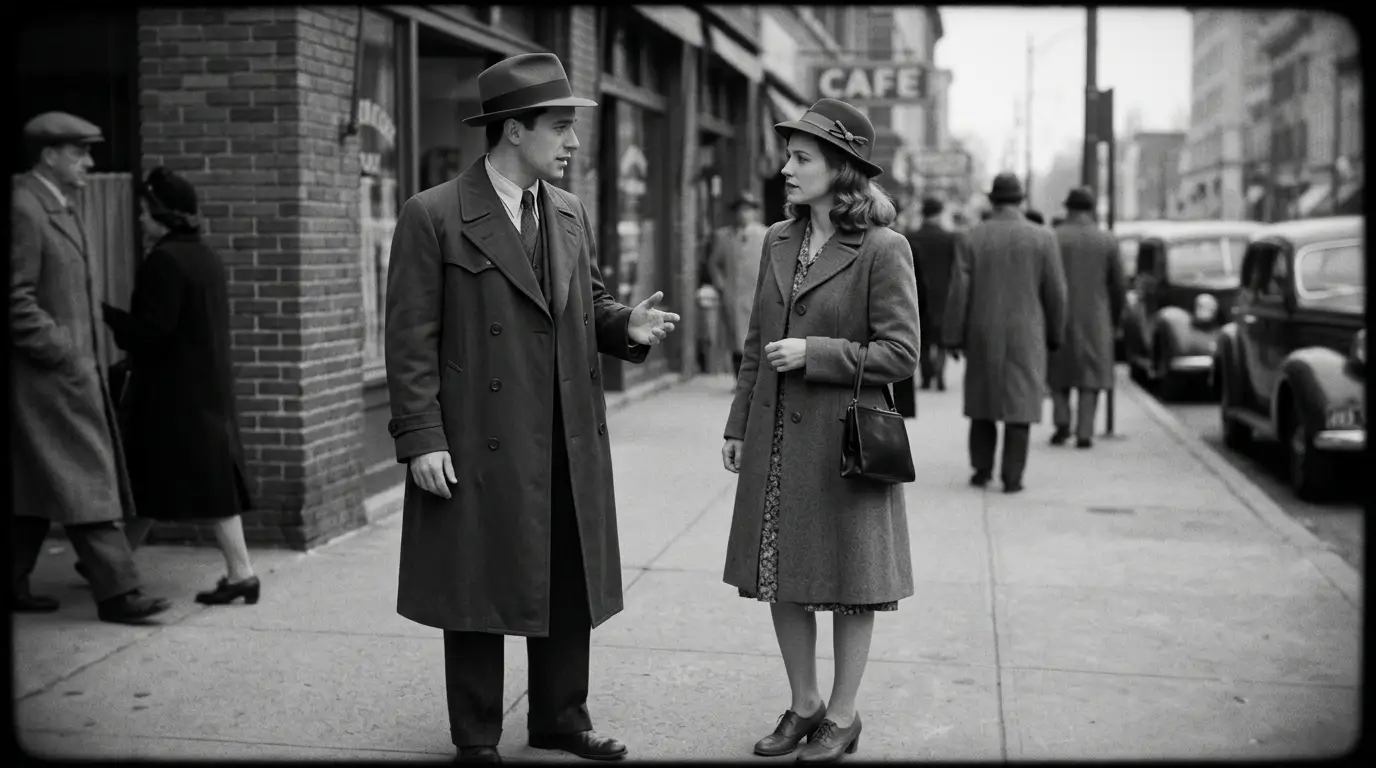
1940s slang insults are colorful put-downs from the World War II era, like “sap,” “meathead,” “chowderhead,” and “four-flusher.”
People used them to call someone foolish, cowardly, or annoying without swearing. Most came from soldier talk, jazz clubs, and old movies, and a few are still heard today.
Key Takeaways
- 1940s slang insults were mostly mild, playful put-downs, not harsh curse words.
- Many came from military slang, radio shows, and film noir dialogue.
- Common examples include “sap,” “meathead,” “square,” and “four-flusher.”
- Some terms, like “creep” and “jerk,” survived into modern English.
- The tone ranged from friendly teasing to real disrespect, depending on context.
- Few of these terms are used seriously today, but they show up in retro media.
People look up 1940s slang insults for different reasons, from exploring old-fashioned language to understanding historical expressions. Some are writing a story or screenplay set during World War II and want dialogue that sounds real.
Others watch old black-and-white movies and hear a word like “palooka” or “four-flusher” and want to know what it means. Teachers, genealogists, and history buffs also look these terms up while reading old letters or newspapers.
This era of slang came from a mix of places: soldiers overseas, jazz musicians, radio announcers, and Hollywood scriptwriters.
It was a decade shaped by World War II, so a lot of everyday language reflected military life, rationing, and tight-knit communities.
Most 1940s slang insults have faded from daily use. A handful, like “jerk” and “creep,” stuck around and are still common today.
Others, like “four-flusher” or “chowderhead,” now sound old-fashioned and mostly show up in movies, books, or nostalgic conversations. This guide deeply breaks down what these insults meant, where they likely came from, and how people used them in real life.
What Do 1940s Slang Insults Mean?
1940s slang insults refer to the informal put-down words and phrases used during the 1940s to criticize, tease, or mock someone. They weren’t usually harsh profanity. Instead, they were colorful, often playful ways to call someone ignorant, cowardly, boring, or dishonest.
For example, calling someone a “sap” meant they were easily fooled. Calling someone a “wet blanket” meant they ruined the fun.
These insults could be said in anger, but many were also used jokingly between friends, similar to how people today might call a buddy a “goof” or “clown.”
Quick Meaning Box
| Meaning | Simple Explanation |
| Foolish person | “Sap,” “dope,” “chowderhead” someone easily tricked or not too bright. |
| Coward | “Yellow-belly” someone afraid to act. |
| Annoying or unpleasant person | “Creep,” “heel” someone with bad character. |
| Boring or joyless person | “Wet blanket,” “stuffed shirt” someone who kills the fun. |
| Show-off or fraud | “Four-flusher” someone who fakes confidence or wealth. |
Pronunciation
“1940s slang insults” is said as: nine-teen-FOR-tees slang IN-sults. Individual terms like “four-flusher” are pronounced FOR-fluh-sher, and “chowderhead” is pronounced CHOW-der-hed.
Where Do 1940s Slang Insults Come From?
Most 1940s slang insults grew out of military life, jazz culture, and Hollywood films of the era. World War II brought millions of Americans into close contact through the armed forces, and soldiers developed their own shorthand for mocking each other, officers, and the enemy.
The exact origin of many individual terms is unclear. Slang rarely has one clean starting point; it spreads through conversation long before anyone writes it down.
What’s clear is that radio dramas, pulp detective novels, and film noir movies helped popularize these insults nationwide, even for people who never served in the military.
Origin of the Term
Slang insults from the 1940s built on earlier decades. Some, like “sap” and “dope,” were already common in the 1920s and 1930s and simply carried over.
Others were shaped by the specific culture of the war years, like military ranks being twisted into insults, or rationing-era frustration showing up in everyday complaints.
After the war ended, many of these words stayed in circulation through the 1950s, especially in detective fiction and crime films.
Some slowly faded as new generations created their own slang. A few, like “jerk” and “creep,” never really left. They have just kept evolving in meaning and remain common insults today.
How People Use It Today
Very few 1940s slang insults are used seriously in everyday conversation now. When they do show up, it’s usually for a retro or humorous effect.
People might use “meathead” or “chowderhead” as a nostalgic joke, or writers might include “four-flusher” in period-accurate dialogue for a book or show.
On platforms like TikTok and Instagram, some of these old terms occasionally resurface in videos about vintage slang, old movie clips, or “guess the decade” style content.
This isn’t because the slang is trending in the traditional sense; it’s more that people enjoy the novelty of old-fashioned insults compared to modern ones.
1920s Slang Insults
The 1920s had its own flavor of insults, often tied to flapper culture and jazz age slang. Terms like “drugstore cowboy” (a man who dressed sharp but had nowhere important to go) and “Reckless Dora” (a foolish woman) were common.
Compared to the 1940s, 1920s insults leaned more into flashy, party-driven culture, while 1940s insults reflected a more serious, wartime mood.
1930s Slang Insults
The Great Depression shaped a lot of 1930s slang. Insults from this decade often pointed at laziness, poverty, or dishonesty, since money and survival were constant worries.
Words like “moocher” (someone who freeloads) and “gold digger” carried real economic weight. By the 1940s, insults shifted slightly toward toughness and courage, likely because of the war.
1950’s Slang Insults
The 1950s brought a new wave of slang shaped by teenagers, rock and roll, and car culture. Insults like “square” (someone boring or old-fashioned) and “drag” (something or someone dull) became popular.
Interestingly, “square” actually started gaining traction in the late 1940s jazz scene before becoming a defining 1950s put-down.
Old School Slang Insults
“Old school slang insults” is a broader term people search when they’re not sure which decade they’re thinking of. It usually covers slang from the 1920s through the 1950s, including many of the terms mentioned here.
If you’re researching vintage dialogue for a creative project, it helps to pick a specific decade, since slang changed quickly year to year.
1940s Slang Phrases
Beyond single-word insults, the 1940s also had full slang phrases. “Blow your top” meant to lose your temper.
“Don’t take any wooden nickels” was a way of telling someone not to be fooled. These phrases often carried a teasing or warning tone, similar to how insults were used in casual conversation.
Examples in Everyday Conversation
- “Quit acting like such a sap, he’s obviously lying to you.”
- “Don’t be a wet blanket, come dance with us.”
- “That guy’s a real four-flusher, he doesn’t have half the money he claims.”
- “Stop being a chowderhead and read the map right.”
- “He’s turned into a real heel since he got that promotion.”
- “She called him a yellow-belly for backing out of the fight.”
- “That stuffed shirt wouldn’t crack a smile if you paid him.”
- “You’re such a meathead, you walked right past the sign.”
- “He’s nothing but a two-bit palooka trying to act tough.”
- “Don’t listen to that windbag, he never stops bragging.”
Text Message Examples
- “lol you’re such a sap for falling for that”
- “Quit being a wet blanket and come out tonight”
- “he’s acting like a real heel rn”
- “Don’t be a chowderhead; check the address again”
- “She’s such a square; she won’t even try new food”
- “Stop being a yellow-belly and just ask her out”
- “he’s a total four-flusher; don’t trust his story”
- “Ugh, my coworker is such a windbag in meetings”
- “Why are you being such a meathead about this”
- “he’s such a stuffed shirt, lighten up dude”
Social Media Caption Examples
- Instagram: “Feeling like a total square at this fancy dinner.”
- TikTok: “POV: your friend is being a total wet blanket on vacation.”
- X: “That guy in the comments is a total four-flusher, all talk no proof.”
- Threads: “Not me being the office chowderhead today, forgot my badge again.”
- Facebook: “My uncle still calls anyone lazy a ‘moocher,’ love his old-school slang.”
- Instagram: “Him: brags about everything. Also him: total windbag.”
- TikTok: “Testing out 1940s insults on my roommate \ ‘you meathead'”
- X: “Don’t be a sap, read the fine print before you sign anything.”
- Threads: “Calling my brother a stuffed shirt for wearing a suit to brunch.”
- Facebook: “Grandpa just called my cousin a ‘yellow-belly’ for skipping the roller coaster, I’m crying .”
Is It Positive or Negative?
1940s slang insults are generally negative, but the tone depends heavily on who’s saying it and why.
Calling a close friend a “sap” while laughing is playful teasing. Calling a stranger a “heel” in a serious tone is a real insult meant to hurt.
The biggest misunderstanding today is tone. Someone unfamiliar with 1940s slang might think a term sounds silly or harmless, not realizing it was once a genuine insult. Context always matters more than the word itself.
Who Uses This Slang?
Today, these insults are mostly used by history enthusiasts, writers, and fans of old films and radio dramas.
Teachers sometimes bring them up when discussing World War II culture. Content creators occasionally use them in retro-themed videos for fun.
During the 1940s itself, this slang was used by soldiers, factory workers, teenagers, and everyday adults. It crossed generations and social classes, though certain terms were more common in military circles than civilian ones.
Similar Slang Words
| Slang | Meaning |
| Sap | A foolish, easily tricked person. |
| Meathead | Ignorant or thick-headed person. |
| Chowderhead | Another word for a foolish person. |
| Four-flusher | A fraud or show-off with no real substance. |
| Heel | A dishonorable or disrespectful person. |
| Wet blanket | Someone who ruins the fun. |
| Stuffed shirt | A stiff, overly formal, joyless person. |
| Yellow-belly | Coward. |
Opposite Words
- Straight shooter: an honest, trustworthy person, the opposite of a “four-flusher.”
- Good egg: a kind, likable person, the opposite of a “heel.”
- Live wire: an energetic, fun person, the opposite of a “wet blanket.”
- Sharp: a smart, quick-thinking person, the opposite of a “sap” or “chowderhead.”
Common Mistakes
People sometimes confuse “square” with a shape reference instead of realizing it meant boring or old-fashioned. Others misspell “four-flusher” as “four flusher” without the hyphen, which changes how it reads in formal writing.
It’s also common to assume all these insults were harsh curse words, when many were closer to lighthearted teasing.
When NOT to Use It
These insults don’t belong in professional emails, school assignments, or formal writing, since they can come across as either confusing or unintentionally rude.
In a workplace setting, calling someone a “meathead” or “sap,” even jokingly, risks sounding disrespectful since tone doesn’t always translate well in text or email.
They work best in creative writing, casual conversation, or content clearly meant to be playful or nostalgic.
Fun Facts
- Many 1940s insults, like “sap” and “dope,” actually started in earlier decades and just stayed popular.
- Film noir movies are one of the best sources for hearing authentic 1940s slang insults.
- “Jerk” and “creep” are two of the few 1940s-era insults still widely used today.
- Military life during World War II heavily influenced everyday American slang.
- The word “square” started gaining traction in jazz circles before becoming iconic 1950s slang.
Frequently Asked Questions
What are old timey insults?
Old timey insults are outdated put-down words from earlier decades that sound unusual by today’s standards. They often described specific traits like cowardice, foolishness, or dishonesty using colorful, sometimes exaggerated language. Unlike modern insults, which often rely on profanity, old-timey insults leaned on creative wordplay. Terms like “four-flusher,” “milquetoast,” or “ne’er-do-well” are good examples. They’re mostly heard now in classic films, old books, or when someone’s imitating a grandparent’s way of speaking.
What are some 1920s insults?
1920s insults were shaped by flapper culture and the jazz age. “Drugstore cowboy” described a man who dressed impressively but had no real ambition. “Foolish Dora” mocked a woman seen as foolish. “Fuddy-duddy” described someone old-fashioned or fussy. These insults often focused on style, social status, and modern versus old-fashioned attitudes, reflecting the fast-changing culture of the Roaring Twenties.
What swear words were used in the 1940s?
Actual profanity from the 1940s was similar to earlier decades and wasn’t unique to the era itself. However, radio, film, and print media were heavily censored at the time, so real swear words rarely appeared in mainstream entertainment. Instead, scriptwriters relied on milder slang insults like “sap,” “heel,” or “louse” to imply frustration or anger without breaking broadcast standards. This is part of why so much 1940s “cursing” sounds tame by modern standards.
What were some common slang terms used in the 1940s?
Beyond insults, the 1940s had general slang for everyday life. “Cat’s pajamas” meant something excellent. “On the ball” meant competent or alert. “Snafu” (an acronym from military slang) meant a chaotic mess. “Dish” referred to gossip. These terms weren’t insults, but they show how playful and inventive everyday language was during the decade, alongside the era’s put-downs.
Final Thoughts
1940s slang insults offer a fun window into how people teased, criticized, and joked with each other during a serious, uncertain decade.
From “sap” to “four-flusher,” these words carried real personality, even when they were meant to sting. While most have faded from daily use, they still pop up in old movies, books, and nostalgic conversations.
Understanding them helps make sense of vintage dialogue and gives a small glimpse into everyday life during World War II-era America.

Sarah Mitchell is a content writer at Slang Insight, passionate about internet culture, trending phrases, and the ever-changing world of digital communication. With a keen eye for spotting new slang before it goes viral, Sarah loves breaking down complex expressions into simple, relatable explanations for readers of all ages.