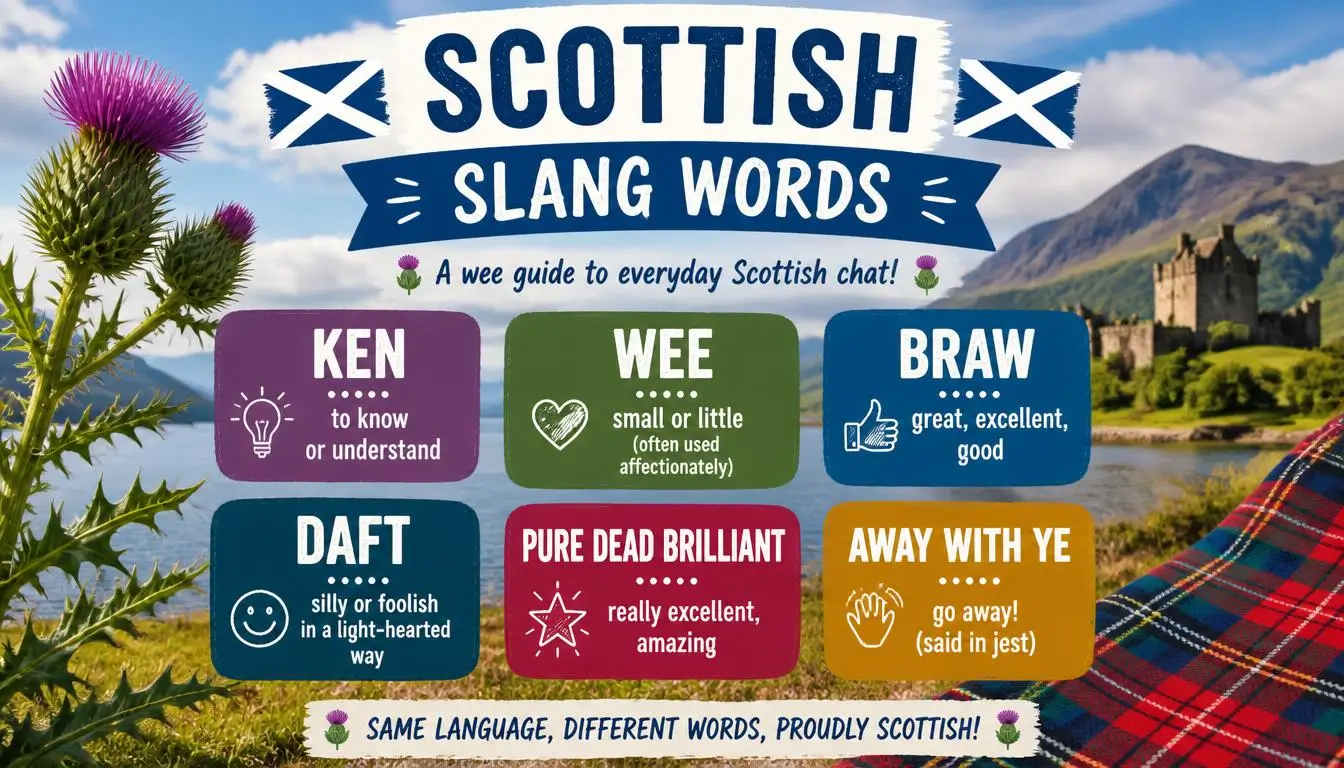
Scottish slang is the informal vocabulary used across Scotland in everyday speech. It includes unique Scots words like “ken” (know), “wee” (small), insults like “bam” and “radge,” and warm greetings like “aye” and “hen.” Much of it comes from the Scots language, a close cousin of English with its own long history.
Key Takeaways
- Scottish slang blends English with words from Scots, a distinct language spoken across Scotland for centuries.
- Common terms include “ken” (know), “wee” (small), “greeting” (crying), and “scunnered” (fed up).
- Some words, like “bam,” “radge,” and “walloper,” can be playful or harsh insults depending on the tone.
- Many terms are still used daily in homes, pubs, and workplaces across Scotland today.
- The tone ranges from affectionate (“hen,” “pal”) to blunt or rude (“dobber,” “numpty”), so context matters a lot.
- Most Scottish slang has no single inventor; it grew naturally out of the Scots and Gaelic languages over generations.
Scottish slang reflects the rich history, culture, and everyday conversations of Scotland. Words like “wee,” “ken,” and “bairn” have been part of Scottish speech for generations, while newer expressions continue to develop through music, social media, and modern youth culture.
You may hear these terms in Glasgow pubs, Edinburgh streets, football crowds, family gatherings, and online conversations from Scottish creators.
Understanding Scottish slang makes it easier to follow local humor, conversations, and cultural references. Some phrases have strong regional roots, while others are widely recognized across Scotland and beyond.
This guide explores the meanings, origins, and everyday uses of popular Scottish slang words, helping you understand how these expressions fit naturally into real conversations.
What Does Scottish Slang Mean?
Scottish slang refers to informal words and phrases used in Scotland that often come from Scots rather than standard English. It covers everything from gentle nicknames to sharp insults.
Some Scottish slang words are simply Scots vocabulary that never fully crossed into standard English, like “ken” for “know” or “greeting” for “crying.”
Others are modern slang, built the same way slang forms anywhere through humor, exaggeration, and shared culture.
A word like “bam” describes a foolish or badly behaved person, while “scunnered” describes being tired or fed up with something. Context and tone decide if a word is an insult, a joke, or just normal conversation.
Quick Meaning Box
| Meaning | Simple Explanation |
| Ken | To know something |
| Wee | Small or little |
| Greeting | Crying |
| Scunnered | Fed up or annoyed |
| Bam | A foolish or reckless person |
| Radge | Angry, wild, or out of control |
| Jakey | A person who drinks heavily, often on the street. |
| Ned | Stereotype for a rowdy or delinquent youth. |
| Scooby | A clue (from “Scooby Doo” rhyming slang) |
| Boaby | Slang term, often used casually or as an insult. |
Pronunciation
Scottish slang follows the sounds of the Scots language, which has its own vowel and consonant patterns. A few examples:
- Ken – sounds like “kehn”
- Wee – sounds like “wee,” rhymes with “see”
- Scunnered – “SKUN-erd”
- Radge – “RAJ” (soft “g”)
- Gyte – rhymes with “kite”
Pronunciation also shifts by region. Glasgow, Edinburgh, Aberdeen, and the Highlands all have different accents, so the same word can sound noticeably different depending on where you hear it.
Where Does Scottish Slang Come From?
Most Scottish slang comes from the Scots language, a Germanic language closely related to English that developed separately over hundreds of years. Some words also trace back to Scottish Gaelic or older dialect terms.
The exact origin of many individual slang words is unclear. Language historians can often trace a word’s Scots roots, but pinpointing exactly when a specific slang meaning first appeared is difficult, since slang spreads through speech long before it’s written down.
What is clear is that Scots has been recognized as a distinct language variety for centuries, and it’s this long history that gives Scottish slang its unique flavor compared to slang from other English-speaking regions.
Origin of the Term
Scots developed from Old English brought north by Anglian settlers over a thousand years ago, then grew alongside Gaelic and other influences across Scotland.
Over time, it became the everyday spoken language for millions of people, especially in the Lowlands.
By the 20th century, standard English became more dominant in schools and official life, but Scots and its slang never disappeared from daily speech.
Words like “wee,” “ken,” and “greeting” stayed common in homes and communities. In recent decades, there’s been a renewed interest in preserving Scots, including school programs and government recognition of it as a language of Scotland.
At the same time, newer slang terms have continued to appear, shaped by youth culture, football, and comedy, keeping the vocabulary evolving rather than frozen in the past.
How People Use It Today
Scottish slang shows up constantly in daily conversation, not just in old sayings. It’s used at home, in schools, at work, and in casual chat between friends.
Online, Scottish creators on TikTok and Instagram often use their natural slang and accent in videos, which introduces terms like “ken,” “bam,” and “radge” to viewers outside Scotland.
Comment sections under these videos frequently turn into informal explainer threads, with Scottish viewers translating words for confused non-Scottish ones.
This natural online exposure is part of why global interest in Scottish slang has grown, even though the slang itself is rooted in everyday speech rather than internet culture.
Scottish Slang Words
Scottish slang words cover a huge range, from everyday verbs to unique nouns you won’t find in standard English.
Learning the most common ones is the fastest way to follow a real conversation.
Words like “ken” (know), “wee” (small), “greeting” (crying), and “messages” (groceries) are used constantly and aren’t considered rude or unusual at all; they’re just part of normal Scottish English.
Scottish Slang Phrases
Beyond single words, Scotland has plenty of full phrases that carry specific meaning. “Away and bile yer heid” is a dismissive way to tell someone to stop talking nonsense.
“Whit’s fur ye’ll no go by ye” means what’s meant to happen to you will happen, often said to comfort someone. These phrases usually don’t translate word-for-word into English, which is part of why they confuse newcomers.
Scottish Slang Translator
A lot of people search for a Scottish slang translator when they hit a word or phrase they can’t figure out from context.
While dedicated translator tools and apps exist online, the most reliable approach is still a solid glossary paired with context, since Scots pronunciation and spelling can vary a lot by region. Reading example sentences, like the ones later in this article, works better than a word-for-word translation for tricky phrases.
Scottish Slang Insults
Scottish slang insults range from mild teasing to genuinely harsh put-downs. Words like “numpty” or “walloper” are often said with a laugh among friends, while others carry real bite depending on tone and relationship.
As with insults in any culture, the same word can be affectionate banter between mates or a genuine insult aimed at a stranger; delivery matters as much as the word itself.
Scottish Slang for Idiot
Several Scottish words mean roughly “idiot” or “fool.” “Numpty,” “walloper,” “bam,” and “roaster” all fall into this category.
They’re usually used casually, often between friends, and rarely carry serious weight unless said with real anger.
Scottish Slang Jobby
“Jobby” (also spelled “jobbie”) is Scottish slang for feces. It’s a mild, almost childish word, similar to how English speakers might say “poo.”
It’s commonly used with kids or in lighthearted, non-serious conversation, and it isn’t considered a harsh or offensive term.
Jobbie Scottish Slang
Spelled with an “-ie” ending, “jobbie” is simply an alternate spelling of “jobby,” with the same meaning. Both spellings are used interchangeably across Scotland, and neither is considered more “correct” than the other.
Scottish Slang for Hooligan
The word most associated with “hooligan” in Scottish slang is “ned.” It describes a stereotype of a rowdy, often young troublemaker, sometimes linked to sportswear and a certain attitude.
It’s worth noting the term can be seen as classist or unkind when used to stereotype people based on appearance or background, so it’s often used carefully or self-referentially.
Ned Scottish Slang
“Ned” is one of the most recognized pieces of Scottish slang outside Scotland. Its origin is debated; some say it stands for “non-educated delinquent,” though language experts generally consider this a backronym rather than the true origin, since the term likely existed before that phrase was attached to it.
The exact origin is unclear.
Scottish Slang for Drunk
Scotland has a long list of words for being drunk, including “steamin,” “blootered,” “mingin,” and “wrecked.” These are used casually and humorously, especially when describing a big night out.
Jakey Scottish Slang
“Jakey” describes someone associated with heavy public drinking, often linked to homelessness or hard living.
It can be used descriptively, but it can also come across as dismissive or unkind toward vulnerable people, so it’s worth using thoughtfully.
Bam Scottish Slang
“Bam” (short for “bampot”) describes someone acting foolish, reckless, or badly behaved.
It’s one of the most common Scottish insults and is usually said in a joking or mildly annoyed tone rather than a truly hostile one.
Radge Scottish Slang
“Radge” describes someone or something wild, angry, or out of control. “He went radge” means he lost his temper or acted erratically. It can also describe a person as generally unpredictable or intense.
Gyte Scottish Slang
“Gyte” means inexplicable or out of your mind, often used in the phrase “away wi’ the gyte,” meaning someone is being ridiculous or acting oddly.
Walloper Scottish Slang
A “walloper” is another word for a foolish or annoying person, similar to “numpty” or “bam.” It’s typically light-hearted rather than genuinely cruel.
Ken Scottish Slang
“Ken” means “know,” as in “Do ye ken whit ah mean?” (Do you know what I mean?). It’s one of the most frequently used Scots words and appears constantly in casual speech, often at the end of sentences as a verbal habit, similar to “you know” in English.
Boaby Scottish Slang
“Boaby” is a casual, sometimes crude Scottish slang term. It can be used as a mild insult or as a joking term for someone or something, depending on context and tone in the sentence.
Scooby Scottish Slang
“Scooby” means “clue,” as in “I’ve not got a scooby.” It comes from rhyming slang, where “Scooby Doo” rhymes with “clue.” It’s a playful, distinctly Scottish twist on cockney-style rhyming slang traditions.
Scottish Greeting Slang
In Scots, “greeting” doesn’t mean saying hello; it means crying. “She was greeting her eyes out” means she was crying hard. This is one of the most commonly misunderstood Scottish slang words for people unfamiliar with Scots, since it looks identical to the English word “greeting.”
For actual hellos, Scots use casual greetings like “Awrite?” (Alright?), “How’s it gaun?” (How’s it going?), or simply “Aye, aye” as a friendly nod hello.
Examples in Everyday Conversation
- “Dae ye ken whit time the bus comes?”
- “She wis greeting efter the film, it wis that sad.”
- “Stop actin’ the bam, we’re gonnae be late.”
- “He went pure radge when the ref gave a penalty.”
- “I’ve not got a scooby whit yer talkin’ aboot.”
- “Ma wee sister’s startin’ school the morn.”
- “He wis steamin’ by the end o’ the night.”
- “Away and bile yer heid, that’s rubbish.”
- “Whit’s fur ye’ll no go by ye, so dinnae worry.”
- “That guy’s a right walloper, honestly.”
Text Message Examples
- “u ken whit time we meetin the day?”
- “omg I was greeting at that movie last night. “
- “stop being a bam and just answer. “
- “he went full rage when I told him lol.”
- “Not got a scooby what she’s on about tbh.”
- “wee man’s got his first game the morn, wish him luck.”
- “Was absolutely steamin last night, head’s mince.”
- “Dinnae fash yersel, it’ll be fine.”
- “he’s such a numpty sometimes. “
- “Aye aye, u free later or naw?”
Social Media Caption Examples
- Instagram: “Wee day trip to the Highlands.”
- TikTok: “POV: yer granny says ‘dinnae greet’ when you’re clearly greeting”
- X: “Man went full radge over a parking space today.”
- Threads: “Not got a scooby how this recipe went so wrong.”
- Facebook: “Lovely wee gathering with the family this weekend.”
- Instagram: “Steamin by 9 pm, no regrets.”
- TikTok: “Explaining Scottish slang to my American pals part 47.”
- X: “Ken whit really grinds my gears?”
- Threads: “Total bam behaviour at the football today.”
- Facebook: “Awrite everyone, hope yer all keeping well.”
Is It Positive or Negative?
Scottish slang covers the full range from affectionate to harsh. Words like “hen,” “pal,” and “wee” are warm and friendly, often used to express closeness. Words like “bam,” “radge,” and “numpty” are usually light insults, more teasing than truly hurtful.
Some words, like “jakey” or “ned,” can sound harsher because they stereotype certain groups of people, so they carry more risk of offending, especially from someone outside the culture using them casually.
Tone, relationship, and context always shape how a word lands; the same insult between close friends can feel completely different coming from a stranger.
Who Uses This Slang?
Scottish slang is used across generations, not limited to any single age group. Older generations use classic Scots vocabulary like “ken” and “wee” as a natural part of daily speech.
Younger people mix these traditional terms with newer slang influenced by social media, humor, and football culture. It’s common across social classes and regions, though specific words can vary between cities like Glasgow, Edinburgh, Dundee, and Aberdeen.
Similar Slang Words
| Slang | Meaning |
| Numpty | A foolish person |
| Roaster | Foolish or annoying person. |
| Dobber | An idiot or unpleasant person. |
| Glaikit | Looking foolish or dazed. |
| Gadgie | A man, often used casually. |
| Bawbag | An unpleasant person (also a literal body part). |
Opposite Words
Words that express approval or admiration are the natural opposite of Scottish insults.
- “Braw” > meaning excellent, the opposite of calling someone a bam or numpty.
- “Belter” > meaning something excellent or impressive, the opposite of a harsh insult.
- “Pure dead brilliant”> a Glasgow phrase meaning fantastic, used for genuine praise.
Common Mistakes
People often mix up “greeting” (crying) with the English meaning of “greeting” (a hello), which causes real confusion in conversation.
A common mistake involves treating words like “bam” or “radge” as serious insults when friends often use them playfully with each other.
Spelling also trips people up, since words like “jobby/jobbie” or “gyte/gyte” don’t have one single official spelling.
When NOT to Use It
Scottish slang doesn’t belong in professional emails, school essays, job interviews, or formal business writing.
Using words like “bam,” “radge,” or “jakey” in these settings can come across as unprofessional or even disrespectful, since some terms stereotype people in ways that don’t fit formal contexts.
Standard English is expected in official documents, academic work, and most workplace communication, even within Scotland itself.
Fun Facts
- Scotland officially recognizes Scots as a language separate from English.
- Scottish speakers use “ken” frequently in everyday speech, and most locals hear it as a natural part of conversation.
- “Scooby” comes from rhyming slang tied to the cartoon character Scooby Doo.
- Regional accents mean the pronunciation of the same slang word can differ across Scottish cities.
- Many Scottish slang words have no single confirmed inventor or invention date.
- Scots vocabulary has influenced some English words used more widely today.
Frequently Asked Questions
How do Scots say “I love you”?
There isn’t one single official Scots phrase everyone uses instead of “I love you”; most Scots simply say “I love you,” just like English speakers. Some older or more traditional Scots speakers might say something like “Ah loue ye,” but this is far less common in everyday conversation than plain English. Affection is often shown instead through nicknames like “hen,” “pal,” or “son,” which carry warmth without needing a direct translation.
What does “och aye the noo” mean?
“Och aye the noo” roughly means “oh yes, right now,” but most Scots rarely use the phrase in everyday conversation. Instead, movies and TV shows often use it to create an exaggerated or stereotypical Scottish accent. It works much like “cheerio, guv’nor,” which people often use to parody British English. If you say “och aye the noo” in Scotland, locals may laugh because they recognize it as a stereotypical phrase rather than authentic everyday slang.
What are some Scottish slurs?
This article focuses on general slang and insults rather than slurs targeting people based on identity, since those terms are harmful and not appropriate to list or explain here. Scottish slang includes harsh general insults like “dobber” and “roaster,” but genuine slurs targeting ethnicity, religion, or identity belong to a different category, and people should avoid using them.
What are some cool Scottish words?
Beyond common insults, Scotland has plenty of colorful, fun words worth knowing. “Braw” means great, “wee” means small, “gallus” means bold or cheeky in a likeable way, and “scunnered” means fed up. These words add personality to conversation and are widely loved even by non-Scots learning the dialect for fun.
Final Thoughts
Scottish slang carries centuries of history in just a few short words. From “ken” and “wee” to sharper terms like “radge” and “bam,” each word reflects how Scots has grown alongside English while keeping its own identity.
If you’re planning a trip, watching a Scottish show, or just curious about the language, understanding these words helps you follow real conversations instead of guessing from context.
Like any slang, tone and relationship matter as much as the word itself; what’s a joke between friends can land very differently from a stranger. Keep this glossary handy, and Scottish conversations will start making a lot more sense.

Sarah Mitchell is a content writer at Slang Insight, passionate about internet culture, trending phrases, and the ever-changing world of digital communication. With a keen eye for spotting new slang before it goes viral, Sarah loves breaking down complex expressions into simple, relatable explanations for readers of all ages.