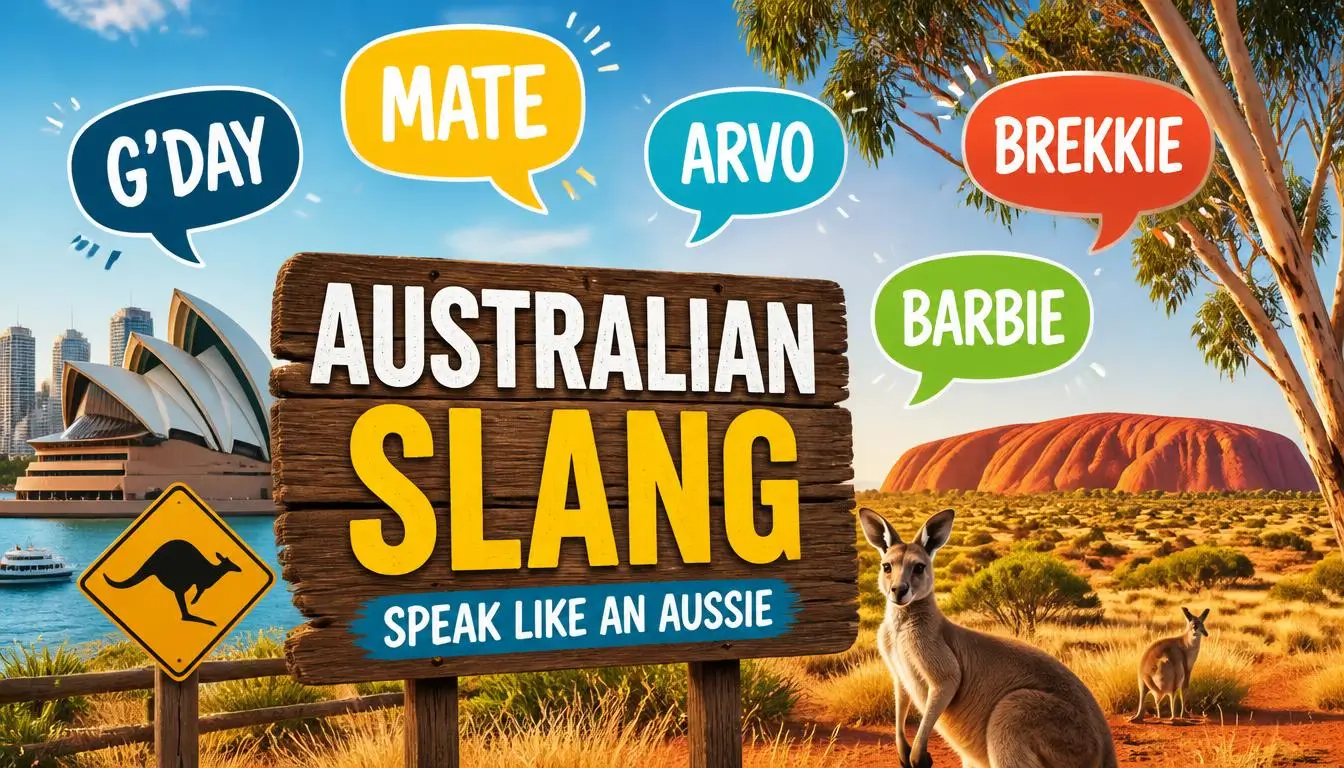
Australian slang is the collection of casual, often shortened words and phrases Australians use in everyday talk, like “arvo” for afternoon, “bogan” for an unrefined person, and “cobber” for friend.
It grew out of British English, working-class humor, and Australia’s outdoor, easygoing culture, and it’s still used daily across the country today.
Key Takeaways
- Australian slang is a mix of shortened words, rhyming phrases, and playful nicknames used in daily conversation.
- Much of it traces back to British and Irish settler speech from the 1800s, shaped by rural and working-class life.
- Words like “arvo,” “bogan,” and “dunny” are still common in Australia today, appearing in casual chats and social media captions.
- Tone varies a lot; some terms are warm and friendly, others are mild insults or joking put-downs.
- Aussie slang keeps evolving, with newer terms like “nang” showing up in younger, online conversations.
If you’ve ever watched an Australian interview, scrolled through Aussie TikTok, or chatted with someone from Down Under, you’ve probably run into a word that left you confused.
Australian slang shows up everywhere in text messages, in workplace banter, on the footy field, and in casual conversations at the pub. It’s part of how Australians talk to each other every single day.
People search for Australian slang for many reasons. Some are planning a trip and want to sound less like a tourist. Some watched an Australian show or movie and got stuck on a word.
Others saw a slang term in a comment section and had no idea what it meant. Whatever the reason, this guide breaks it all down in plain English.
Australian slang isn’t a thing of the past, either. While some older terms have faded, plenty are still used by people of all ages, from grandparents to teenagers.
This guide covers where the slang came from, what it means today, how it’s used online and in real life, and which words to avoid in certain settings.
What Does Australian Slang Mean?
Australian slang means the informal words, shortened terms, and playful expressions Australians use instead of more formal English. It covers everything from friendly nicknames to blunt insults.
Australian English is known for two big habits: shortening words and adding an “-o,” “-ie,” or “-y” ending to almost anything. That’s how “afternoon” becomes “arvo,” “mosquito” becomes “mozzie,” and “breakfast” becomes “brekkie.”
Some slang words are unique to Australia, while others come from older British or Irish sayings that changed shape over time.
Not all Australian slang means the same thing everywhere. A word can be a joke among friends in one context and a genuine insult in another. That’s why tone and context matter so much when using these words.
Quick Meaning Box
| Meaning | Simple Explanation |
| Informal Australian vocabulary | Everyday casual words used instead of formal English. |
| Shortened slang | Words shortened and given an “-o” or “-ie” ending. |
| Regional identity marker | A way Australians express local culture and humor. |
| Mix of friendly and rude terms | Ranges from affectionate nicknames to sharp insults. |
Pronunciation
Australian slang doesn’t have one single pronunciation rule, since it’s a whole vocabulary rather than one word. But a few patterns help:
- “Arvo” is said AR-voh.
- “Bogan” is said BOH-gun.
- “Dunny” is said DUN-ee.
- “Cobber” is said COB-er.
Most Australian slang words are pronounced exactly how they’re spelled, which makes them easy to pick up once you hear them a few times.
Where Does Australian Slang Come From?
Australian slang comes mostly from British and Irish English brought over by early settlers and convicts in the 1700s and 1800s, later shaped by rural life, working-class humor, and military service.
Many words started as English or Irish dialect terms that changed meaning once they reached Australia.
Rural and farming communities added their own twist, since much of early Australian life revolved around agriculture, mining, and isolated towns. Soldiers in World War I and World War II also spread slang between regiments, which helped spread certain terms nationally.
The exact origin of many individual slang words is unclear, since slang usually spreads through spoken conversation long before anyone writes it down. Language researchers often have to piece together the history from old letters, newspapers, and diaries.
History of the Term
Australian slang has developed in waves rather than all at once.
In the 1800s, convict and settler communities blended English regional dialects with new local expressions tied to farming, droving, and gold mining. By the early 1900s, slang had become part of a growing sense of Australian identity, separate from British English.
World War I and World War II played a big role in spreading slang across the country, since soldiers from different regions mixed together and brought local words home with them. The mid-1900s saw slang become part of Australian film, radio, and later television, which helped standardize certain terms nationally.
In recent decades, slang has kept evolving through pop culture, sports commentary, and now social media. Some older terms have faded from daily use, while others have had a resurgence thanks to internet culture and nostalgia content online.
How People Use It Today
Australians use slang constantly in daily speech, and it also shows up regularly online, especially on TikTok, Instagram, and X, where Australian creators use it naturally in captions and comments.
Texting and social media have made Australian slang more visible to people outside the country. A comment full of Aussie slang can go viral simply because international viewers find it funny or confusing.
On TikTok in particular, Australian creators often use slang heavily, which has introduced global audiences to terms like “arvo” and “bogan” that used to stay mostly local.
Australian Slang Words
Australian slang words cover a huge range of everyday life, from people and places to feelings and food. Common examples include “arvo” (afternoon), “brekkie” (breakfast), “servo” (gas station), “mozzie” (mosquito), and “esky” (cooler).
These words follow a familiar Aussie pattern: take a normal word, shorten it, and tack on “-o,” “-ie,” or “-y.” Once you notice the pattern, a lot of unfamiliar Australian words suddenly make more sense.
Australian Slang Insults
Australian slang insults are usually blunt but often used with humor rather than genuine cruelty. Words like “drongo” (a foolish person), “galah” (someone silly or loud), and “dill” (a bit of a goof) are common examples.
Aussies tend to use insult-style slang between friends as a form of teasing, sometimes called “taking the mickey.”
That said, tone and relationship matter a lot. The same word said by a stranger can land very differently than when said by a close mate.
Australian Slang Dictionary
An Australian slang dictionary is essentially a reference list of these informal terms and their meanings, similar to how you’d look up any regional dialect.
Since Australian slang is constantly evolving, no single list is ever complete, but the core, long-standing terms stay fairly consistent across dictionaries and everyday use.
Bogan Australian Slang
In Australian slang, a “bogan” is someone seen as unrefined, often associated with a particular working-class style, taste in music, or fashion sense.
The term can be used as a light joke or as a genuine put-down, depending on who’s saying it. Some Australians even use “bogan” to describe themselves proudly, especially in a self-deprecating or humorous way.
Sheila Australian Slang
“Sheila” is an older Australian slang term for a woman. It was extremely common through the mid-1900s but has become much less frequent in everyday speech today.
You’re more likely to hear “sheila” in older films, throwback jokes, or nostalgic references than in casual modern conversation. Younger Australians tend to use it ironically rather than as a genuine everyday term.
Dunny Australian Slang
A “dunny” is Australian slang for a toilet, especially an outdoor one. The word dates back to a time when many Australian homes, particularly in rural areas, had a separate outhouse rather than indoor plumbing.
Even though most homes now have indoor bathrooms, “dunny” has stuck around as a casual, often humorous way to refer to any toilet.
Arvo Australian Slang
“Arvo” is Australian slang for afternoon. It’s one of the most commonly used slang words in the country and appears constantly in casual conversation, texting, and plans.
You’ll hear it in everyday sentences like “See you this arvo” or “I’ve got plans this arvo.”
It’s considered completely normal and casual, not rude or old-fashioned in any way.
Cobber Australian Slang
“Cobber” is an older Australian slang term for a friend or mate. It was especially popular in the early 1900s, including among soldiers during World War I.
While “mate” has largely replaced “cobber” in modern speech, the word still shows up in historical references, older generations’ speech, and nostalgic or patriotic contexts.
What Is a Nang in Australian Slang?
In Australian slang, “nang” refers to a nitrous oxide canister, often linked to inhalant misuse, and it’s a term that has become more visible through social media and news coverage about the health risks of nitrous oxide use.
It’s a newer term compared to most Australian slang, and its use has grown alongside broader public conversations about nitrous oxide misuse in Australia.
Australian Rhyming Slang
Australian rhyming slang follows the same idea as Cockney rhyming slang from England: a phrase that rhymes with a word replaces that word in conversation, and often only the first part of the phrase gets said out loud.
This style of slang isn’t used as heavily in everyday Australian speech as other slang types, but it still shows up, especially among older generations or in playful, old-school conversation.
Examples in Everyday Conversation
- “It’s stinking hot this arvo, let’s grab an ice cream.”
- “That bloke’s a total drongo, he locked his keys in the car again.”
- “Where’s the dunny in this place?”
- “My cobber’s picking me up in ten minutes.”
- “Don’t be such a bogan, use a fork.”
- “She’s a proper sheila, always up for a laugh.”
- “I’m heading to the servo before we hit the road.”
- “Grab the esky, we’re off to the beach.”
- “He’s acting like a galah, running around like that.”
- “We’ll catch up this arvo for a barbie.”
Text Message Examples
- “Free this arvo? Wanna grab a coffee?”
- “Running late, stuck behind a drongo who can’t park.”
- “Meet you at the servo in 5.”
- “Bringing the esky for the drinks tonight.”
- “My cobber’s coming too, hope that’s sweet.”
- “Ugh, dunny’s out of order again lol.”
- “Quit being a bogan and text me back properly.”
- “See you this arvo, don’t be late!”
- “That galah left the gate open again.”
- “Same time this arvo works for me.”
Social Media Caption Examples
- Instagram: “Arvo vibes at the beach.”
- TikTok: “POV: your cobber shows up 20 minutes late again.”
- X: “Why is every servo out of my favorite drink today?”
- Threads: “Explaining ‘bogan’ to my American friends was a whole ordeal.”
- Facebook: “Perfect arvo for a backyard barbie with mates.”
- Instagram: “Dunny views only.”
- TikTok: “Rating Aussie slang words my American cousin didn’t understand.”
- X: “That galah nearly walked into a glass door.”
- Threads: “Sheila is not a word I hear often anymore, but I love it.”
- Facebook: “Arvo nap incoming, don’t wake me up.”
Is It Positive or Negative?
Australian slang covers a huge emotional range, so it depends entirely on the word and the context. Friendly terms like “arvo,” “cobber,” and “mate” are almost always positive or neutral.
Insult-style words like “drongo,” “galah,” and “bogan” sit in a gray zone. Between close friends, they’re usually harmless teasing.
Said to a stranger or in a tense situation, the same word can come across as genuinely rude. Tone of voice and relationship context matter just as much as the word itself.
Who Uses This Slang?
Australian slang is used across nearly every age group, though certain words are more common with certain generations.
Older Australians are more likely to use terms like “cobber” or “sheila,” while younger Australians tend to favor newer or more heavily shortened words.
Slang is also common across regions, workplaces, and hobby communities, including sports fans, tradespeople, and rural communities where older slang has stuck around longer than in big cities.
Similar Slang Words
| Slang | Meaning |
| Mate | Friend |
| Barbie | Barbecue |
| Servo | Gas station |
| Brekkie | Breakfast |
| Esky | Portable cooler |
| Mozzie | Mosquito |
Opposite Words
Since Australian slang is mostly casual and informal, its “opposite” is really just formal or standard English. A few examples:
- “Arvo” (afternoon) vs. simply saying “afternoon” in a formal setting.
- “Cobber” or “mate” (friend) vs. “colleague” or “acquaintance” in professional speech.
- “Bogan” (unrefined person) vs. “refined” or “polished” as a formal description.
Common Mistakes
A common mistake is assuming Australian slang is used the same way across the whole country, when regional and generational differences actually matter a lot.
Another mistake is treating older slang, like “cobber” or “sheila,” as still common everyday speech, when it’s now used more for nostalgia or humor than genuine daily conversation.
People also sometimes misuse insult-style slang without realizing the tone shift between joking with a friend and saying the same word to someone they don’t know well.
When NOT to Use It
Australian slang generally doesn’t belong in professional emails, formal reports, school assignments, or business meetings, since it can come across as unprofessional or unclear to readers unfamiliar with the terms.
It’s best kept for casual conversation, texting, and informal social media posts, especially in workplaces or academic settings where a more polished tone is expected.
Fun Facts
- Many Australian slang words end in “-o,” “-ie,” or “-y,” a pattern linguists call hypocoristic shortening.
- “Arvo” is one of the most frequently used Australian slang words in everyday speech.
- Australian slang spread nationally in part through soldiers serving together during World War I and World War II.
- Some slang terms have faded almost entirely from daily use, like “cobber,” while others, like “arvo,” remain extremely common.
- Social media has introduced Australian slang to international audiences who previously had little exposure to it.
- Australia shares some rhyming slang traditions with the United Kingdom’s Cockney rhyming slang.
Frequently Asked Questions
What are 5 Aussie slang words or phrases?
Five common Australian slang words are “arvo” (afternoon), “servo” (gas station), “esky” (cooler), “brekkie” (breakfast), and “mate” (friend). These are used constantly in everyday Australian speech, from casual chats to texting. They’re generally safe, friendly terms that won’t cause confusion or offense, making them a good starting point if you’re trying to understand or use Australian slang for the first time.
How do Aussies say “cool”?
Australians often say things like “grouse,” “beauty,” or simply “nice one” to express that something is cool or impressive. “Beauty” in particular is used constantly, often shortened to “beaut.” These words tend to carry a warm, enthusiastic tone rather than a neutral one, and they show up in casual conversation far more than in writing or formal speech.
What is the most Australian thing to say?
There’s no single official answer, but phrases built around “arvo,” “mate,” and “no worries” are often seen as some of the most recognizably Australian expressions. “No worries” in particular reflects the relaxed, easygoing tone that Australian English is known for. These phrases are widely used across the country and are commonly what people picture when they think of Australian speech.
What are some Aussie slurs?
Some Australian slang words function as mild insults rather than genuine slurs, like “drongo,” “galah,” or “dill,” and these are usually used in joking or teasing contexts rather than to seriously harm someone. Like any language, Australian English does have some genuinely offensive terms tied to discrimination, and those aren’t appropriate to use casually. Context and intent matter a lot, so it’s worth being thoughtful about how and when insult-style slang is used.
Final Thoughts
Australian slang is a living, everyday part of how people talk across the country. It’s shaped by history, shortened for convenience, and used constantly in casual conversation, texting, and social media.
Some words have stuck around for over a century, while newer ones keep popping up as language and online culture change.
If you’re planning a trip, chatting with an Australian friend, or just curious after seeing a confusing comment online, understanding these terms makes conversations easier and a lot more fun.
Slang like this isn’t static, so don’t be surprised if new Aussie words keep showing up in the years ahead.

James Carter is a slang researcher and writer at Slang Insight, dedicated to exploring the origins and meanings behind today’s most popular internet expressions. With a background in linguistics and a love for pop culture, James brings a unique perspective to every article, making slang easy to understand for everyone.