Lowkey is slang for “a little,” “quietly,” or “secretly.” People use it to say they feel or do something without making a big deal of it.
“I lowkey love this song” means “I really like this song, but I’m not announcing it loudly.” Its opposite is highkey.
Key Takeaways
- Lowkey means “kind of,” “a bit,” or “in a quiet, private way.”
- It started as an older English word for “restrained” or “understated.”
- The slang use grew through Black American English, hip-hop, and then social media.
- It is still common in texts, captions, and everyday talk.
- The tone is casual and usually friendly or honest, not rude.
- Its opposite is “highkey,” which means openly or very much.
You scroll through a caption and see, “Lowkey obsessed with this café.” Then a friend texts, “I lowkey forgot about the test.” Same word, two slightly different feelings. No wonder people search for the low key meaning slang.
You will see this word on TikTok, Instagram, X, Discord, and in plain old group chats. It shows up in school hallways and in office Slack channels too.
The short version: lowkey softens a statement. It lets you admit a feeling without shouting it. Sometimes it means “a little.” Sometimes it means “secretly.” Context tells you which.
Is it still used today? Yes. It has been around for years and is still part of everyday casual speech.
Next, this guide covers the meaning, the origin, the spelling, how it works in Hindi, Arabic, and Spanish, and plenty of examples you can copy.
What Does Low Key Mean in Slang?
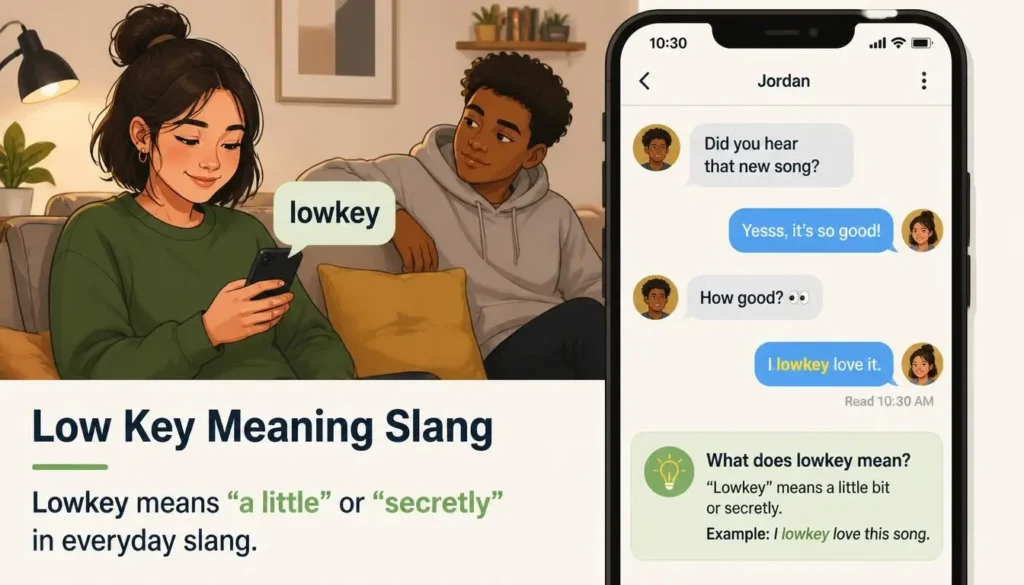
In slang, “low key” means “somewhat,” “quietly,” or “secretly.” It marks a feeling or action that is real but not loud or showy.
The word has three common jobs:
- “A little” or “kind of.” “I’m lowkey tired.” You are tired, but not dying.
- “Secretly” or “privately.” “I lowkey want to quit.” You have not told anyone.
- “Understated” or “chill.” “It was a lowkey party.” Small and relaxed, not a big event.
In all three, the speaker keeps the volume down. That is the heart of the low key meaning slang.
Quick Meaning Box
| Meaning | Simple Explanation |
| Kind of / a little | A mild feeling: “I’m lowkey hungry.” |
| Secretly | A private feeling: “I lowkey miss school.” |
| Understated | Calm and simple: “a lowkey night in.” |
| Honest admission | Saying something a bit embarrassing: “I lowkey cried at that movie.” |
Pronunciation
Say it LOH-kee. The phonetic spelling is /ˌloʊˈkiː/. Both syllables get some stress, with a long “o” and a long “ee.”
Where Does Low Key Come From?
“Low-key” is an older English word meaning restrained or not intense. The slang use grew out of that meaning.
The older adjective is often linked to lighting. A “low-key” photo or stage has soft, subdued light. From there, people used it for anything quiet or modest, like a “low-key dinner.”
The slang sense, where “lowkey” works like “kind of” or “secretly,” is widely connected to Black American English and hip-hop culture. It then spread through social media in the 2010s. The exact first use of the slang meaning is unclear, so it is best not to pin it to one person or year.
How People Use It Today
People use lowkey mostly in casual writing and speech, especially on social apps.
- Texting: “lowkey can’t wait for Friday”
- TikTok and Instagram: captions and comments like “lowkey the best day ever”
- X and Threads: short confessions: “lowkey tired of Mondays”
- Discord and gaming chats: “that boss was lowkey impossible”
- Reddit: casual comments and replies
- Snapchat: quick messages between friends
It usually sits before a verb or adjective: “lowkey love,” “lowkey annoyed,” “lowkey scared.”
Lowkey Meaning Slang Gen Z
Gen Z uses lowkey as a soft way to share honest feelings.
It is one of the best-known words in Gen Z vocabulary. Gen Z speakers often use it to admit something real while sounding relaxed. The word lowers the pressure. “I lowkey need help” sounds easier to say than “I need help.”
This group also uses it as a joke. “Lowkey living my best life” is playful and not meant to be taken as a hidden secret.
Low Key Meaning Slang Gen Alpha
Gen Alpha, the youngest generation, picks up lowkey from older siblings, games, and videos.
Gen Alpha kids hear the word on YouTube, in games, and on short-video apps. They use it much like Gen Z does: “lowkey cool,” “lowkey funny.”
Their slang changes fast, and it is hard to say how long any one word stays popular. Lowkey is already familiar enough that it no longer feels brand new to them.
Lowkey Meaning Slang Urban Dictionary
Urban Dictionary entries describe lowkey as “secretly,” “moderately,” or “quietly.”
Urban Dictionary is a crowd-written site, so definitions come from users, not editors. That makes it useful for seeing how real people use a word.
It is not a final authority. For a trusted definition, compare it with a published dictionary such as Merriam-Webster, which covers the older “low-key” meaning.
Lowkey Meaning Slang TikTok
On TikTok, lowkey is common in captions, voiceovers, and comments.
Creators use it to sound honest and chill: “lowkey proud of this edit.” It also appears in hashtags and video text. TikTok did not invent the word, but its short format helped it travel to more viewers.
Lowkey Meaning Slang in Hindi
In Hindi, there is no single perfect word, but phrases like “chupke se” and “thoda sa” come close.
- Chupke se (चुपके से) means “quietly” or “secretly.”
- Thoda sa (थोड़ा सा) means “a little.”
- Ek tarah se (एक तरह से) means “in a way.”
Many young Hindi speakers simply use the English word in Hinglish: “Main lowkey nervous hoon.” It works the same way as in English.
Lowkey Meaning Slang in Arabic
Arabic has no fixed one-word match, but several phrases cover the idea.
- نوعًا ما (naw’an ma) means “kind of.”
- سرًّا (sirran) means “secretly.”
- بهدوء (bihudu’) means “quietly” or “calmly.”
Choose the phrase by meaning. For a mild feeling, use “kind of.” For a hidden feeling, use “secretly.” Bilingual speakers online sometimes use “lowkey” directly in chats.
Lowkey Meaning: Slang in Spanish
Spanish speakers use phrases like “un poco,” “en secreto,” and “la verdad” instead.
- Un poco means “a little.”
- En secreto means “in secret.”
- La verdad means “to be honest.”
- Discreto / discreta describes a low-key person or event.
Bilingual speakers also mix English into Spanish on social media, so you may see “lowkey” on its own.
High Key vs Low Key Meaning Slang
Highkey means openly or very much. Lowkey means quietly or a little.
The two words are mirror images. Highkey is loud and obvious. Lowkey is soft and private.
| Term | Meaning | Key Difference |
| Lowkey | A little, secretly | Keeps the feeling quiet. |
| Highkey | Very much, openly | Makes the feeling loud. |
| Low-key (hyphenated) | Calm, understated | Usually describes a thing or event. |
Example: “I lowkey like him” is a secret. “I highkey like him” is out in the open.
Lowkey vs Low Key: Spelling
Both “lowkey” and “low key” are used. “Lowkey” is more common in texts, and “low-key” suits more careful writing.
In slang, writers join the words: “lowkey.” When it describes a noun, such as “a low-key dinner,” the hyphen is standard in formal writing. Neither form is wrong in casual use.
Low Key Meaning Slang Examples: How It Fits in a Sentence
Lowkey usually comes before the word it softens.
Try this pattern: lowkey + verb or adjective.
- Before a verb: “I lowkey want pizza.”
- Before an adjective: “She’s lowkey funny.”
- Before a phrase: “He lowkey knew it would happen.”
You can also say “lowkey” alone as a reply: “Do you like the song?” “Lowkey.” That means “kind of, yes.”
Examples in Everyday Conversation
- “Are you coming tonight?” “Lowkey, I’d rather stay home.”
- “How was the movie?” “Lowkey better than I expected.”
- “You okay?” “Lowkey stressed about finals.”
- “Do you like my haircut?” “Lowkey, yeah. It suits you.”
- “Want to go to the big party?” “Nah, let’s do something lowkey.”
- “Did you study?” “Lowkey forgot.”
- “Is the new teacher nice?” “Lowkey scary, but fair.”
- “Why are you smiling?” “I lowkey won the game.”
- “Do you miss school?” “Lowkey, a little.”
- “Was the food good?” “Lowkey the best I’ve had.”
Text Message Examples
- “lowkey can’t wait to see you”
- “ngl I lowkey forgot your birthday, sorry”
- “this song is lowkey stuck in my head”
- “lowkey freezing rn”
- “can we keep dinner lowkey tonight?”
- “I lowkey love your new place”
- “lowkey running late, 10 mins”
- “that was lowkey rude lol”
- “lowkey need coffee”
- “he lowkey got us tickets”
Social Media Caption Examples
- Instagram: “Lowkey the best sunset of the summer.”
- TikTok: “Lowkey proud of how this turned out.”
- X: “Lowkey wish Mondays were optional.”
- Threads: “Lowkey rewatching my favorite show again.”
- Facebook: “Lowkey grateful for this crew.”
- Instagram: “A lowkey Sunday with good coffee.”
- TikTok: “Lowkey nailed the recipe.”
- X: “Lowkey can’t stop thinking about tacos.”
- Threads: “Lowkey love a quiet morning.”
- Facebook: “Lowkey the best family dinner in ages.”
Is It Positive or Negative?
Lowkey is neutral. The feeling after it decides whether it sounds good or bad.
“Lowkey happy” is positive. “Lowkey annoyed” is negative. The word itself is just a volume knob. It is friendly and casual, not rude.
A small misunderstanding can happen when someone says “lowkey” to avoid hurting a friend: “That’s lowkey not my favorite.” It can sound like a polite way to criticize. Listeners may also wonder whether “lowkey” means “a little” or “secretly,” so tone and context matter.
Who Uses This Slang?
Teens and young adults use it most, but many adults use it too.
- Teens and college students: daily use in chats and captions
- Gamers: in voice and text chat
- Millennials and Gen X: often picked up from social media and coworkers
- Pop culture fans: it appears in songs, shows, and online videos
It is understood widely across English-speaking regions, though how often it is used varies by community.
Similar Slang Words
| Slang | Meaning |
| Kinda | Somewhat |
| Sorta | A bit, in a way |
| Ngl | Not gonna lie; honest admission |
| Tbh | To be honest |
| Deadass | Seriously, for real |
| Lowkey-ish | Mildly, casually |
| Chill | Relaxed, easygoing |
Opposite Words
- Highkey: openly or very much. “I highkey love this.”
- Loud: obvious and not subtle.
- Over the top: dramatic or extreme.
- Flashy: designed to get attention.
- Obviously: with no attempt to hide a feeling.
Common Mistakes
- Using it as “low” in quality. “Lowkey good” means “kind of good,” not “bad.”
- Spelling it “low-kee” or “lowkie.” The standard forms are “lowkey” and “low key.”
- Mixing it up with “highkey.” They are opposites, not synonyms.
- Using it everywhere. It works best once in a sentence. Repeating it makes your message sound unsure.
- Treating it as a noun. It is mainly an adverb or an adjective: “a lowkey night.”
When NOT to Use It
- Professional emails: it sounds too casual and can weaken a clear message.
- School essays: teachers usually expect formal wording.
- Business reports and legal writing: precision matters, and “lowkey” is vague.
- Job interviews: a plain phrase like “somewhat” or “to some extent” sounds more polished.
If you must write formally, swap in “slightly,” “somewhat,” “privately,” or “understated.”
Fun Facts
- The word started as a general English adjective meaning restrained.
- “Low-key” is also a term used in photography and lighting for dark, soft images.
- “Highkey” grew up later as the playful opposite.
- The slang meaning is widely linked to Black American English and hip-hop.
- It works as an adjective, an adverb, and even a one-word reply.
- The hyphen is common in formal writing but often dropped in slang.
- Bilingual speakers often carry the word into other languages online.
Frequently Asked Questions
What does Gen Z mean by lowkey?
Gen Z often uses lowkey as an emotional cushion. It lets a speaker share a real feeling without sounding too serious or dramatic. “I’m lowkey anxious” says more than it seems, but it keeps the mood light. It can also be a joke, as in “lowkey a genius.” The best way to read it is to listen for tone: a quiet confession, a mild opinion, or a playful boast.
Why do teenagers say “low key”?
Teens say it because it is fast, flexible, and safe. Language experts often describe words like this as hedges, meaning small words that soften a statement. Saying “I lowkey like her” feels less risky than saying “I like her.” It also signals that the speaker is relaxed, not trying too hard. Friends copy each other’s words, and short, useful ones spread quickly in group chats and videos.
What is a lowkey person?
A lowkey person is calm, private, and not interested in showing off. They avoid drama and big attention. You might hear, “He’s super lowkey,” meaning he is easygoing and quiet about his achievements. The phrase usually sounds like a compliment. It does not mean the person is boring or shy. It just describes someone who prefers simple plans over loud ones.
Do people still say “lowkey”?
Yes. It remains common in texts, captions, and everyday talk, and it has stayed in use for years while other slang words came and went. Because it fills a real need, softening a feeling or opinion, people keep reaching for it. It is no longer brand new, so some younger speakers may treat it as everyday language rather than a fresh trend.
Final Thoughts
Lowkey is a small word that does a lot of work. It can mean “a little,” “secretly,” or “calm and simple,” and the right meaning depends on the sentence around it.
Its roots are in an older English word, and its slang life grew through Black American English, hip-hop, and social media. The exact first use is unclear, but its place in casual speech is clear.
Use it with friends, in texts, and in captions. Skip it in formal writing. If you want to sound louder, reach for highkey. Next time you read “lowkey obsessed,” you will know the speaker is excited, just quietly.

Sarah Mitchell is a content writer at Slang Insight, passionate about internet culture, trending phrases, and the ever-changing world of digital communication. With a keen eye for spotting new slang before it goes viral, Sarah loves breaking down complex expressions into simple, relatable explanations for readers of all ages.