In slang, tea means gossip, juicy news, or the truth about something. “Spill the tea” means share the gossip.
Gen Z also uses “tea” as praise, as in “that outfit is tea,” meaning it looks great. The meaning depends on context, so tone and the words around it matter most.
Key Takeaways
- Tea most often means gossip, news, or the real truth about a situation.
- “Spill the tea” is the classic phrase. It asks someone to share the story.
- Some younger users also say “tea” to mean great or attractive.
- The exact origin is unclear, but it is widely linked to Black American and LGBTQ+ communities, especially drag culture.
- The tone is usually playful and positive, but gossip itself can hurt people.
You scroll past a post that says “spill the tea,” and a comment replies “this is tea.” Is someone making a drink? Not quite. Many people search tea meaning slang because the word shows up with several meanings, and none of them are about drinks.
Online, tea mostly means gossip or the truth. It can also mean praise, especially when someone calls a look or a body “tea.” You will see it on TikTok, Instagram, X, and in group chats.
Is it still used? Yes. “Spill the tea” is still common, and it has spread well beyond the communities where it began. Newer uses, like calling something “tea” as a compliment, are less settled and vary by group.
This guide explains each meaning in plain language. You will learn where the word likely came from, how Gen Z uses it, what it means in LGBTQ+ spaces, and how it differs from similar-sounding terms.
You will also find examples you can copy for chats, texts, and captions, plus tips on when to skip it. By the end, you will not need another page to understand it.
What Does Tea Mean in Slang?
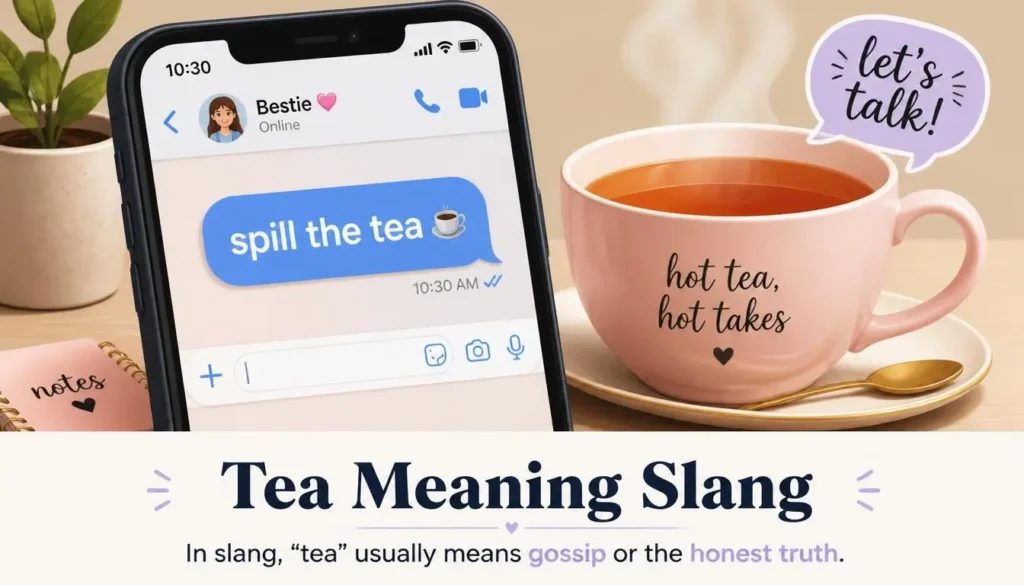
Tea means gossip, news, or the truth. It usually points to information that is interesting, surprising, or a little dramatic.
The word works as a noun in most cases: “I have tea about Jordan.” People also use it as a verb phrase, “sip the tea,” which means to enjoy watching drama without joining in. In newer use, it can act as an adjective for something excellent.
Here are the main meanings:
- Gossip or news: “Did you hear the tea?”
- The truth: “That’s the tea. Nobody wants to say it.”
- Praise: “Your look today is tea.”
- Staying out of it: “sips tea” means “I’m watching, not getting involved.”
Quick Meaning Box
| Meaning | Simple Explanation |
| Gossip | Juicy news about people or events. |
| Truth | The real story, with no sugarcoating. |
| Compliment | Something looks or feels great. |
| Sipping tea | Watching drama quietly from the side. |
Pronunciation
Tea is pronounced /tiː/, like the letter “T.” It rhymes with “see” and “me.” Nothing changes in the slang version. Only the meaning is different.
Origin of the Term
Older dictionaries record a different slang sense of “tea” in early 20th-century US speech, tied to cannabis. That meaning is unrelated to today’s use.
The gossip sense grew inside the communities mentioned above for years before most people outside them heard it. During the 2010s, social media carried it into mainstream use. Memes of people calmly sipping tea while drama unfolds helped fix the image in people’s minds.
The phrase “spill the tea” became the standard form. Since then, younger users have stretched the word into new uses, such as praise. The term has stayed visible for years, so it looks like a lasting piece of internet language, not a short trend.
How People Use Tea Today
Tea shows up wherever people talk about people. On Instagram and TikTok, it appears in captions and comments. X and Threads, it often introduces a story or a hot take. On Reddit and Discord, people use it in drama threads and group chats. In texting, it is a fast way to say “I have news.”
Creators also use it as a hook: “Tea time, everyone.” That signals a story is coming. Fans of reality TV, celebrity news, and online commentary use it constantly.
Tea Meaning Slang Gen Z
For Gen Z, tea means gossip, truth, or sometimes “great.” The first two uses are the most common, and they are shared across age groups.
Younger users often shorten and mix the phrase. They may say “the tea is hot” for big news, or “no tea, no shade” to say they mean no offense. Gen Z also adds tone through emojis and lowercase typing, which makes the word feel casual. Older users tend to stick to “spill the tea.”
Tea Meaning Slang TikTok
On TikTok, tea usually signals a story or a reaction. A creator might open with “storytime, grab your tea” before sharing something that happened to them.
It also shows up in comments, where “spill” or “tea?” asks for more detail. Commentary creators use it for entertainment news and online drama. Keep in mind that a TikTok claim is not always true, so “tea” does not mean “verified.”
Spill the Tea Meaning Slang
To spill the tea means to share gossip or reveal the truth. It is the most recognized tea phrase.
You can say it to ask for information: “Okay, spill the tea.” You can also say it as a statement: “I’m about to spill the tea.” The phrase works best with friends, since it invites candid talk. A related phrase, “what’s the tea?”, asks the same question more casually.
Your Body Is Tea Meaning Slang
In this use, “your body is tea” is a compliment. It means someone’s body looks great.
This is a newer, informal use, and its origin is unclear. It is less documented than the gossip meaning, so expect it to vary by group.
People usually say it about a photo or an outfit. Since it comments on someone’s body, only use it with people who would welcome it. Even a compliment can feel unwelcome from a stranger.
Clock That Tea Meaning Slang
To “clock the tea” means to notice or take in a piece of gossip or truth. Phrases like “clock that tea” are playful and are associated with drag and ballroom-influenced speech.
Here, “clock” means to notice or see something, in the same way that “read” can mean to call out someone’s flaws.
The phrase sounds like an invitation to pay attention: “Clock that tea, she’s not lying.” You will mostly see it in group chats, fan communities, and comment sections.
Tea Meaning Slang Adjective
Tea can work like an adjective, though that use is informal and still shifting. In that role, it means excellent, accurate, or on point.
Someone might say, “That take is so tea,” meaning it is true and well put. Or “the fit is tea,” meaning the outfit looks great.
Because grammar in slang is flexible, you will hear it both ways. When unsure, listen to the rest of the sentence. If it describes a thing, it is probably praise.
Tea Meaning Slang UK
In the UK, “tea” has older everyday meanings that can confuse readers. In many parts of Britain, “tea” can mean an evening meal, especially in the north of England. “What’s for tea?” means “What’s for dinner?”
The slang meaning of gossip is understood too, largely through global social media. The two uses rarely clash, since the context makes it clear. “Come round for tea” is about food. “Come round, I’ve got tea” is about news.
Cup of Tea Meaning Slang
“Cup of tea” is an idiom, not the same as the slang “tea.” “Not my cup of tea” means something is not to your taste. “Just my cup of tea” means you like it.
The phrase is long established, especially in British English. It has nothing to do with gossip. If someone says a movie is “not my cup of tea,” they mean they did not enjoy it. They are not saying it lacked drama.
Teabag Meaning Slang Gaming
In gaming, “teabagging” is a crude taunt. A player crouches repeatedly over a defeated opponent’s character to mock them.
It is unrelated to the gossip meaning. The name comes from the motion, not from drinking or gossip. Because the term is crude, avoid it in school, work, or family-friendly spaces. In many online games, it is seen as unsporting, and some communities treat it as a reason for complaints.
Tea Meaning Slang Urban Dictionary
Urban Dictionary shows many user-written entries for tea. Most describe gossip or truth, and some add the complimentary sense.
The site is open to anyone, so definitions vary in quality and are not edited like a traditional dictionary.
Use it to see how people talk, not as the final word. For firm definitions, check an edited source such as Merriam-Webster or Dictionary.com.
Comparison: Tea and Look-Alike Terms
| Term | Meaning | Key Difference |
| Tea | Gossip, truth, or praise | The main slang term |
| Cup of tea | Something you like | An idiom about taste |
| Tease | To playfully mock or provoke | A different word with a different spelling |
| Teabag (gaming) | A crude taunt | Describes an action, not gossip |
| Tea (UK meal) | An evening meal | A food meaning, not slang |
Examples in Everyday Conversation
- “Did you see the group chat?” “Yes, spill the tea.”
- “I have tea about the party.” “Don’t keep me waiting.”
- “Why is everyone whispering?” “The tea is hot today.”
- “Did she really quit?” “That’s the tea, but keep it quiet.”
- “What happened in class?” “I’ll tell you at lunch. It’s a lot of tea.”
- “Are you picking a side?” “No, I’m just sipping my tea.”
- “That outfit is tea.” “Thanks, I almost didn’t wear it!”
- “So what’s the tea on the new manager?” “Nothing yet.”
- “Her take was so tea.” “I agree. She said what we were all thinking.”
- “Come over tonight.” “Is there tea?” “Always.”
Text Message Examples
- “ok i need the tea ASAP”
- “No tea, no shade, but that was awkward”
- “spill. I’m waiting”
- “got tea about this weekend, call me”
- “lol the tea is piping hot”
- “just here sipping tea”
- “Is the tea true or just a rumor?”
- “That fit is tea; send more pics”
- “I heard some tea, but I’ll wait for proof”
- “Don’t spill my tea to anyone, okay?”
Social Media Caption Examples
- Instagram: “Sunday outfit, pure tea.”
- Instagram: “Coffee date, but I’m here for the tea.”
- TikTok: “Storytime: grab your tea, this one is long.”
- TikTok: “Spilling the tea on my first week at work.”
- X: “Not me sipping tea while the timeline argues.”
- X: “Some real tea dropped today. Thread below.”
- Threads: “Quiet day, no tea. Send me something good.”
- Threads: “That new show has all the tea.”
- Facebook: “Girls’ night with snacks and tea.”
- Facebook: “No tea, just love for my family today.”
Is It Positive or Negative?
Tea is mostly neutral to positive. Among friends, it is playful and friendly.
The tone can turn negative when the gossip is cruel or false. Sharing private details about someone can hurt them, even if the word itself sounds light.
Misunderstandings also happen with the compliment use, since not everyone knows it. If someone says “you’re tea,” they likely mean you are great. When in doubt, ask.
Who Uses This Slang?
Teens and young adults use it most. Social media users of all ages know it. Fans of reality TV, celebrity news, and commentary content use it often. Gamers may know it, but they more often use “teabag” in the gaming sense.
Its roots in Black American and LGBTQ+ communities mean that people from those groups use it with a particular history. Others who use it should be aware of where it came from.
What Does Tea Mean in LGBTQ+ Spaces?
In LGBTQ+ spaces, especially drag and ballroom culture, tea means gossip, truth, or a candid story. It is a longtime part of the community’s speech.
The word reached a wider audience through drag-related media and social platforms. Many users today do not know that background. Using the term is common, but crediting its roots shows respect.
Similar Slang Words
| Slang | Meaning |
| Gossip | Talk about other people’s lives. |
| Scoop | Fresh news or information. |
| Receipts | Proof that backs up a claim. |
| Shade | A subtle insult or criticism. |
| Dish | To share gossip. |
| Lowdown | The key details. |
Opposite Words
- Secret: something kept hidden, the opposite of shared tea.
- Silence: saying nothing instead of spilling.
- Fake news: false claims, the opposite of the truth sense.
- Boring: the opposite of the “tea is great” sense.
- Mind your business: a direct way to say “don’t gossip.”
Common Mistakes
- Wrong meaning: thinking tea always means gossip. Check the sentence.
- Wrong spelling: writing “tee” or “t.” Either is rare and can confuse readers.
- Mixing with “tease”: these words sound alike but mean different things.
- Wrong setting: using the gaming meaning outside a game.
- Overusing it: dropping “tea” into every message sounds forced.
When NOT to Use It
Skip it in formal settings. Professional emails, job applications, and business reports call for plain wording, and slang may seem unprofessional.
In school essays, it can hurt your tone. In sensitive moments, such as a serious conflict, “spill the tea” can sound dismissive. And avoid sharing gossip that could harm someone’s reputation, no matter how casually you phrase it.
Fun Facts
- “Tea” has a separate older slang sense in early 20th-century US speech.
- In parts of the UK, “tea” can mean dinner.
- “Spill the tea” is the best-known slang phrase using the word.
- “Not my cup of tea” is a long-established idiom about taste.
- The “T for truth” explanation is popular but not confirmed.
- The sipping-tea image became a common reaction meme.
- Drag-related media helped spread the term to wider audiences.
- Dictionaries now list “tea” in the slang sense of gossip.
Frequently Asked Questions
What is tea in Gen Z slang?
In Gen Z slang, tea means gossip, honest news, or sometimes high praise. What makes it a Gen Z habit is how flexible it feels. Younger users shorten it, add emojis, and use it in captions, comments, and group chats. You may hear “the tea is hot,” “no tea, no shade,” or “that look is tea.” Older speakers tend to use only “spill the tea.” Context decides the meaning, so look at the whole sentence before you guess.
Why do people say body is tea?
People say “body is tea” as a compliment. They mean someone’s body looks great. The reason is that “tea” has shifted from gossip toward the idea of something excellent or on point. The origin of that exact phrase is unclear, and it is less documented than other uses. It usually appears on photos or in comments. Because it refers to someone’s body, use it only where it is welcome.
Why do people say tea?
People say tea because it is a short, playful way to talk about gossip or truth. It also signals closeness, since sharing tea feels like a private chat. The image of sitting down with a warm drink while someone tells a story fits the mood. Social media made the word easy to repeat, and reaction memes made it even more recognizable. For many, saying it is simply a way to join a shared style of talk.
What does tea mean in LGBTQ?
In LGBTQ+ culture, especially drag and ballroom spaces, tea means gossip, truth, or a candid story. It is a long-standing piece of community speech, and it later spread to mainstream social media. Many people use it today without knowing that history. If you use it, it helps to acknowledge where it came from. Within the community, the word often carries humor, closeness, and a tradition of speaking honestly.
Final Thoughts
Tea is a small word with a big range. It can mean gossip, truth, praise, or a calm choice to stay out of the drama. The meaning always comes from the sentence around it.
If you want to use it, keep it light and kind. Share stories that are fun, not harmful. Be careful with compliments about bodies, and keep it out of formal writing. And if you are unsure about a meaning, ask or check an edited dictionary.
Now you know what people mean when they ask you to spill it. Go ahead and join the conversation with a bit more confidence.

Emily Rodriguez is a content creator and editor at Slang Insight, specializing in Gen Z language trends and social media culture. Emily’s mission is to help readers stay updated with the latest slang so they never feel out of the loop in online conversations.