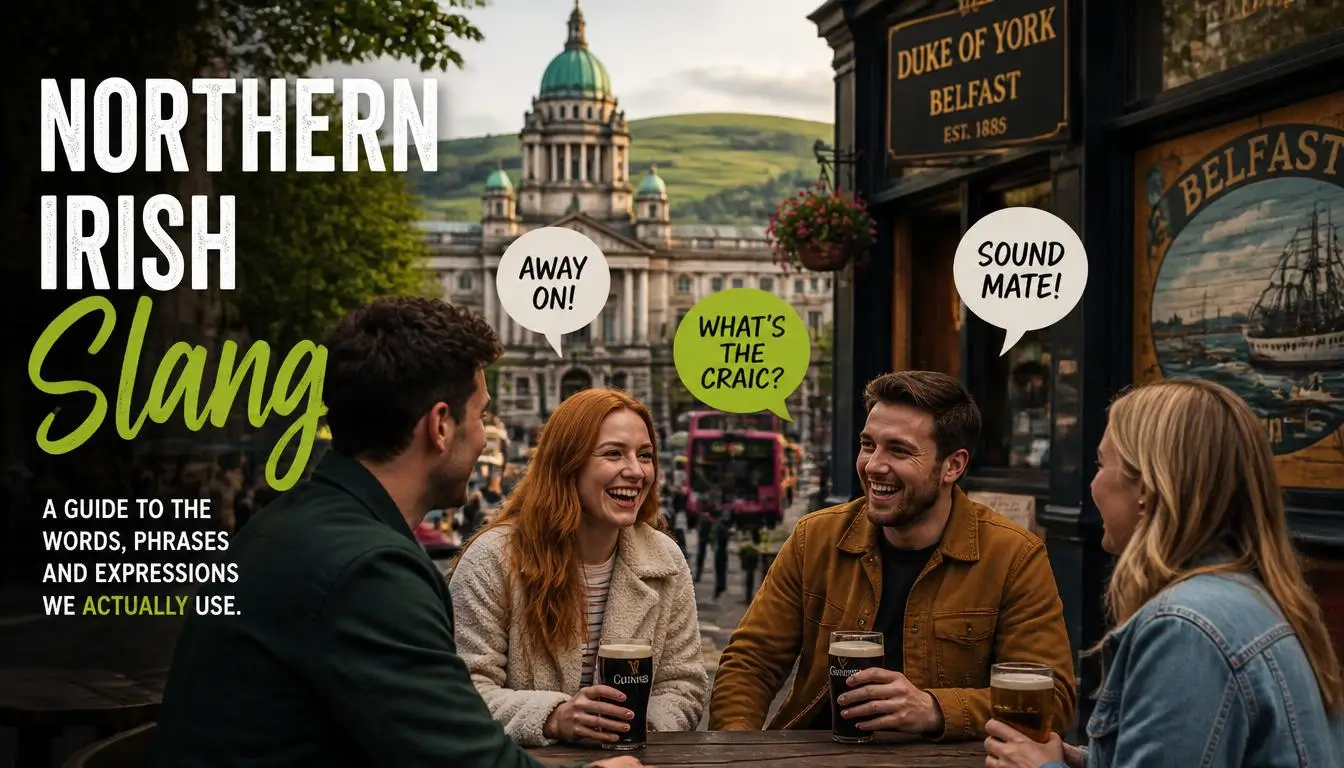
Northern Irish slang is the mix of local dialect words, sayings, and expressions used across Northern Ireland, blending Ulster Scots, Hiberno-English, and local wit.
It covers everything from friendly greetings and insults to words for police, drunkenness, and everyday chat, and it’s still widely used today in speech, texting, and social media.
Key Takeaways
- Northern Irish slang mixes Ulster Scots, Irish, and English influences.
- Much of it dates back generations, passed down through family and community speech.
- Some terms (like “hun” or “taig”) are tied to Northern Ireland’s political and religious divide and can be used as insults.
- Many words, like “dead on” or “geg,” are lighthearted and used constantly in daily conversation.
- The slang is still very much alive today, especially among younger people online.
- Tone varies a lot by word; some are warm and funny, others are sharp or offensive.
Northern Irish slang gives everyday conversations a distinct local flavor. From Belfast to Derry, people use words and phrases that can sound unfamiliar to visitors, even when the rest of the sentence is easy to understand.
People search for Northern Irish slang to understand conversations, prepare for a trip, follow local media, or connect more easily with Northern Irish friends and family.
A single phrase can carry a meaning that standard English does not make obvious.
Many Northern Irish expressions reflect the region’s rich linguistic history. Ulster Scots, Irish, local speech patterns, humor, and generations of everyday use have all shaped the vocabulary people use today.
Northern Irish slang refers to informal words and expressions commonly used in Northern Ireland. This guide explains the meanings, origins, examples, and everyday use of popular Northern Irish slang terms.
What Does Northern Irish Slang Mean?
Northern Irish slang refers to the informal words and phrases specific to Northern Ireland, shaped by Ulster Scots, Irish, and English. It includes everyday chat words, insults, and terms tied to local identity and history.
It’s not one single “type” of slang; it’s really a whole local vocabulary. Some words are just fun, casual ways of talking, like calling something “dead on” (meaning fine or good).
Others carry more weight, tied to Northern Ireland’s religious and political history, like the words used for Protestant or Catholic communities.
Because Northern Ireland has such a layered history, its slang reflects that mix. You’ll hear words shared with the rest of Ireland, words shared with Scotland, and words that seem to exist nowhere else at all.
Quick Meaning Box
| Meaning | Simple Explanation |
| Local dialect words | Everyday slang used across Northern Ireland. |
| Ulster Scots influence | Words borrowed from Scots settlers’ language. |
| Community-specific terms | Words tied to Protestant or Catholic identity. |
| Everyday chat slang | Casual words for good, bad, funny, or drunk. |
Pronunciation
There’s no single pronunciation for “Northern Irish slang” as a phrase; it’s said the way it reads (NOR-thurn EYE-rish slang).
Individual slang words, though, often have their own distinct sound shaped by regional accents, which can shift a lot even within Northern Ireland itself, from Belfast to Derry to rural border areas.
Where Does Northern Irish Slang Come From?
Northern Irish slang comes from a mix of Ulster Scots, Hiberno-English, and Irish language roots, shaped over centuries by migration, trade, and local community life.
The exact origin of many individual words is unclear, since slang tends to spread by speech rather than written record.
Ulster Scots arrived with Scottish settlers centuries ago and left a lasting mark on vocabulary and pronunciation in parts of Northern Ireland, especially in Antrim and Down.
At the same time, Irish language and Hiberno-English influence shaped speech patterns across the region, especially in border counties and nationalist communities.
A lot of Northern Irish slang also grew out of close-knit local life in small towns, shipyards, farms, and later, city streets, where inside jokes and shorthand terms became part of everyday speech.
Because slang passes through conversation rather than textbooks, it’s often impossible to pin an exact year or person to when a word started.
Origin of the Term
Northern Irish slang has developed gradually rather than in one clear moment. Older generations still use dialect words tied to farming, trade, and community life, while newer slang has emerged from pop culture, social media, and youth humor.
Many words in use today, like “wee” (small) or “aye” (yes), have roots going back generations and are shared across Scotland and parts of Ireland. Other terms are newer, shaped by television, comedy, and online culture.
There’s also been a noticeable resurgence in interest around Northern Irish dialect in recent years.
Shows and social media content featuring Northern Irish accents and phrases have introduced the slang to wider audiences outside the region, and locals have leaned into that attention with humor, often poking fun at outsiders trying to pronounce local words correctly.
How People Use It Today
Northern Irish slang is used constantly in daily speech, but it’s also spread through texting, Instagram captions, TikTok videos, and X posts.
Younger users especially mix slang into casual online chat the same way they would in person.
On TikTok, it’s common to see videos explaining or joking about Northern Irish words for the benefit of outsiders.
Instagram captions often use slang for humor or local flavor. Texting between friends is where a lot of the shorter, punchier slang really lives, since it fits naturally into quick back-and-forth messages.
Peelers: Northern Irish Slang For Police
“Peelers” is a common Northern Irish slang term for police officers. It’s not usually meant as a harsh insult; more of an old-fashioned, slightly cheeky nickname.
The word traces back to Sir Robert Peel, who founded modern police forces in the 1800s. “Peeler” became an informal nickname for police officers across Ireland and the UK, and it stuck especially strongly in Northern Ireland.
You’ll still hear people say things like “the peelers were called” the same way someone elsewhere might say “the cops showed up.”
Tout: Northern Irish Slang
A “tout” is someone who informs on others, especially to police or authorities. It’s a seriously loaded word in Northern Ireland, tied closely to the region’s political history, and calling someone a tout is a strong accusation, not a joke.
Historically, the term carried heavy weight during periods of conflict in Northern Ireland, where being labeled a tout could have real social and safety consequences.
Today it’s used more broadly to mean any kind of snitch or informer, but it still carries a sharper edge than the standard English word “snitch.”
Hun: Northern Irish Slang
“Hun” is a slang term used in Northern Ireland, often associated with the Protestant or loyalist community. It can be used descriptively, but it’s frequently used as an insult or stereotype, and its tone depends heavily on who’s using it and why.
The word is tied to Northern Ireland’s sectarian divide, and using it can come across as mocking or derogatory depending on context.
It’s worth understanding this term to make sense of conversations or media where it appears, but it’s not a word to toss around casually, especially by outsiders unfamiliar with its weight.
Dead On: Northern Irish Slang
“Dead on” means fine, good, or okay. It’s one of the friendliest, most common phrases in Northern Irish slang, used constantly in everyday conversation.
You’ll hear it in response to almost anything: “How’s the food?” “Dead on,” or “Are we still meeting at six?” “dead on.”
It can also describe a person who’s decent or easygoing, as in “he’s dead on,” meaning he’s a good guy. It’s warm, casual, and used across all ages.
Header: Northern Irish Slang
A “header” is someone acting foolish, reckless, or a bit unhinged. It’s usually said with a mix of humor and mild criticism, describing someone doing something silly or over the top.
It’s not usually meant as a serious insult, more like calling someone a “nutcase” or “wild card” in a joking way.
Context matters a lot here, since it can range from affectionate teasing among friends to a genuine criticism of reckless behavior.
Bake: Northern Irish Slang
“Bake” is Northern Irish slang for someone’s face or mouth. It shows up most often in phrases telling someone to be quiet, like “shut your bake.”
It’s a blunt, informal word, usually used between friends or in moments of frustration.
It’s rarely used seriously or aggressively outside of joking contexts more like a rougher, funnier version of saying “zip it.”
Geg: Northern Irish Slang
A “geg” refers to something funny or a good laugh, often used in the phrase “a bit of a geg.” It’s one of the more purely positive slang words in the Northern Irish vocabulary.
If someone says a night out was “a geg,” they mean it was entertaining. It can also describe a person, as in “he’s a right geg,” meaning he’s funny or entertaining to be around.
Scoots: Northern Irish Slang
“Scoots” refers to diarrhea, used the same blunt, informal way people elsewhere might say “the runs.” It’s a casual, slightly humorous term, typically used between friends rather than in formal settings.
It’s a good example of how Northern Irish slang often takes an everyday, unglamorous topic and turns it into something conversational and light rather than clinical.
Funny Northern Irish Slang
Some of the funniest Northern Irish slang comes from how bluntly and creatively locals describe everyday situations.
Words like “geg” (fun), “header” (someone acting silly), and “bake” (face or mouth) show off the dry, playful humor built into the dialect.
Northern Irish humor tends to lean dry and understated, and the slang reflects that. Rather than exaggerated descriptions, locals often use short, punchy words that say a lot with very little part of what makes the dialect so distinctive and entertaining to outsiders.
Examples in Everyday Conversation
- “You alright?” “Aye, dead on, you?”
- “He’s such a header, jumping off that wall.”
- “Shut your bake for two minutes, would you?”
- “That party last night was a right geg.”
- “I’ve had the scoots since this morning, it’s brutal.”
- “The peelers pulled him over on the main road.”
- “Nobody trusts him, people reckon he’s a tout.”
- “She’s dead on, always helps out when you need it.”
- “That fella’s a header, I swear.”
- “It was a geg of a weekend, honestly.”
Text Message Examples
- “u coming out later? should be a geg”
- “he’s actin like a total header lol”
- “I’m dead on, just tired”
- “shut ur bake and send the location “
- “got the scoots, not coming in today”
- Peelers everywhere on the main road rn”
- “she’s dead on, don’t worry about her”
- “that was such a geg last night”
- “he’s a header, ignore him”
- “u alright? aye dead on”
Social Media Caption Examples
- Instagram: “Weekend was an absolute geg “
- TikTok: “POV: your ma calls you a header for the 100th time”
- X: “Peelers out in full force tonight, lads”
- Threads: “Shut your bake, it’s too early for this”
- Facebook: “great to see everyone, dead on night all round”
- Instagram: “he’s a header, and I love him for it”
- TikTok: “explaining Northern Irish slang to my English mates”
- X: “the scoots got me good this morning, brutal”
- Threads: “aye dead on, best day ever”
- Facebook: “such a geg catching up with old friends”
Is It Positive or Negative?
Northern Irish slang covers a huge emotional range, from warm and funny to genuinely offensive.
Words like “dead on” and “geg” are almost always positive, while terms like “tout,” “hun,” or “taig” carry real weight and can be insulting or divisive depending on context.
Misunderstandings often happen when outsiders use a word without realizing its history or tone.
Something that sounds playful between two lifelong friends can land very differently coming from a stranger, especially with slang tied to Northern Ireland’s political and religious identities.
Who Uses This Slang?
Northern Irish slang is used across generations, but the specific words vary. Older generations often use more traditional dialect terms tied to farming or rural life, while younger people mix classic slang with newer online humor.
Teens and young adults are especially active in spreading slang through social media, often explaining it for wider audiences.
Adults use it naturally in daily conversation without thinking twice, and it shows up in regional comedy, local media, and everyday workplace chat too.
Similar Slang Words
| Slang | Meaning |
| Wee | Small, or used as a general softener (e.g. “wee minute”) |
| Aye | Yes |
| Craic | Fun, good times, or news (“what’s the craic?”) |
| Ma / Da | Mom / Dad |
| Cop on | To use common sense or wise up |
Opposite Words
- Standard English equivalents > “police” instead of “peelers,” “face” instead of “bake,” these swap the local flavor for plain, neutral English.
- Formal speech > words like “informant” instead of “tout” strip away the emotional weight of the slang version.
- Southern Irish slang > while there’s overlap, some Northern Irish terms (like “hun” or “taig”) don’t carry the same meaning south of the border, where the sectarian context is different.
Common Mistakes
People often assume all Northern Irish slang is interchangeable with general Irish slang, but plenty of terms are specific to the North because of its distinct history.
Another common mistake is using politically or religiously loaded words like “hun” or “taig” casually, without realizing how sharp they can sound depending on who says them and why.
Spelling mistakes are common too, since a lot of this slang exists mainly in speech. Words like “geg” or “scoots” don’t have one single official spelling, so you’ll see variations online.
When NOT to Use It
Avoid using Northern Irish slang in professional emails, formal writing, school assignments, or business communication.
It can come across as unprofessional or confusing to readers unfamiliar with the dialect, and terms tied to religious or political identity can cause real offense in the wrong setting.
It’s also worth being cautious with slang like “hun,” “taig,” or “tout” in mixed company or with people you don’t know well.
These words carry historical and social weight in Northern Ireland, and using them without understanding that context can come across as careless or even hurtful.
Fun Facts
- “Peeler” comes from Sir Robert Peel, the founder of modern policing.
- Northern Irish slang blends Ulster Scots, Irish, and English influences.
- “Craic” is shared across Northern Ireland and the rest of Ireland.
- Words like “wee” are used constantly, even to describe things that aren’t small at all.
- Local slang often varies noticeably even between nearby towns.
- Some Northern Irish slang has become more widely known thanks to social media and comedy content.
Frequently Asked Questions
What are some funny slang words from Northern Ireland?
Some of the funniest ones include “geg” (a laugh or fun time), “header” (someone acting silly or wild), and “bake” (a blunt word for someone’s mouth or face, usually in “shut your bake”). These words stand out because they’re short, punchy, and full of dry humor. A lot of the comedy in Northern Irish slang comes from how casually serious-sounding topics get turned into something lighthearted, which is part of what makes the dialect so entertaining to people hearing it for the first time.
What does “yer ma’s yer da” mean?
“Yer ma’s yer da” is a joking insult, roughly meaning “your mom is your dad,” used to imply someone’s family is a bit mixed up, as a lighthearted jab rather than a serious accusation. It’s mostly used between friends as a quick, silly comeback rather than a genuine insult. It doesn’t have a deep origin story; it’s more of a playground-style joke that stuck around into adult banter, especially online where it gets used for comedic effect.
What do Irish people say instead of “I love you”?
Direct declarations of love aren’t always common in everyday Irish or Northern Irish speech. Instead, people often show affection through actions, teasing, or phrases like “you’re dead on” or “you’re gas” (meaning funny or great) rather than saying the words outright. This isn’t unique to romance either; it reflects a broader cultural tendency toward understated, humor-based ways of expressing warmth rather than direct emotional language.
What do Irish people say in slang?
Common Irish slang includes words like “craic” (fun or news), “grand” (fine or okay), and “eejit” (a foolish person). Northern Ireland shares some of this vocabulary with the rest of Ireland but also has its own distinct terms shaped by its specific history, like “peelers” for police or “dead on” for good. The overlap and differences both matter for understanding how the dialect fits into wider Irish English.
Final Thoughts
Northern Irish slang is more than a list of odd-sounding words; it’s a living reflection of the region’s history, humor, and identity. Some of it is purely playful, built for laughs and quick banter between friends.
Other parts carry real weight, tied closely to Northern Ireland’s religious and political past.
Understanding both sides matters. Knowing that “geg” means fun and “dead on” means good will help you follow casual conversation, while understanding why words like “tout” or “hun” carry more weight will help you avoid awkward or hurtful missteps.
Either way, this dialect is very much alive, spoken daily by people across every generation, and shaped constantly by new humor and online culture.

James Carter is a slang researcher and writer at Slang Insight, dedicated to exploring the origins and meanings behind today’s most popular internet expressions. With a background in linguistics and a love for pop culture, James brings a unique perspective to every article, making slang easy to understand for everyone.