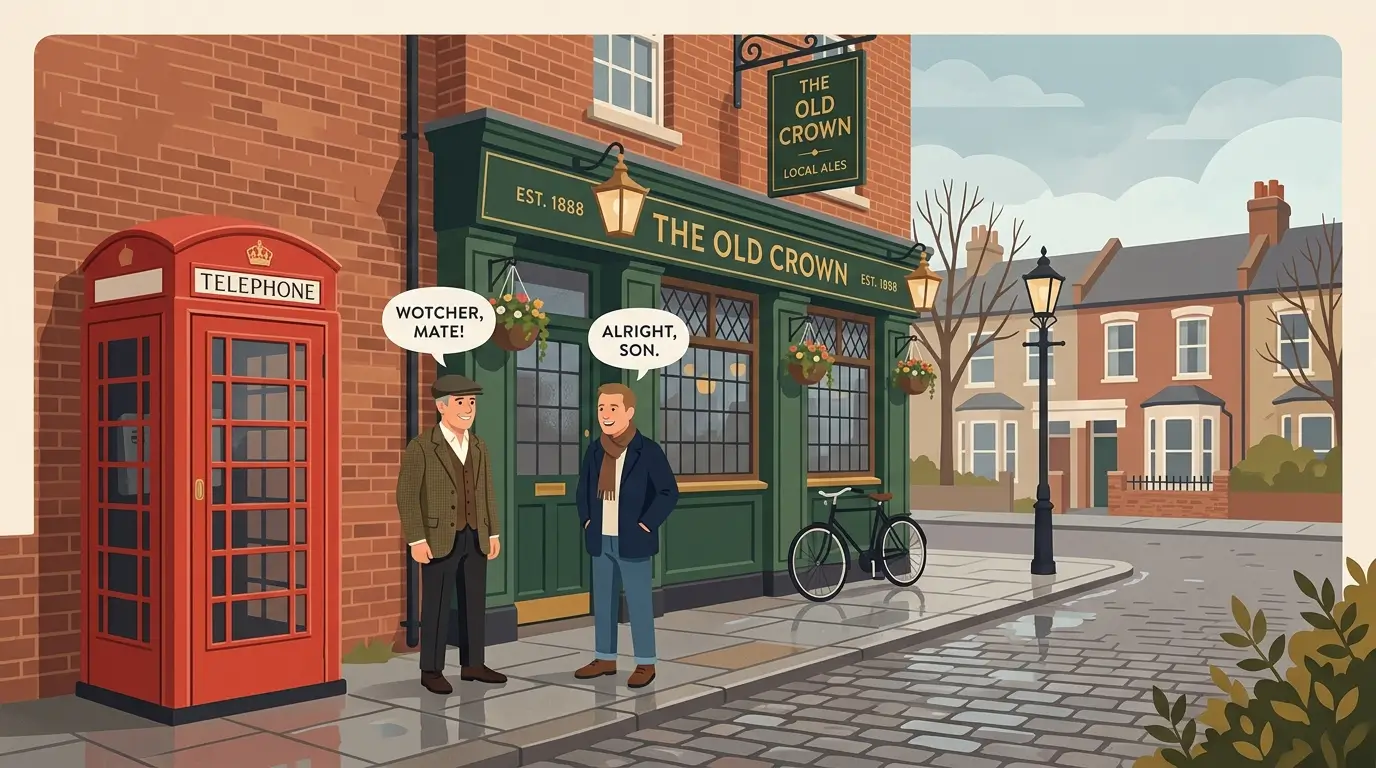
Cockney rhyming slang describes a collection of London expressions that replace a word with a two- or three-word phrase that rhymes with it, such as “dog and bone” for “phone.”
People developed these phrases in East London during the 1800s, and speakers still use them today in jokes, texts, and casual British conversations.
Key Takeaways
- Cockney rhyming slang replaces common words with rhyming phrases, then often drops the rhyming part entirely.
- It began in East London, likely in the 1840s, among market traders and working-class communities.
- The exact origin is unclear, though many historians link it to street sellers and possibly a way to talk in code.
- People still use it today, with older Londoners using it sincerely and younger generations often using it playfully online.
- The tone usually feels playful and affectionate, although some older terms may sound outdated or offensive today.
- You’ll spot it in pubs, on British TV, in memes, and increasingly in TikTok and Reddit posts about “weird British slang.”
People search for a cockney rhyming slang list for a few different reasons. Some heard a confusing phrase on a British show and want a translation. Others are planning a trip to London and want to sound less like a tourist.
A lot of people just find the whole idea funny: why would anyone say “plates of meat” instead of “feet”?
You’ll run into cockney rhyming slang in older British films, in pub conversations, and in memes that poke fun at how confusing British English can be. It’s also popped up again on TikTok and Reddit, where users share lists of terms and quiz each other on the meanings.
Is it still used today? Yes, but not the way it once was. Some phrases, like “dog and bone” for phone, have become so common that people use them without even thinking about the rhyme.
Others have mostly faded, kept alive by comedians, tour guides, and slang enthusiasts. This guide covers the full cockney rhyming slang list: the classics, the rude ones, the money terms, and the ones people misspell while searching for it online.
What Does Cockney Rhyming Slang List Mean?
A cockney rhyming slang list is simply a reference of phrases used by cockneys, traditionally, people born within earshot of the Bow Bells church in East London. Each phrase rhymes with the word it replaces.
Here’s how it works. Instead of saying “stairs,” a cockney speaker might say “apples and pears.” The phrase rhymes with “stairs,” even though none of the individual words do on their own. Often, speakers shorten the phrase further, dropping the rhyming word completely.
So “apples and pears” might just become “apples,” and only someone who knows the slang would understand you’re talking about stairs.
Some phrases stayed close to their original meaning for over a century. Others have shifted, been shortened, or picked up new uses as pop culture changed.
A cockney rhyming slang list usually groups these terms by category: money, body parts, people, and insults to make them easier to learn.
Quick Meaning Box
| Meaning | Simple Explanation |
| A rhyming slang phrase | A two- or three-word phrase that rhymes with the real word. |
| The “drop” | Shortening the phrase so only the non-rhyming word is spoken. |
| East End origin | Traditionally tied to working-class East London speech. |
| Coded speech | Some believe it let traders or workers talk without outsiders understanding. |
| Living slang | Still used today, both seriously and as a joke. |
Pronunciation
There’s no single hard word to pronounce here, since “cockney rhyming slang” is really a category name. Say it as: KOK-nee RY-ming SLANG. Individual terms, like “dog and bone,” are pronounced exactly as they’re spelled; the fun part is remembering what they stand for, not saying them.
Where Does Cockney Rhyming Slang List Come From?
The exact origin is unclear, but most language historians trace cockney rhyming slang back to the East End of London in the 1840s. It’s often linked to markets, street traders, and working-class neighborhoods.
One common theory is that traders used it to speak in a kind of code, so customers or police couldn’t easily follow what they were saying. Another idea is that it simply grew out of wordplay and humor among people who worked and lived closely together.
Because there are no reliable written records from that exact period confirming a single origin story, it’s best to treat these as theories rather than confirmed facts.
The “cockney” part of the name refers to a specific London identity; traditionally, someone born within hearing distance of the bells of St Mary-le-Bow church in East London.
Over time, the term “cockney” came to describe both a working-class London accent and this style of rhyming wordplay.
Origin of the Term
Cockney rhyming slang spread slowly through the 1800s and 1900s, mostly by word of mouth in East London communities. It picked up new terms as culture changed; some phrases reference people, places, or products that were well known at the time they were coined.
By the mid-1900s, cockney rhyming slang had become well known outside London too, thanks to British films, sitcoms, and postwar media that featured cockney characters. This gave the slang a reputation as charming, working-class, and distinctly London.
In recent years, the term has seen a small resurgence online. Language accounts, comedians, and British creators share cockney rhyming slang lists as a way to explain “weird British words” to global audiences.
This has introduced the slang to people who have never set foot in London, keeping old phrases alive in a new context.
How People Use It Today
Today, cockney rhyming slang shows up in three main places: everyday London speech, British media, and social platforms like TikTok and Reddit. Older Londoners may use it naturally in conversation, while younger people often use it as a joke or a way to sound old-school.
On TikTok, creators post short videos translating cockney phrases for confused viewers. On Reddit, threads pop up asking for a full cockney rhyming slang list or debating which terms are still actually used versus which ones are mostly stereotypes.
It rarely appears in professional writing or formal speech, since it’s considered informal and regional.
Cockney Rhyming Slang List PDF: Where to Find One
If you want a printable cockney rhyming slang list PDF, look for lists published by language and culture sites, London tourism boards, or British heritage organizations, since these tend to be more accurate than random social posts.
A PDF version is useful if you’re studying the slang for a trip, a class, or just want something to reference offline. Many of these guides organize terms by category: money, food, people, which makes them easier to skim than a long block of text.
When picking a PDF, check that it explains the reasoning behind each phrase (the actual rhyme), not just the final meaning, since that’s what makes the slang stick in your memory.
Cockney Rhyming Slang List Rude: The Terms to Know Before You Use Them
Some cockney rhyming slang covers rude topics, including insults, body parts, and outdated slurs, so it’s worth knowing which terms can offend using them casually.
For example, older terms tied to sexuality or ethnicity were coined in a time when casual slurs were common, and using them today, even as a “joke”, can come across as genuinely offensive. Other rude terms are simply cheeky rather than harmful, like slang for backside or drunkenness.
If you’re building a personal cockney rhyming slang list to use with friends, it helps to separate the harmless, funny entries from the ones that haven’t aged well.
Cockney Rhyming Slang List Money: Slang for Cash and Coins
Cockney culture produced a lot of slang for money, since cash was a constant topic among market traders and working-class communities. “Bread and honey” means money, often shortened to just “bread.” “Sausage and mash” is slang for cash.
Beyond strict rhyming slang, British English also uses related money terms often grouped into these lists, like “a pony” for £25 and “a monkey” for £500.
These aren’t always classic two-word rhymes, but they came from the same working-class London culture and usually appear together on cockney rhyming slang list money resources.
Cockney Rhyming Slang List Funny: The Silliest Entries
The funniest cockney rhyming slang tends to come from unexpected or silly-sounding phrase pairings, like “trouble and strife” for wife, or “dog and bone” for phone a phrase that sounds nothing like what it means until you say it out loud.
Part of what makes this slang funny is the mental gap between the phrase and the meaning. “Plates of meat” for feet doesn’t make logical sense; it only works because “meat” rhymes with “feet.”
That absurd logic is exactly why cockney rhyming slang list funny searches are so popular; people enjoy sharing the most ridiculous examples with friends.
Cockney Rhyming Slang List Iron Hoof: What It Means and Why It’s Controversial
“Iron hoof” is an older piece of cockney rhyming slang that rhymes with a derogatory term for a gay man. It’s one of the clearest examples of a phrase that has not aged well.
Language historians document it as part of the slang’s history, but that doesn’t mean it’s appropriate to use today. Many older cockney terms were coined in a much less accepting era, and “iron hoof” falls into that category.
Most modern cockney rhyming slang list resources include it for historical completeness while noting that it’s considered offensive by current standards, and it’s best avoided in everyday conversation.
Cockney Rhyming Slang List Reddit: What Online Communities Say
Reddit communities, especially those focused on British culture and language, regularly discuss cockney rhyming slang, often debating which terms Londoners still actually say versus which ones are mostly tourist trivia.
A common theme in these threads is that real, everyday cockney speakers use a smaller, more practical set of terms like “dog and bone” or “brown bread” for dead, while many of the more obscure or old-fashioned entries on a cockney rhyming slang list Reddit thread are rarely heard outside of joke posts or heritage articles.
Old Cockney Rhyming Slang List: Vintage Terms From the East End
An old cockney rhyming slang list usually includes terms tied to specific decades, referencing people, products, or places that were well known at the time but may be unfamiliar now.
These vintage entries are still fun to learn, even if nobody uses them in daily conversation anymore. They work like a time capsule, showing what was culturally relevant in East London decades ago.
If a term references a person or brand you don’t recognize, that’s often a sign it’s an older entry rather than a modern one.
Cockney Rhyming Slang Listen: A Common Search Mix-Up
Some people search “cockney rhyming slang listen” when they actually want to hear the slang spoken aloud, not read a written list.
This usually means they’re looking for audio clips or videos of native Londoners using the phrases naturally.
If that’s what you’re after, look for British media, interviews, or creators who specialize in London dialects, since hearing the rhythm and accent helps the phrases make a lot more sense than reading them on a page.
Cockney Rhyming Slang Listerine: Another Search Mix-Up Explained
“Cockney rhyming slang Listerine” is almost always a typo or autocomplete mix-up for “listen,” since Listerine (the mouthwash brand) has no real connection to cockney slang history.
It’s a good example of how search engines can misread what someone actually wants.
If you landed here searching that phrase, you were most likely looking for a full list of terms, or audio examples of the slang being spoken.
Funny Cockney Rhyming Slang List PDF: Best Free Downloads to Look For
When looking for a funny cockney rhyming slang list PDF, prioritize downloads from language sites or cultural organizations over random forum uploads, since those are more likely to have correct, well-explained entries.
A good funny-focused PDF usually groups the silliest or most absurd rhymes, with a short explanation of the wordplay behind each one. That structure makes it easier to actually remember the terms, rather than just skimming a long alphabetical list.
Examples in Everyday Conversation
- “Hang on, let me grab my dog and bone, it’s ringing.”
- “My plates are killing me after that walk.”
- “He’s told so many porky pies, I don’t believe a word.”
- “Come up the apples, dinner’s ready.”
- “She’s my trouble, we’ve been married ten years.”
- “Put your titfer on, it’s freezing out.”
- “I’ll have a butcher’s at the menu before we order.”
- “He’s gone a bit Hampstead lately, hardly makes sense.”
- “That old boy’s been brown bread for years now.”
- “Give us a bell on the dog later, yeah?”
Text Message Examples
- “on the dog with mum, call u back in 5.”
- “my plates are done, can’t walk another step lol.”
- “he’s such a porky pie teller, don’t trust him.”
- “Meet me by the apples, top floor.”
- “grabbing my titfer, it’s freezing.“
- “Had a quick butcher’s, the menu looks decent.”
- “Trouble’s not happy I’m late again.”
- “he’s brown bread mate, sorry to say.”
- “Give me a bell later on the dog.”
- “You look proper Hampstead today lol what’s up.”
Social Media Caption Examples
- Instagram: “Sunday roast, sore plates, zero regrets.”
- TikTok: “teaching my American friend cockney slang and she’s SHOOK.“
- X: “Why does ‘dog and bone’ mean phone? This makes no sense, and I love it.”
- Threads: “Just learned ‘trouble and strife’ means wife and I can’t stop laughing.”
- Facebook: “Nan called the remote a ‘dicky’ again, love that woman.”
- Instagram: “new titfer, new me.”
- TikTok: “rating cockney rhyming slang from least to most confusing.”
- X: “had a butcher’s at the sale prices, not worth it.”
- Threads: “Explain why ‘brown bread’ means dead someone, please”
- Facebook: “My grandad still calls stairs the ‘apples,’ and I adore it.”
Is It Positive or Negative?
Cockney rhyming slang is mostly playful and affectionate in tone. Terms for phone, feet, stairs, or wife are lighthearted, not insulting. Using them shows familiarity with London culture and often gets a laugh.
That said, tone depends heavily on the specific term. Some older rude or offensive entries, like “iron hoof,” carry real negative history and can hurt or offend if used carelessly.
Misunderstandings can also happen if someone doesn’t realize a phrase is slang at all; hearing “she’s my trouble” without context might sound like a real complaint rather than an affectionate nickname.
Who Uses This Slang?
Cockney rhyming slang is traditionally used by working-class East Londoners, especially older generations who grew up hearing it at home. Many of these speakers use it naturally, without thinking about the original rhyme.
Younger people and non-Londoners tend to use it differently, often as a joke, a party trick, or content for social media.
Comedians and actors have also kept certain phrases alive by using them in British TV and film. It’s not tied to gaming or hip-hop culture, and there’s no strong evidence linking its recent online popularity to any single platform beyond general interest in British slang content.
Similar Slang Words
| Slang | Meaning |
| Dog and bone | Phone |
| Plates of meat | Feet |
| Trouble and strife | Wife |
| Apples and pears | Stairs |
| Porky pies | Lies |
| Brown bread | Dead |
| Titfer (tit for tat) | Hat |
| Boat race | Face |
| Mince pies | Eyes |
| Dicky dirt | Shirt |
Opposite Words
There isn’t a true “opposite” to cockney rhyming slang, since it’s a style of wordplay rather than a single word with a clear antonym. However, a few contrasting ideas are worth knowing:
- Plain English > speaking directly, without any coded or rhyming substitution.
- Formal British English > the polished, standard version of British speech used in writing, business, and professional settings, which avoids slang entirely.
- Received Pronunciation (RP) > the “posh” British accent often seen as the cultural opposite of a strong cockney accent.
Common Mistakes
People often assume every rhyming phrase is still commonly spoken, when many are historical or rarely used outside of jokes and lists.
Another common mistake is only saying half the phrase without knowing the full rhyme it’s based on, which can make the meaning unclear to anyone unfamiliar with the term.
Some learners also mix up similar-sounding phrases or misspell searches, like typing “cockney rhyming slang listen” or “listerine” instead of “list.”
It’s also a mistake to assume all cockney slang is harmless; a few older terms carry real offensive history and shouldn’t be used casually, even as a joke.
When NOT to Use It
Avoid cockney rhyming slang in professional emails, school assignments, business meetings, or any formal writing, since it reads as overly casual and can confuse readers unfamiliar with British slang.
It also doesn’t translate well in international business settings, where clarity matters more than charm.
It’s best kept for casual conversation, texting friends, or content clearly meant to be playful. In formal or written communication, stick to plain English, so your message is easy to understand for everyone, regardless of where they’re from.
Fun Facts
- Cockney rhyming slang traditionally comes from East London, tied to the area within earshot of the Bow Bells.
- Many phrases get shortened over time, dropping the actual rhyming word entirely.
- “Dog and bone” for phone is one of the most widely recognized examples outside the UK.
- The slang has appeared in British sitcoms and films for decades, helping it spread nationally.
- Some terms reference specific people or products from the time they were coined, which is why certain phrases feel dated today.
- Cockney rhyming slang has picked up new attention on social platforms as international audiences discover it as “weird British slang.”
Frequently Asked Questions
What are some Cockney rhyming slang words?
Some well-known examples include “dog and bone” for phone, “plates of meat” for feet, “trouble and strife” for wife, “apples and pears” for stairs, and “porky pies” for lies. Many people also know “brown bread,” which means dead. These are some of the most common entries on any Cockney rhyming slang list because they’re easy to remember and still appear in British TV, films, and casual conversations among Londoners today.
How do you say “I love you” in cockney slang?
There isn’t one standard, widely documented cockney rhyming slang phrase specifically for “I love you.” Cockney slang tends to focus on nouns, people, objects, and numbers rather than full sentences or emotional phrases. You might hear affectionate nicknames like calling someone “my old china” (short for “china plate,” meaning mate), but that’s a term of friendship, not a direct translation of “I love you.” It’s honest to say this phrase simply doesn’t have a fixed cockney equivalent.
What is Dicky in Cockney?
“Dicky” comes from “dicky dirt,” which rhymes with “shirt,” so Cockney speakers use it to mean a shirt. The term also connects loosely with “dicky bird,” which means “word,” as in the phrase “he never said a dicky bird.” In general British English, “dicky” has another meaning: people use it to describe something that feels unstable or unwell, such as a “dicky knee.”Context matters a lot here, since the same word can point to different meanings.
What’s 50 in Cockney rhyming slang?
British money slang commonly refers to £50 as “half a ton,” since a “ton” is slang for £100, making £50 exactly half of that. This isn’t a strict two-word rhyme like “dog and bone,” but it comes from the same working-class London money-slang tradition and is frequently grouped alongside cockney rhyming slang money lists. The exact origin of “ton” for £100 is unclear, though it’s long been part of British slang for cash amounts.
Final Thoughts
Cockney rhyming slang is one of the most fun corners of British English to learn, mostly because the logic behind it is so unexpected. A phrase like “plates of meat” for feet only makes sense once you know the rhyme, which is exactly why it sticks with people once they learn it.
If you’re using this list to prepare for a London trip, impress friends with a fun fact, or enjoy some clever wordplay, focus on which terms people still use today and which ones mainly belong to Cockney history.
Stick to the friendly, well-known phrases in casual settings, be mindful of the outdated or offensive ones, and you’ll have a solid handle on this uniquely London way of speaking.

Sarah Mitchell is a content writer at Slang Insight, passionate about internet culture, trending phrases, and the ever-changing world of digital communication. With a keen eye for spotting new slang before it goes viral, Sarah loves breaking down complex expressions into simple, relatable explanations for readers of all ages.