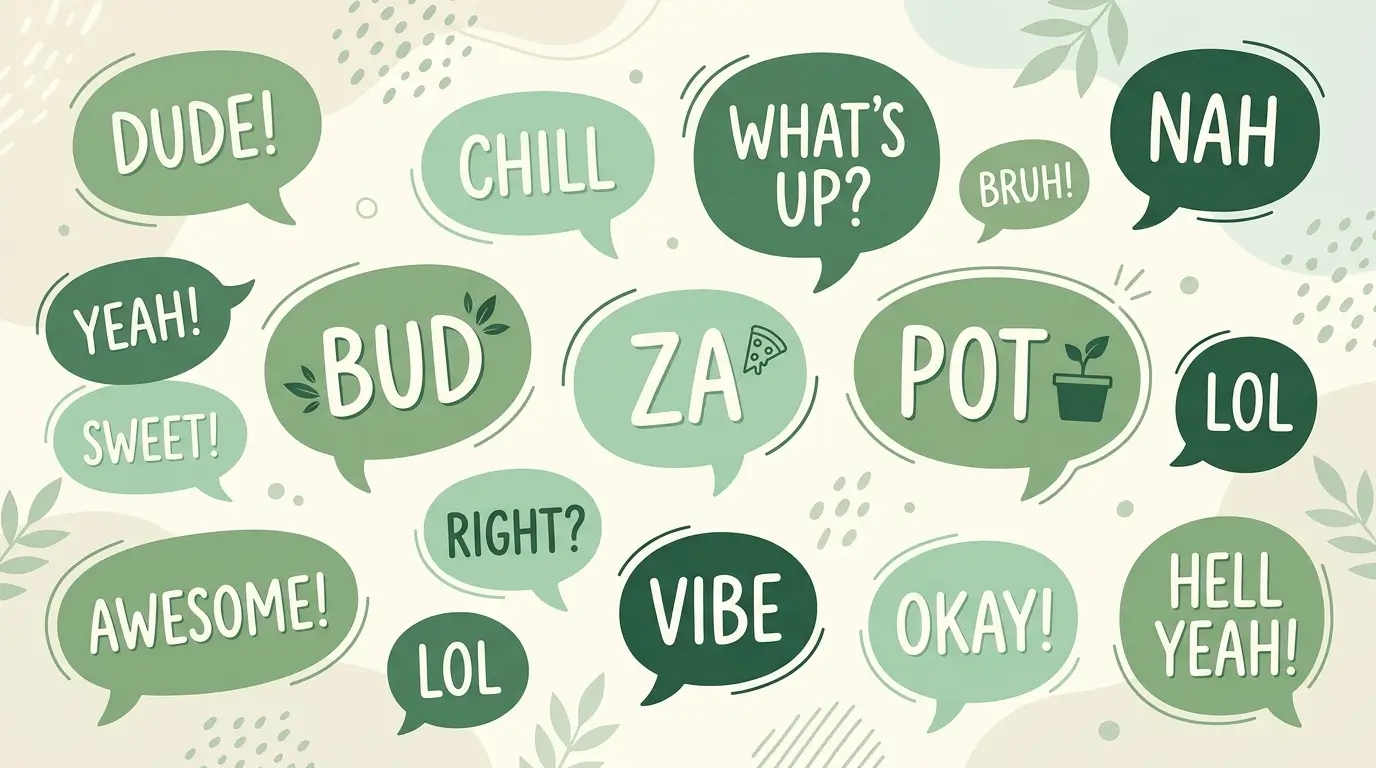
Weed slang refers to the many informal words people use for marijuana, its amounts, and the experience of smoking it. Common examples include “bud,” “flower,” “za,” and “pot.” These terms vary by region, generation, and platform, but they all point back to the same plant.
Key Takeaways
- Weed slang covers the plant itself, amounts, quality, and the high it produces.
- Many terms trace back to jazz-era slang, Spanish loanwords, and hip-hop culture.
- The language is still evolving, with newer terms like “za” gaining traction online.
- Usage is casual and mostly neutral to positive, though some terms describe low-quality weed.
- Context matters; the same word can mean different things depending on who says it.
- These terms are common in texting, social media captions, and everyday conversation among people who smoke.
People search for weed slang for a lot of reasons. Maybe someone heard a term in a song and didn’t know what it meant. Maybe a text from a friend used a word that didn’t make sense. Or maybe someone is just curious how so many different words came to mean the same plant.
These terms show up everywhere: song lyrics, group chats, TikTok captions, and everyday conversation. Some have been around for decades. Others are newer and mostly used online. Either way, this kind of slang is still very much alive.
Weed slang isn’t one fixed list of words. It changes by region, by generation, and by who’s talking. A term that’s common in Jamaica might sound unfamiliar in the Midwest. A word teens use on TikTok might not mean much to someone older. That’s part of what makes this kind of language interesting to track.
This guide walks through what these terms mean, where they likely came from, and how they show up in real conversations today. By the end, you’ll be able to read a text or caption using weed slang and know exactly what’s being said.
What Does Weed Slang Mean?
Weed slang is the collection of informal words people use instead of saying “marijuana” directly. It includes names for the plant, words for specific amounts, and expressions for being high.
Some terms are simple substitutes, like calling it “grass” or “herb.” Others are more specific, describing quality (“za” for high-grade weed) or state of mind (“baked” for being high). A single conversation might mix several types of slang, like describing an amount, a quality level, and an effect all in one sentence.
Quick Meaning Box
| Meaning | Simple Explanation |
| The plant itself | Words like “bud,” “pot,” “grass,” or “flower” |
| An amount | Terms like “dime bag,” “eighth,” or “zip” |
| Quality | “Za” for good weed, “reggie” for lower quality |
| The effect | “High,” “baked,” or “stoned” |
| A method of use | “Blunt,” “joint,” “bowl,” or “pen” |
Pronunciation
“Weed” is pronounced exactly like it looks: weed (rhymes with “need”). Most slang terms tied to it are pronounced normally too, though regional accents can shift how words like “za” (rhymes with “spa”) or “reggie” (REJ-ee) come out.
Where Does Weed Slang Come From?
Weed slang comes from a mix of jazz-era street language, Spanish-language influence, and decades of hip-hop and pop culture references. The exact origin of most individual terms is unclear, but the broader pattern is well documented.
Words like “pot” and “grass” go back to mid-20th-century slang, when marijuana use was often discussed in coded language to avoid legal trouble. Some terms, like “mota,” have roots in Spanish.
Others emerged from music scenes, especially reggae and hip-hop, where marijuana culture has long been part of the lyrical content. The exact origin of many specific terms is unclear, since slang typically spreads through spoken conversation long before anyone writes it down.
History of the Term
This slang has shifted a lot over the decades. In earlier eras, terms like “reefer” and “tea” were common ways to refer to marijuana without saying the word directly. By the 1960s and 70s, “pot” and “grass” became widespread, tied closely to counterculture movements.
Hip-hop in the 1990s and 2000s introduced or popularized many terms still used today, including regional variations tied to specific cities and artists.
More recently, the internet has sped up how quickly new slang spreads and how fast it changes. Terms like “za” became widely recognized after gaining traction on social media, showing how a single platform can push a word into everyday use much faster than word-of-mouth ever could.
How People Use It Today
Weed slang today lives mostly in texting, social media captions, and casual conversation. On platforms like TikTok, Instagram, and X, these terms show up in captions, comments, and short-form videos discussing the plant, culture, or humor around it.
Group chats and texting are where a lot of this slang gets used in real time, often mixed with emojis or abbreviations. It’s casual language, so it rarely appears in formal writing, but it’s extremely common in informal digital spaces.
Weed Slang Names
Some of the most recognizable names for weed include “bud,” “flower,” “grass,” “herb,” “Mary Jane,” and “pot.” Each name carries a slightly different tone; “flower” sounds more polished, while “grass” feels more old-school.
These names are often interchangeable in casual conversation. A person might say “got any bud?” one day and “got any flower?” the next, without changing the meaning at all.
Another Word for Weed
If someone wants a simple substitute for the word “weed,” common options include “pot,” “grass,” “herb,” “Mary Jane,” and “ganja.” These are some of the most universally recognized alternatives, understood across different age groups and regions.
“Ganja” in particular has roots tied to South Asian languages and later became closely associated with Jamaican culture and reggae music.
Za Weed Slang
“Za” is slang for high-quality, expensive weed, often referring to specific well-known strains. It became popular online, especially on TikTok and X, as a shorthand way to signal that weed is top-shelf rather than average.
The exact origin of “za” is unclear, though it appears to be a shortened, stylized twist on strain names or the idea of “the” best weed essentially “the” weed, condensed into one syllable.
Bad Weed Slang
Lower-quality weed often gets called “reggie” (short for “regular”), “schwag,” or “brick weed.” These terms describe weed that’s dry, seedy, or generally less potent compared to higher-grade options.
“Reggie” specifically implies something average or below-average, especially when compared to “za.” Someone might say “that’s reggie, not za” to clearly separate the two quality levels in one sentence.
High on Weed Slang
Being high on weed has its own set of terms, including “baked,” “stoned,” “high,” “blazed,” and “faded.” These words describe the state of being under the influence, though some imply a stronger effect than others.
“Baked” and “blazed” tend to suggest a more intense high, while “high” is the most neutral, general term. “Faded” often implies being very high, sometimes to the point of being noticeably out of it.
Jamaican Weed Slang
Jamaican culture has contributed heavily to weed slang, most notably the word “ganja,” which is deeply tied to Rastafarian culture and reggae music. Other terms like “herb” and “sensimilla” (referring to seedless, high-potency weed) also have strong ties to Jamaican usage.
This influence spread globally through reggae music, especially through artists whose lyrics openly referenced marijuana as part of spiritual and cultural practice.
Mexican Weed Slang
Spanish-language slang has shaped a lot of weed terminology used in the U.S., especially “mota,” a common Spanish word for marijuana. “Mota” is widely used in both Spanish-speaking communities and has crossed over into broader English-language slang as well.
Other Spanish-origin terms are less common in mainstream English but still appear in bilingual communities and border regions.
Weed in Spanish Slang
In Spanish, common slang terms for weed include “mota,” “hierba” (meaning “herb”), and “yerba.” These terms function the same way English slang does: casual substitutes for the more formal or clinical word for marijuana.
“Hierba” and “yerba” both translate loosely to “herb” or “grass,” mirroring similar English-language slang patterns.
Weed Slang for Amounts
Common amount-related slang includes “dime bag” (originally around $10 worth), “eighth” (an eighth of an ounce), “quarter” (a quarter ounce), “half” (half an ounce), and “zip” (a full ounce).
A “bowl” refers to a single load of weed packed into a pipe, not a fixed weight; the size depends on the pipe and how tightly it’s packed. When someone asks what 7 grams of weed slang would be, that amount is commonly called a “quarter,” since 7 grams is roughly a quarter of an ounce.
These terms are practical shorthand, often used when discussing buying or sharing weed, and they save people from having to say exact weights out loud.
Weed Pen Slang
A “weed pen” refers to a vape pen used for cannabis oil or concentrate, and it’s sometimes just called a “pen” in casual conversation. Related terms include “cart” (short for cartridge) and “dab pen,” which refers to a pen designed specifically for concentrates.
This slang became common as vaping shifted from a niche method into one of the most widely used ways to consume weed, especially among younger users.
Examples in Everyday Conversation
- “You still got that za from last week?”
- “Nah man, that’s straight reggie, don’t waste your money.”
- “I’m so baked right now, I can’t even focus.”
- “Can you roll a blunt for later?”
- “He picked up a zip for the trip.”
- “This bowl isn’t hitting right, pack it again.”
- “My cousin only smokes mota, doesn’t touch anything else.”
- “She brought her pen so we don’t need papers.”
- “That’s some good herb, where’d you get it?”
- “I’m way too high to drive right now.”
Text Message Examples
- “yo you got any bud left?”
- “bring the pen tonight 🙏”
- “that eighth lasted like a week lol”
- “he’s so faded rn 💀”
- “is that za or reggie”
- “Pack a bowl before they get here”
- “mota run before the movie?”
- “grabbing a quarter after work”
- “Blunt or joint tonight?”
- “Stoned and starving, send help”
Social Media Caption Examples
- Instagram: “za season 🌿”
- TikTok: “POV: the pen dies mid session”
- X: “reggie prices, za expectations”
- Threads: “just tryna get baked and watch a movie”
- Facebook: “throwback to simpler times, just herb and good friends”
- Instagram: “eighth gone in a weekend, no regrets”
- TikTok: “when the bowl actually hits right”
- X: “mota season hits different”
- Threads: “faded but functional”
- Instagram: “blunt wraps and good vibes”
Is It Positive or Negative?
Weed slang is mostly neutral to positive in tone, used casually among people who smoke without any negative implication. Some terms, though, carry a clearly negative meaning: “reggie,” “schwag,” and “brick weed” all describe low-quality product and are meant as a mild insult toward the weed itself, not the person.
Misunderstandings can happen when someone unfamiliar with the slang assumes a neutral term like “baked” or “high” sounds more alarming than it’s meant to. In most casual contexts, these words are said lightly, without any serious tone behind them.
Who Uses This Slang?
This slang spans a wide range of people: teens and young adults who pick it up through social media, older adults who’ve used similar terms for decades, gamers who reference it casually in voice chats, and communities where cannabis culture is deeply tied to music and regional identity.
Usage isn’t limited to any one group, though the specific words in someone’s vocabulary often depend on their age, location, and social circles.
Similar Slang Words
| Slang | Meaning |
| Bud | The plant itself |
| Grass | Another word for weed. |
| Herb | A common, mild substitute term. |
| Ganja | Weed, especially tied to Jamaican culture. |
| Mary Jane | A playful nickname for marijuana. |
| Reefer | An older term for weed. |
| Chronic | Slang for strong, high-quality weed. |
Opposite Words
- Sober > the state of not being under the influence of anything.
- Straight > sometimes used to describe someone who doesn’t smoke or drink at all.
- Clean > used to describe someone not currently using any substances.
These aren’t direct antonyms of “weed” itself, but they describe the opposite state or lifestyle compared to smoking.
Common Mistakes
People often misspell “reggie” as “reggy,” or confuse “za” with unrelated slang terms that sound similar. Another common mistake is assuming “bowl” refers to a fixed weight; it actually depends entirely on the size of the pipe being used.
Some also mix up “blunt” and “joint,” though they’re different: a blunt uses tobacco-leaf wrapping, while a joint uses rolling paper.
When NOT to Use It
Weed slang should be avoided in professional emails, school assignments, job interviews, and any formal writing. Using casual drug slang in these settings can come across as unprofessional or inappropriate, regardless of the actual legal status of marijuana in a given location.
Formal contexts call for clear, neutral language or avoiding the topic altogether unless it’s directly relevant and appropriate to the setting.
Fun Facts
- “420” is widely recognized as shorthand tied to cannabis culture, often used to mark a specific time or date associated with smoking.
- “Mary Jane” is a playful English nickname that plays on the sound of “marijuana.”
- “Ganja” has linguistic roots connected to South Asian languages before becoming closely tied to Jamaican culture.
- Vaping introduced an entirely new set of terms, like “pen” and “cart,” that didn’t exist in older weed slang.
- Slang around weed quality, like “za” versus “reggie,” reflects a broader trend of ranking product much like people do with other consumer goods.
- Regional slang can differ so much that two people from different parts of the country might use completely different words for the same amount of weed.
Frequently Asked Questions
What does Gen Z call weed?
Gen Z commonly uses “za” to describe high-quality weed, along with older standbys like “bud” and “pot.” Much of this vocabulary spreads through TikTok and other social platforms, where short, catchy terms get picked up quickly. Gen Z also leans heavily on slang tied to vaping, using words like “pen” and “cart” far more often than older generations, since vaping has become a much more common method of use among younger smokers.
What is the slang term weed?
“Weed” itself is already slang; it’s an informal stand-in for “marijuana” or “cannabis,” which are the more formal or scientific terms. The word likely comes from describing the plant as a wild-growing weed, in contrast to a cultivated crop. Over time, “weed” became so common that it’s often treated as the default casual term, with other slang words built on top of it.
What is the slang 420 for weed?
“420” refers to a time (4:20) and a date (April 20th) that have become closely associated with cannabis culture and celebration. It’s used as a code or reference point rather than a name for the plant itself. People might say “let’s 420” to suggest smoking, or reference the date as an unofficial holiday within cannabis culture.
What is the best slang for weed?
There’s no single “best” term; it depends on tone and context. “Bud” and “flower” sound more neutral and widely understood, while “za” signals quality specifically. “Pot” and “grass” are classic, easily recognized options that work across most casual conversations without needing further explanation.
Final Thoughts
Weed slang keeps changing, but the core idea stays the same: people looking for casual, quick ways to talk about the plant, its amounts, and the experience of using it. Some terms have stuck around for decades, while others, like “za,” show how fast new slang can spread once it catches on online.
Understanding these words isn’t about promoting use; it’s about being able to read a text, a caption, or a conversation and actually know what’s being said.
Slang like this reflects culture, region, and generation all at once, which is part of why it’s stayed so interesting to track over time.

Sarah Mitchell is a content writer at Slang Insight, passionate about internet culture, trending phrases, and the ever-changing world of digital communication. With a keen eye for spotting new slang before it goes viral, Sarah loves breaking down complex expressions into simple, relatable explanations for readers of all ages.