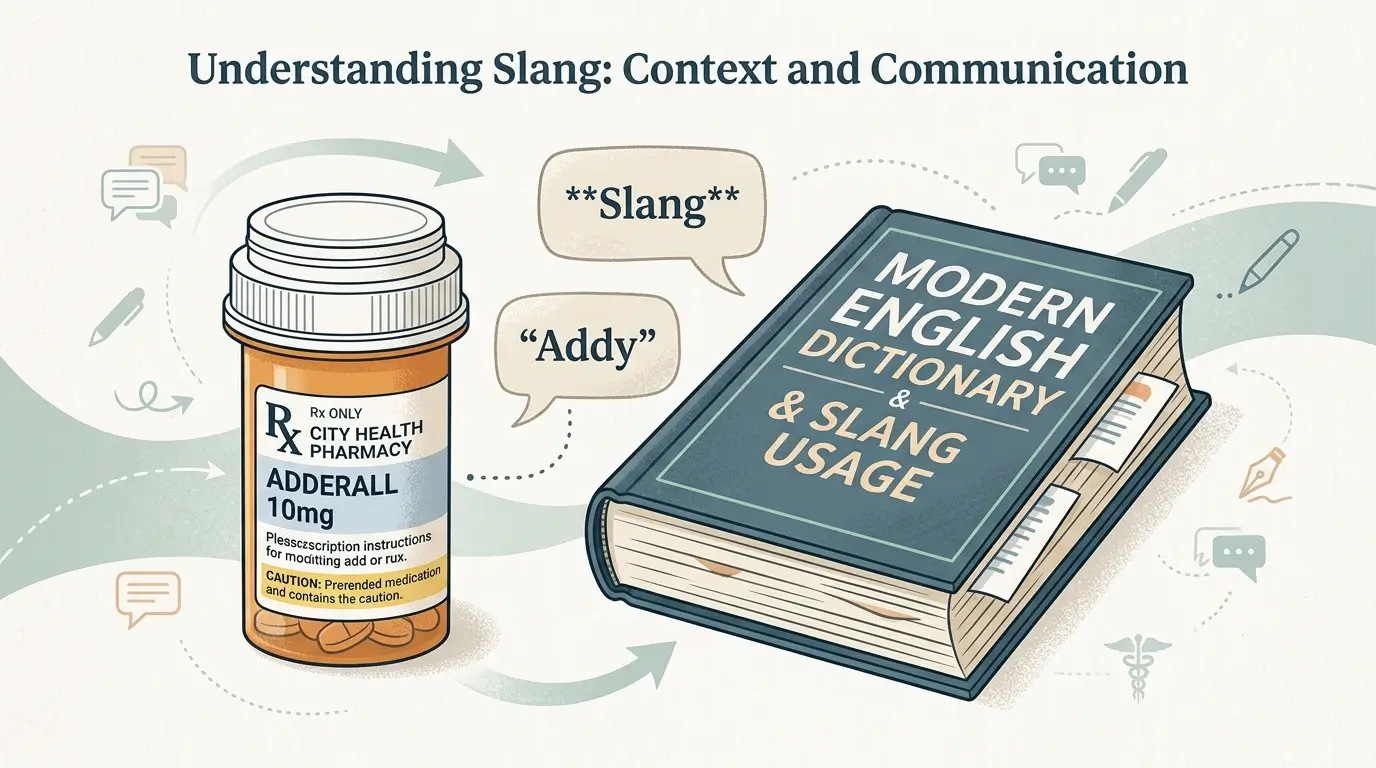
Slang terms for Adderall are informal names people use for the prescription stimulant, with Addy being the most recognizable. Other expressions include addies, study drug, and smart drug, though these broader terms can describe other substances too.
The exact meaning depends on context, and slang never changes the medication’s medical identity.
Key Takeaways
- Addy is the most common informal nickname for Adderall.
- Adderall is a prescription medication containing amphetamine and dextroamphetamine.
- Study drug and smart drug describe how people talk about stimulant use, not exact synonyms.
- Speed and uppers refer to stimulants broadly and don’t specifically mean Adderall.
- The tone can be neutral, casual, or negative depending on context.
Adderall is a brand-name medication containing amphetamine and dextroamphetamine, prescribed for ADHD and narcolepsy. Because it comes up often in conversation, texting, and online discussion, people have developed casual shorthand for it, most commonly Addy.
Understanding this language helps readers recognize what someone means without assuming every nickname points to the same substance. This interpretation covers where these terms come from, how they’re used today, and where broader stimulant slang like speed or uppers fits in.
What Do Slang Terms for Adderall Mean?
The best-known nickname is Addy, a shortened, informal version of the brand name. Broader terms like study drug or smart drug describe a category of substances associated with focus and academic performance rather than one specific medication.
The key difference is specificity. Addy generally functions as a direct nickname for Adderall, while study drug, upper, and speed can apply to other stimulants entirely. Adderall itself belongs to the stimulant category, and mixing it up with unrelated substances, including methamphetamine, is a common but inaccurate assumption.
Quick Meaning Box
| Term | Simple Explanation |
| Addy | Common informal nickname for Adderall. |
| Addies | Casual plural of Addy. |
| Study drug | Broad phrase for stimulants discussed around studying. |
| Smart drug | Broad term for substances linked to focus or performance. |
| Uppers | General stimulant slang; not specific to Adderall. |
| Speed | Broad amphetamine-type term; not an exact synonym for Adderall. |
Pronunciation
Adderall is pronounced uh-DER-all. The nickname Addy sounds like AD-ee. Because “addy” is also informal British shorthand for an email address, context determines which meaning applies.
Where Do These Terms Come From?
The exact origin of “Addy” is unclear. It follows a common English pattern of shortening longer names into casual nicknames, likely drawn straight from the first syllable of Adderall. There’s no documented evidence tying it to one specific group or moment.
The broader stimulant vocabulary has deeper roots. Amphetamine has been part of medical English since at least 1938, and dextroamphetamine since 1943.
That history doesn’t mean every modern nickname has a traceable origin; most slang spreads through everyday conversation rather than a clear starting point.
History of the Adderall Term
As Adderall became a widely recognized brand for ADHD treatment, informal shorthand developed alongside it. Addy emerged as an easy way to reference the name casually. Other phrases, like study drug, grew out of conversations about stimulant effects and academic use rather than describing one exact chemical.
Some slang overlaps with older stimulant vocabulary; dex, for instance, is an established term tied to dextroamphetamine specifically, not a universal stand-in for every Adderall product.
How People Use It Today
Addy shows up mostly in informal settings texting, casual conversation, and online discussions- usually as a simple abbreviation rather than a coded term.
Broader words create more confusion: study drug might mean Adderall, or it might mean a different stimulant discussed in an academic context.
Smart drug casts an even wider net. Online language shifts quickly, so context always matters more than the word itself.
Another Name for Adderall
Addy remains the most common alternative name. Dex deserves separate mention because it specifically refers to dextroamphetamine, a related but distinct pharmaceutical term.
If someone says “Addy,” they most likely mean Adderall; if they say “study drug,” they may mean Adderall, another stimulant, or use it as a general label.
What Is the Proper Name for Adderall?
The proper name is Adderall, a brand name for a combination of amphetamine and dextroamphetamine, prescribed for ADHD and narcolepsy. The generic formulation is described simply as amphetamine and dextroamphetamine.
It’s worth noting Adderall isn’t the same as methylphenidate, the stimulant found in Ritalin or Concerta, a different medication entirely.
Other Names for Adderall
Beyond Addy and Addies, you may see broader labels such as study drug, smart drug, prescription stimulant, and uppers. These aren’t interchangeable: prescription stimulant describes a medication category, while uppers refers to a wide group of stimulant substances.
When accuracy matters, Adderall or “amphetamine/dextroamphetamine” is clearer than any of these.
Terms for Adderall
- Exact or close terms: Adderall, Addy, Addies.
- Medical/descriptive terms: Amphetamine and dextroamphetamine, prescription stimulant, ADHD stimulant medication.
- Broader slang: Study drug, smart drug, upper, speed.
The last group needs caution, since these words can point to other substances entirely.
What Is “Addy” Slang For?
Addy is informal shorthand for Adderall, used in casual conversation, texting, and online writing. It doesn’t represent a separate medication; when someone says Addy, they usually mean Adderall itself. It’s not suited for formal medical writing, where the exact name matters more.
How to Say Adderall
Say it as uh-DER-all. The nickname Addy is pronounced AD-ee. In medical or professional settings, use the full name to avoid ambiguity; in casual conversation, Addy tends to sound more natural.
What Does Addy Mean in Slang?
In slang, Addy usually means Adderall, the brand-name medication containing amphetamine and dextroamphetamine. It functions mainly as a nickname and doesn’t specify dose, effect, or context of use on its own. It’s also worth separating Addy from general stimulant slang like speed or uppers, which can describe other substances, including methamphetamine.
What Is Adderall’s Scientific Name?
Adderall isn’t a scientific name; it’s a brand name for a combination containing amphetamine and dextroamphetamine. Amphetamine describes a chemical class, while dextroamphetamine refers to one specific form of it.
It’s also inaccurate to call Adderall “meth”; methamphetamine is a distinct substance, even though both belong to the broader stimulant family.
Examples in Everyday Conversation
- “Have you picked up your prescription?” “Yeah, I picked up my Adderall yesterday.”
- “What does ‘study drug’ mean?” “It’s a broad term for stimulants people mention around studying.”
- “I heard someone say ‘Addy.'” “It’s a casual nickname for Adderall.”
- “Is ‘upper’ another name for Adderall?” “Not exactly; it can refer to many stimulants.”
- “Why do people call it Addy?” “It’s just a shortened, informal version of the name.”
- “Is speed the same as Adderall?” “No, that usually refers to other amphetamine-type stimulants.”
- “Should I use ‘Addy’ at the doctor’s office?” “The full name is clearer in a medical setting.”
Is It Positive or Negative?
Addy is generally neutral on its own, though surrounding conversation can shift its tone. Someone discussing a legitimate prescription might use it casually; in another context, the same word could sound more concerning.
Broader terms like speed or uppers carry stronger negative associations because of ties to illicit stimulant use. In formal settings, slang can also read as careless; the official medication name is the safer choice when precision matters.
Who Uses This Slang?
Adderall slang appears mostly in informal English, across texting, casual conversation, and online discussion. Younger speakers may encounter it in school-related contexts, while adults may hear it in discussions about prescriptions or ADHD. It isn’t exclusive to any one age group, and regional or national differences in prescription practices can affect which terms feel familiar.
Similar Slang Words
| Slang | Meaning |
| Addy | Informal nickname for Adderall. |
| Addies | Casual plural of Addy. |
| Study drug | Broad phrase for a stimulant discussed around studying. |
| Smart drug | Informal term for substances tied to cognitive performance. |
| Upper | Broad slang for a stimulant. |
| Speed | Amphetamine-type slang; not specific to Adderall. |
| Dex | Term tied to dextroamphetamine. |
Opposite Words
- Downer > slang for a substance that depresses central nervous system activity.
- Sedative > a medication associated with calming or sleepiness.
- Depressant > a category of substances that slow CNS activity.
- Non-stimulant > a general term for something outside the stimulant category.
Common Mistakes
People often treat every stimulant slang word as a direct synonym for Adderall, which is inaccurate. Others confuse Adderall with methamphetamine simply because both are stimulants; they’re not the same substance.
Calling “study drug” a formal medical term is another common error; it’s informal language that can point to different substances entirely.
When Not to Use It
Avoid slang like Addy in medical, legal, academic, or professional contexts. A doctor’s office, pharmacy, or medical document requires the precise name Adderall or its generic ingredients. The same applies to professional emails, business writing, and formal school assignments, where a casual nickname can undercut clarity.
Fun Facts
- Adderall is a brand name, not a single chemical’s scientific name.
- Amphetamine’s first recorded use dates to 1938; dextroamphetamine to 1943.
- Dex has dictionary roots connected to dextroamphetamine dating to at least 1961.
- “Addy” also means “email address” in informal British English.
- Speed isn’t a precise synonym for Adderall and can refer to other stimulants.
Frequently Asked Questions
Is ketamine a drug?
Yes, ketamine is a medication classified as a dissociative anesthetic. It’s used in medical and veterinary settings for anesthesia and, in some regulated forms, for treatment-resistant depression. It’s a separate substance from Adderall and belongs to a different drug class entirely dissociatives rather than stimulants.
Is ketamine an illegal drug?
Ketamine is a controlled substance with legitimate medical uses, meaning it’s legal when prescribed and administered by a licensed provider. Non-prescribed use or possession outside medical settings is illegal in the U.S. and many other countries. This legal status differs from Adderall, which is also controlled but prescribed for different conditions.
Is ketamine a tranquilizer?
Ketamine is often described as a dissociative anesthetic rather than a traditional tranquilizer, though it does produce sedative and detached effects at certain doses. This distinguishes it from classic tranquilizers like benzodiazepines. It’s unrelated to Adderall’s stimulant classification.
Is ketamine an opioid?
No, ketamine is not an opioid. It works differently in the brain, primarily affecting NMDA receptors rather than opioid receptors. It’s grouped with dissociative anesthetics, distinct from both opioids and stimulants like Adderall.
Final Thoughts
Understanding Adderall slang comes down to separating a true nickname from broader drug terminology. Addy is the clearest informal name, while study drug, smart drug, upper, and speed can carry wider meanings depending on context.
The medication’s medical identity stays precise regardless: Adderall is a brand-name combination of amphetamine and dextroamphetamine with established medical uses.
When the stakes are higher medical care, schoolwork, professional writing the official terminology is always the safer choice.

Emily Rodriguez is a content creator and editor at Slang Insight, specializing in Gen Z language trends and social media culture. Emily’s mission is to help readers stay updated with the latest slang so they never feel out of the loop in online conversations.