FOMO stands for “Fear of Missing Out.” It describes the anxious feeling you get when you think other people are having fun, doing something exciting, or experiencing something good and you’re not there for it.
People use it in texts, captions, and everyday talk to explain that nagging worry of being left out.
Key Takeaways
- FOMO means “Fear of Missing Out.”
- It describes anxiety about missing an event, trend, or experience others are enjoying.
- The term grew popular with the rise of social media in the 2000s and 2010s.
- It’s still widely used today, especially by teens and young adults.
- The tone is usually neutral to slightly negative; it describes a feeling, not an insult.
- It can be used seriously or jokingly, depending on context.
You’ve probably seen “FOMO” pop up in a text from a friend, a caption under a party photo, or a headline about marketing tricks. It’s one of those slang terms that spread so fast it barely feels like slang anymore; it shows up in casual chats and in business meetings.
People search for the fomo meaning slang because they see the word everywhere but aren’t always sure exactly what it covers.
Does it mean jealousy? Anxiety? Just wanting to be included? The short answer is all three, depending on how someone uses it.
FOMO is still very much alive today. You’ll spot it on Instagram captions, TikTok comments, group chats, and even in ads designed to make you feel like you need to buy something right now. This guide breaks down exactly what FOMO means, where it started, how to use it correctly, and where it doesn’t belong.
What Does FOMO Meaning Slang Mean?
FOMO means the fear of missing out on something an event, a trend, a moment, or an experience that other people seem to be enjoying without you.
At its core, FOMO is a feeling, not an action. It’s the discomfort that shows up when your phone fills with photos from a party you skipped, or when everyone online is talking about a show you haven’t watched yet.
It can be small, like missing a group dinner, or bigger, like feeling left out of a major life milestone your friends are hitting.
FOMO can also apply to things, not just events. Someone might have FOMO about a sneaker drop, a concert, or a limited-time sale.
The common thread is always the same: a sense that something good is happening, and you’re not part of it.
Quick Meaning Box
| Meaning | Simple Explanation |
| Fear of missing out | Anxiety about not being part of an event or experience. |
| Feeling left out | Sadness or worry from being excluded. |
| Urge to join in | Wanting to participate because others are. |
| Marketing pressure | A tactic used to make people feel they’ll lose out if they don’t act fast. |
Pronunciation
FOMO is pronounced FOH-moh (rhymes with “no more” minus the “r”). It’s said as one word, not spelled out letter by letter like some acronyms.
Where Does FOMO Meaning Slang Come From?
FOMO comes from the phrase “fear of missing out,” shortened into an acronym that became its own word. The exact origin is unclear, but the term is widely credited to marketing strategist Dr. Dan Herman, who wrote about the concept in a 1996 academic paper, and later to writer Patrick McGinnis, who is often credited with popularizing the acronym itself in a 2004 Harvard Business School publication.
The idea existed before the word did; people have always worried about being left out. But the acronym form took off once social media gave people a constant window into what others were doing in real time.
History of the Term
FOMO started gaining traction in the early 2000s as social networking sites became more common. Seeing friends’ updates, photos, and check-ins made the feeling of “missing out” much more visible and immediate than it used to be.
By the early 2010s, FOMO had become mainstream enough to appear in major dictionaries. Oxford Dictionaries added it in 2013, cementing it as a recognized part of everyday English rather than just internet slang.
Since then, the term hasn’t faded. If anything, it’s expanded. It’s used casually among friends, but it’s also become a common term in marketing and psychology, where it’s studied as a real behavioral pattern tied to social comparison and anxiety.
How People Use It Today
FOMO shows up across nearly every platform where people share their lives. On Instagram and TikTok, it’s often used in captions about trips, parties, or trends. On X and Threads, people use it to joke about missing viral moments.
In group chats and texts, it’s a quick way to explain why someone wants to join a plan last-minute.
Brands and advertisers also lean on FOMO deliberately. Countdown timers, “only 3 left in stock” labels, and “limited time only” banners are all designed to trigger that same fear-of-missing-out reaction and push people to act fast.
FOMO Meaning Slang Urban Dictionary
On Urban Dictionary, FOMO is generally defined the same way it’s used everywhere else: the fear of missing out on something fun, exciting, or important that other people are doing.
User-submitted definitions on sites like Urban Dictionary can vary in tone and aren’t always reliable sources, but for FOMO, the crowd-sourced definitions line up closely with its accepted, mainstream meaning.
FOMO Meaning Slang in English
In standard English usage, FOMO functions as a noun describing a feeling or, less often, as an adjective describing a situation (“that FOMO feeling”). It’s now common enough that it appears in major English dictionaries, including Merriam-Webster, without needing to be explained as slang first.
FOMO Meaning Slang TikTok
On TikTok, FOMO is often used in captions and comments about trips, concerts, or trends people feel they missed. It’s also used self-aware or jokingly, with creators poking fun at their own FOMO over things like a viral restaurant or a sold-out event.
FOMO Meaning Slang in Spanish
In Spanish-speaking online spaces, FOMO is typically borrowed directly from English rather than translated. People might say “tengo FOMO” (I have FOMO) the same way English speakers do, since there isn’t one single Spanish word that captures the same meaning.
FOMO Meaning Slang Text
In texting, FOMO is used the same way it’s used everywhere else: short, quick, and casual. A friend might text “ugh major FOMO rn” after seeing photos from an event they missed, or ask “coming? don’t want u to get FOMO” when inviting someone last minute.
FOMO Meaning Slang Origin
As covered above, the term’s roots trace back to marketing and business writing in the 1990s and early 2000s, well before it became internet slang.
The exact moment it shifted from a niche business term into everyday slang is unclear, but social media’s rise is widely seen as the turning point.
FOMO Meaning Slang in Hindi
Among Hindi-speaking internet users, especially in urban and youth-focused spaces, FOMO is typically used as-is, borrowed straight from English, similar to how many other English acronyms are used in casual Hindi-English mixed conversation online.
FOMO Meaning Slang Tagalog
In Filipino online spaces, FOMO is also commonly borrowed directly from English rather than translated. It fits naturally into Taglish (a mix of Tagalog and English), which frequently uses English slang terms without modification.
Get FOMO Meaning Slang
“Get FOMO” simply means to start feeling that fear-of-missing-out sensation. Someone might say “I get FOMO every time I see travel photos,” meaning that specific type of content triggers the feeling for them.
FOMO Baby Meaning Slang
“FOMO baby” is a more specific, informal phrase people use when they feel a pull toward having a baby after seeing friends or family with their own kids, driven by a fear of missing out on that life stage, rather than a fully planned decision.
It’s less common than general FOMO but follows the same core idea: wanting to be part of something because others are experiencing it.
Examples in Everyday Conversation
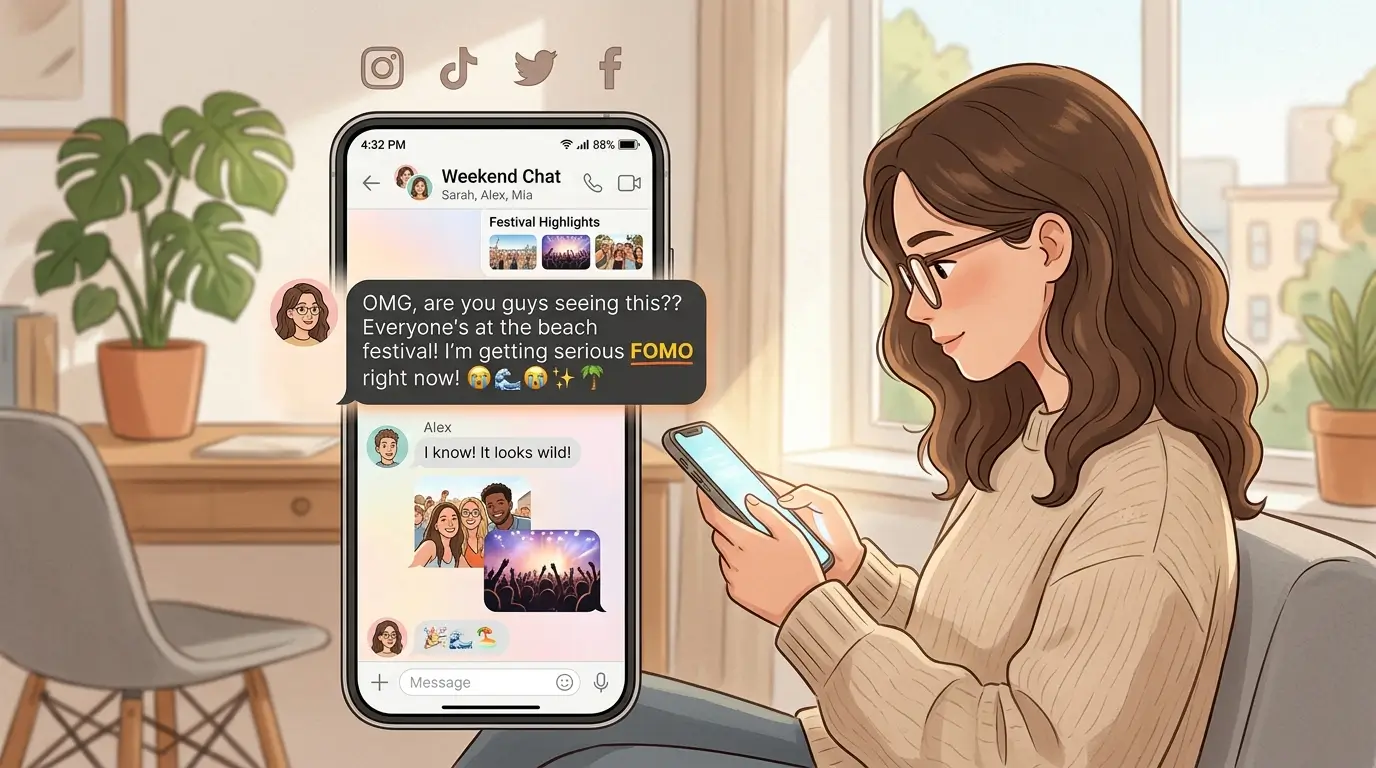
- “I had such bad FOMO watching everyone’s festival videos.”
- “Don’t let FOMO make you say yes to every single plan.”
- “She skipped the trip, and now she’s dealing with major FOMO.”
- “I get FOMO just scrolling through my feed sometimes.”
- “He canceled because of work, but the FOMO is real.”
- “I used to have FOMO, now I just enjoy staying home.”
- “That party looked wild, instant FOMO.”
- “We stayed in, but honestly zero FOMO tonight.”
- “My FOMO kicked in the second I saw those photos.”
- “Try not to let FOMO control your weekend plans.”
Text Message Examples
- “omg the concert looked amazing, huge FOMO rn“
- “u coming tonight? don’t want u catching FOMO later lol”
- “saw ur story, instant FOMO ngl”
- “no FOMO here, staying in bed all day”
- “Everyone’s at the beach, and I have the worst FOMO”
- “not gonna lie, low key FOMO seeing this group chat”
- “skip it, trust me, zero FOMO worthy”
- “my FOMO is through the roof rn”
- “don’t stress, nothing FOMO worthy happened lol”
- “Ugh, FOMO hitting hard after seeing those pics”
Social Media Caption Examples
- Instagram: “FOMO got me booking this trip in 5 minutes.”
- TikTok: “POV: your FOMO wins every single time.”
- X: ” The amount of FOMO I have rn watching this festival stream.”
- Threads: “No FOMO tonight, choosing sleep over everything.”
- Facebook: “Missed the reunion and the FOMO is real, see you all next year!”
- Instagram: “That FOMO feeling when your group chat is popping, and you’re at work.”
- TikTok: “FOMO check: did I really need to go? Yes.”
- X: “FOMO marketing got me again, bought it in 2 minutes.”
- Threads: “Choosing peace over FOMO this weekend.”
- Facebook: “Sorry we couldn’t make it, already feeling the FOMO from the photos.”
Is FOMO Meaning Slang Positive or Negative?
FOMO leans slightly negative because it describes an uncomfortable feeling, but it isn’t an insult and isn’t meant to hurt anyone. It’s more of a neutral, descriptive word similar to saying you’re “nervous” or “bored.”
It becomes negative when it drives someone to overspend, overcommit, or feel genuinely anxious about missing out on things. It can also be used lightly and jokingly, where it’s more playful than serious.
Misunderstandings are rare, but context matters; calling out someone else’s FOMO in a teasing way is usually fine among friends, though it can come across as dismissive if someone is genuinely struggling with it.
Who Uses This Slang?
FOMO is used across a wide age range, but it’s especially common among teens and young adults who grew up online. Gamers use it when talking about limited-time events or exclusive in-game items.
Marketers and business writers use it constantly when describing consumer behavior. Because it’s now a dictionary-recognized word, adults of all ages use it too, not just younger generations.
Similar Slang Words
| Slang | Meaning |
| YOLO | “You Only Live Once” used to justify taking a risk or doing something spontaneous. |
| FOBO | “Fear Of Better Options” hesitating to choose because something better might come along. |
| JOMO | “Joy of Missing Out” feeling content, not anxious, about skipping something. |
| Left on read | Being ignored after sending a message, sometimes tied to social exclusion. |
Opposite Words
- JOMO (Joy of Missing Out): Enjoying the choice to skip an event instead of feeling anxious about it.
- Contentment: A general sense of satisfaction that doesn’t involve comparing yourself to others.
- Peace with missing out: Not a formal slang term, but commonly used to describe the calm opposite of FOMO.
Common Mistakes
People sometimes misspell FOMO as “fomo” with random capitalization inconsistencies, or confuse it with unrelated acronyms that sound similar.
Others use it too broadly, applying it to any disappointment rather than the specific feeling of being excluded from something others are experiencing.
It’s also sometimes mistakenly treated as a rude or mocking term, when it’s really just a description of a common emotional response.
When NOT to Use FOMO Meaning Slang
FOMO doesn’t belong in professional emails, formal reports, school essays, or official business writing. In these settings, it can come across as too casual or unclear to readers who aren’t familiar with internet slang.
If you need to express the same idea formally, phrases like “concern about missing an opportunity” or “reluctance to be excluded” work better in professional contexts.
Fun Facts
- FOMO was added to the Oxford Dictionaries Online in 2013.
- The concept was discussed academically before the acronym became popular slang.
- FOMO is often studied alongside social media use and its effects on mental well-being.
- Marketers frequently use FOMO-based tactics, like countdown timers and low-stock alerts.
- JOMO (“Joy of Missing Out”) emerged later as a direct response to FOMO.
- FOMO applies to both real-life events and online trends.
Frequently Asked Questions
What does FOMO mean in texting?
In texting, FOMO means the same thing it does everywhere else: the fear of missing out. People text it as a quick, casual way to say they feel anxious, jealous, or left out after seeing something fun happening without them. It’s often paired with reactions to a friend’s story, photo, or update. Because texting favors short phrases, FOMO fits perfectly as a fast way to express a feeling that would otherwise take a full sentence to explain.
What is FOMO in Gen Z slang?
For Gen Z, FOMO isn’t really a “new” slang term anymore; it’s a normal part of everyday vocabulary, often used self-aware or jokingly rather than seriously. Gen Z tends to use it both to describe real anxiety about missing events and to poke fun at themselves for caring too much about being included. It’s commonly paired with other slang, like “no cap” or “lowkey,” in casual conversation.
Is FOMO an insult?
No, FOMO is not an insult. It’s a descriptive term for a feeling, similar to saying someone feels “anxious” or “left out.” Calling out someone’s FOMO is usually lighthearted, not meant to criticize or mock them. It only risks sounding dismissive if it’s used to brush off someone’s genuine feelings, but the word itself carries no negative or insulting intent.
What is FOMO and MOMO?
FOMO and “MOMO” aren’t a standard slang pairing. MOMO isn’t a widely recognized companion term to FOMO in the same family as JOMO or FOBO. If you’ve seen “MOMO” used online, it’s most likely referring to something unrelated, such as a name, character, or separate internet trend, rather than a direct counterpart to FOMO’s meaning.
Final Thoughts
FOMO has gone from a niche marketing term to one of the most recognizable pieces of modern slang. It captures something people have always felt: the worry of being left out, but gives it a name that fits perfectly into fast-paced texting and social media culture.
Whether you’re using it to describe skipping a party, watching a trend from the sidelines, or resisting a flash sale, FOMO says a lot in four letters.
It’s not an insult, it’s not overly formal, and it’s not going anywhere anytime soon. Just remember to save it for casual conversations, not professional ones.

James Carter is a slang researcher and writer at Slang Insight, dedicated to exploring the origins and meanings behind today’s most popular internet expressions. With a background in linguistics and a love for pop culture, James brings a unique perspective to every article, making slang easy to understand for everyone.