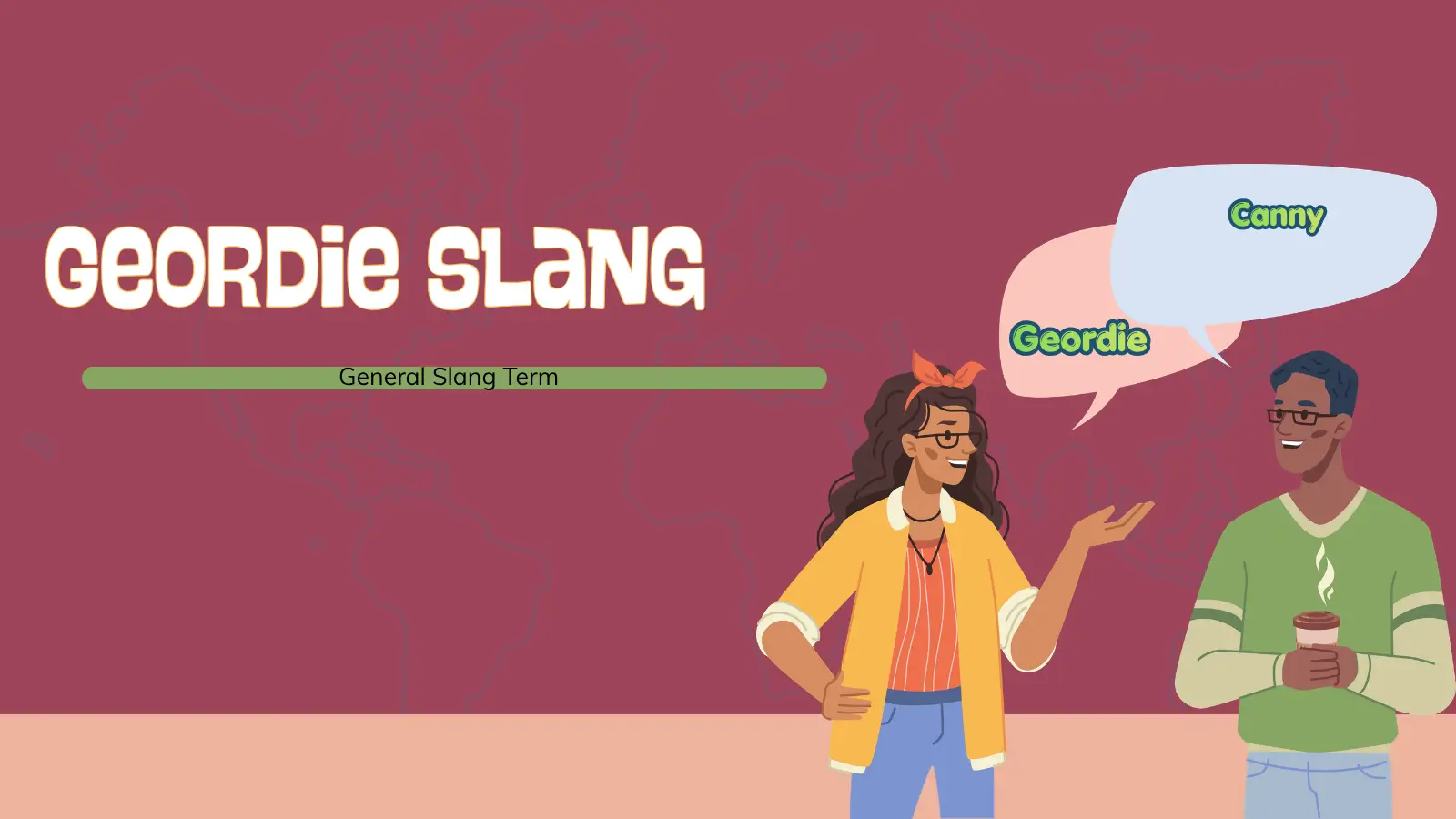
Geordie slang is the local dialect spoken in Newcastle upon Tyne and the surrounding North East England area.
It includes unique words such as “marra” (friend), “canny” (good or quiet), and “radgie” (angry or wild), along with a distinct accent that sets it apart from other British English dialects.
Key Takeaways
- Geordie slang comes from Newcastle upon Tyne and the wider North East of England.
- Many words have roots in Old English, Scandinavian languages, and local mining history.
- The dialect is still spoken daily by locals, not just used for jokes or TV shows.
- Most Geordie slang is friendly and warm, though a few words carry an edge.
- Shows like Geordie Shore introduced the accent to a wider audience, but the real dialect existed long before the show.
- Younger Geordies mix traditional slang with modern texting and social media language.
There are several reasons people look up “Geordie slang.”Some heard it on TV and got curious. Others are planning a trip to Newcastle and want to understand the locals. A few are just chatting online with someone from the North East and got stuck on a word they’d never seen before.
Geordie slang is the everyday speech of Newcastle upon Tyne and nearby towns like Gateshead, North Shields, and Sunderland. It’s not made up for entertainment. Real people use these words at the pub, at work, and at home, every single day.
The accent and vocabulary can catch outsiders off guard. A Geordie might call you “pet” as a term of warmth, tell you something is “canny good,” or ask if you’re “gannin doon toon” (going into town). None of that is rude. It’s just how people talk up there.
This guide breaks down the most common Geordie words and phrases, where they might have come from, and how people actually use them today. By the end, you’ll be able to follow a conversation with a Geordie without feeling lost.
What Does Geordie Slang Mean?
Geordie slang refers to the specific words, phrases, and pronunciations used by people from Newcastle upon Tyne and the surrounding Tyneside area. It’s a full dialect, not just a handful of odd words.
The term “Geordie” itself describes both the dialect and the people who speak it. A Geordie is someone from Newcastle or the wider North East region. The slang includes greetings, insults, terms of endearment, and everyday phrases that don’t always translate directly into standard English.
For example, “howay” means “come on” and gets used constantly if someone is hurrying a friend along or cheering on a football team. “Divvent” means “don’t.” These aren’t slang in the sense of trendy internet words. They’re part of a dialect with its own grammar patterns and pronunciation rules.
Quick Meaning Box
| Meaning | Simple Explanation |
| Regional dialect | The way people from Newcastle and North East England speak. |
| Local identity | Using it signals you’re from, or connected to, Tyneside. |
| Everyday speech | Used in normal conversation, not just for jokes. |
| Mix of old and new | Combines centuries-old words with modern slang. |
Pronunciation
“Geordie” is pronounced JOR-dee. The dialect itself has a sing-song rhythm that rises and falls more than standard British English. Vowel sounds often shift too. “Home” can sound closer to “hyem,” and “no” can come out as “nee” in certain phrases.
There’s no single phonetic spelling for the whole dialect since pronunciation varies even within Newcastle and its surrounding towns. Listening to real speakers, through interviews or videos, is the best way to pick up the actual sound.
Where Does Geordie Slang Come From?
Geordie slang comes from a long mix of Old English, Norse, and Scots influences that settled into the North East of England over centuries. The exact origin of the word “Geordie” itself is unclear, though several theories exist.
The North East of England was shaped by Anglo-Saxon settlers, Viking invaders, and its position near the Scottish border. This mix left a lasting mark on the local speech. Many Geordie words, like “bairn” for child, come from Old Norse rather than standard English roots.
The name “Geordie” is often linked to the common use of “George” as a name in the region, or to local support for King George during the Jacobite risings, but historians don’t agree on one single explanation. The North East’s coal mining industry also shaped the dialect, since pit communities developed their own shared vocabulary over generations.
Evolution of the Term
The Geordie dialect has been documented for centuries, evolving alongside Newcastle’s growth as an industrial and shipbuilding hub. Coal mining and shipyard work brought communities together in ways that reinforced a shared way of speaking.
Through the 1900s, the dialect stayed strong even as national media pushed a more standardized British accent. Local pride played a big role in keeping it alive. Rather than fading out, Geordie speech held its ground in schools, pubs, and homes across Tyneside.
In recent decades, the dialect saw a resurgence in mainstream attention thanks to television. Shows filmed in or about Newcastle introduced Geordie speech patterns to viewers who had never heard the accent before.
This didn’t create the dialect, but it did put a spotlight on it for a much wider audience.
How People Use It Today
Geordie slang is used in daily conversation, texting, and increasingly on social media platforms like TikTok and Instagram. It hasn’t been replaced by internet slang. Instead, the two often blend.
Younger Geordies text using standard abbreviations mixed with local words, so a message might include “lol” alongside “canny” or “marra.”
On TikTok, creators from Newcastle often lean into the accent and vocabulary in their videos, which has introduced terms like “radgie” and “howay” to viewers well outside North East England.
It’s less about a single platform driving the slang and more about the dialect naturally showing up wherever Geordies are talking, online or off.
Geordie Slang Words You Should Know
A solid list of Geordie slang words gives you a starting toolkit before diving into full phrases. Here are some of the most common ones:
- Bairn – a child
- Howay – come on
- Divvent – don’t
- Gan – go
- Netty – toilet
- Nowt – nothing
- Aye – yes
- Deek – to look at something
These words show up constantly in casual conversation. Learning them first makes it much easier to follow along when longer phrases come into play.
Geordie Slang Phrases for Everyday Talk
Geordie slang phrases often combine several dialect words into short, punchy expressions used constantly in daily life. Understanding a few key phrases makes real conversations much easier to follow.
“Gannin’ doon toon” means going into town, usually for a night out. “Whey aye” is an enthusiastic way of saying “yes, of course.”
“Divvent be foolish” means “don’t be silly.” These phrases carry the rhythm of the dialect better than single words alone, since Geordie speech often relies on tone and delivery just as much as vocabulary.
Geordie Slang Insults
Geordie slang insults tend to be blunt but are often said with more humor than real malice. Context and tone usually matter more than the word itself.
Calling someone a “divvy” suggests they’ve done something silly or clumsy, similar to calling someone a goof. “Radgie” can describe someone acting aggressively or out of control. These words can sting if said seriously, but among friends, they’re often thrown around jokingly. As with most regional slang, the relationship between the speaker and listener changes how an insult lands.
Geordie Slang for Friend
The most common Geordie slang for friend is “marra,” a warm, casual word used between mates in Newcastle and across the North East. It works the same way “mate” or “buddy” does elsewhere in the UK.
“Marra” gets used constantly, from greeting someone to closing out a conversation. “Alright, marra?” is a completely normal way to say hello to a friend. The word carries genuine warmth and is rarely used sarcastically, unlike some slang terms for friend used in other regions.
Canny Geordie Slang
“Canny” is one of the most flexible and widely used words in Geordie slang, meaning “good,” “nice,” or “quite/very” depending on context. It shows up constantly in everyday speech.
Someone might say a meal was “canny good,” meaning it was really good. Or they might describe a person as “canny,” meaning they’re likeable and down to earth. The flexibility of “canny” is part of what makes it such a defining feature of the dialect. It adjusts to fit almost any sentence.
Radgie Geordie Slang
“Radgie” describes someone who is acting angry, aggressive, or out of control, often in an unpredictable way. It can describe a person or a heated situation.
“He went radgie” means someone lost their temper or started acting wild. It’s not typically a compliment, though it can be used lightly depending on the situation, like describing a chaotic but harmless night out.
Tone and context decide if it’s a serious warning or just playful exaggeration.
Wor Geordie Slang
“Wor” is the Geordie way of saying “our,” commonly used before a family member’s name to show closeness, like “wor lass” for girlfriend or wife. It reflects the tight-knit, family-oriented feel of the dialect.
“Wor kid” often refers to a younger sibling, while “wor lass” or “wor fella” refers to a partner. The word adds a layer of familiarity and affection that “our” doesn’t quite capture in standard English. It’s a small word, but it says a lot about how Geordies talk about the people close to them.
Hinny Geordie Slang
“Hinny” is a gentle, affectionate term similar to “honey” or “dear,” often used by older generations toward people they care about. It’s considered one of the warmest words in the dialect.
You might hear an older Geordie say “aw, hinny” to a child, a grandchild, or even a stranger they’re being kind to. It’s less common among younger speakers today, but it still carries strong emotional weight when used.
Many people associate “hinny” with grandparents and older relatives specifically.
Haddaway Geordie Slang
“Haddaway” is an exclamation meaning “go away” or “you’re joking,” often used to express disbelief. It’s frequently paired with other words for extra emphasis.
The full phrase “haddaway and shite” is a stronger, more colorful way of telling someone you don’t believe them or that they’re talking nonsense. On its own, “haddaway” simply expresses surprise or disbelief, similar to saying “no way” in standard English. It’s one of the more instantly recognizable Geordie exclamations.
Geordie Shore Slang
Geordie Shore, a reality TV show set in Newcastle, introduced many viewers outside the UK to the Geordie accent and some of its slang, though the dialect existed long before the show aired. The show didn’t invent the words, but it did spread awareness of them.
Viewers picked up on cast members using words like “canny” and “radgie” in casual conversation on screen.
This gave many people their first real exposure to the dialect. It’s worth noting the show represents one slice of Geordie culture and speech, mainly centered on nightlife and young adult social life, rather than the full range of how the dialect is used across all ages in the North East.
Comparison Table: Words Often Confused
| Term | Meaning | Key Difference |
| Canny | Good, nice, or quite/very | Positive and flexible, used to describe things or intensify statements. |
| Radgie | Angry, wild, aggressive | Negative or chaotic energy, describes a mood or behavior. |
| Hinny | A gentle term of endearment | Affectionate, typically used by older generations. |
| Marra | Friend or mate | Neutral to positive, used as a greeting or friendly term. |
Examples in Everyday Conversation
- “Alright, marra? You gannin doon toon later?”
- “That pie was canny good, man.”
- “Divvent be ignorant, of course I’ll help ye.”
- “He went proper radgie when the ref made that call.”
- “Aw, hinny, come and sit doon by the fire.”
- “Haddaway, you’re never 25, you look about 18.”
- “Wor lass is working late the night.”
- “I’m gannin to the netty, back in a sec.”
- “Nowt much happening the day, just chillin’.”
- “Whey aye, I’d love a cup of tea.”
Text Message Examples
- “howay we’re gonna be late lol”
- “canny night last night”
- “wor kid’s driving me to aggravate today”
- “u alright marra? haven’t heard from ye”
- “divvent forget ur jacket, it’s freezing”
- “haddaway lol no way that happened”
- “gannin toon later if ur free”
- “that film was canny good ngl”
- “he’s proper radgie today, avoid him lol”
- “nowt planned tonight, wbu?”
Social Media Caption Examples
- Instagram: “Canny night with the best marras”
- TikTok: “POV: your nana calls you hinny for the 100th time today”
- X: “Wor lass just beat me at darts again”
- Threads: “Haddaway, this weather is actually mental”
- Facebook: “Gannin doon toon this weekend, who’s in?”
- Instagram: “Radgie weather today, stay in and stay warm”
- TikTok: “Explaining Geordie slang to my mates who aren’t from Newcastle”
- X: “Divvent even ask me about today, absolute chaos”
- Facebook: “Nowt beats a Sunday dinner with the family”
- Threads: “Canny catch up with old friends this weekend”
Is It Positive or Negative?
Most Geordie slang carries a warm, friendly tone, though a handful of words can turn negative depending on context and delivery. Words like “hinny,” “marra,” and “canny” almost always come across as kind or affectionate.
Others, like “radgie” or “divvy,” lean negative when used seriously, describing anger or foolishness. The same word can flip meaning based on tone. A friend calling you a “divvy” while laughing is very different from a stranger saying it in an argument. Outsiders sometimes misread the bluntness of Geordie speech as rudeness, when it’s often just directness paired with a strong regional accent.
Who Uses This Slang?
Geordie slang is used across all age groups in Newcastle and the North East, though certain words are more common among older or younger speakers.
Teenagers might lean more on modern hybrid phrases mixed with texting slang, while older generations use classic terms like “hinny” and “bairn” more consistently.
People outside the dialect’s home region, including fans of Geordie Shore or visitors to Newcastle, sometimes adopt a few words casually without using the full dialect. Locally, though, this isn’t limited to any one group. It’s simply how people from the region talk, regardless of age, job, or background.
Similar Slang Words
| Slang | Meaning |
| Ket | Sweets or candy |
| Shan | Unfair or disappointing |
| Pet | Friendly term of address, similar to “dear” |
| Way aye man | Emphatic way of saying “yes, obviously” |
Opposite Words
- Radgie vs. Canny – “Radgie” describes chaotic or angry energy, while “canny” describes something good or pleasant, making them near opposites in tone.
- Shan vs. Canny – “Shan” means unfair or rubbish, the opposite of describing something as good or “canny.”
- Divvent vs. Aye – “Divvent” means “don’t,” directly opposing “aye,” which means “yes.”
Common Mistakes
People often misuse “canny” by assuming it always means “good,” when it can also mean “quite” or “very” depending on the sentence. Another common mistake is spelling “howay” as “how way,” splitting it into two words when it’s meant to be one.
Some people also assume all Geordie slang is rude or aggressive because of words like “radgie,” missing that most of the dialect is actually warm and friendly. Mixing up “marra” and “hinny” is common too.
“Marra” is for friends, while “hinny” leans toward affectionate, often used by older generations toward younger people or loved ones.
When NOT to Use It
Geordie slang isn’t a good fit for professional emails, formal business meetings, or academic writing, since it can come across as too casual or be misunderstood outside the region. Clear, standard English is safer in these settings.
Using words like “howay” or “marra” in a job interview or client email risks confusion, especially if the other person has no familiarity with the dialect.
Formal writing generally calls for universally understood language rather than regional expressions. Save the slang for texts, casual chats, and conversations with people who’ll actually get it.
Fun Facts
- The word “Geordie” refers to both the dialect and the people from Newcastle and the North East.
- “Howay” is used both as encouragement and as a way to hurry someone along.
- Many Geordie words have roots in Old Norse due to Viking settlement in northern England.
- The Geordie accent is often ranked among the most recognizable regional accents in the UK.
- Coal mining communities historically helped preserve and shape parts of the dialect.
- Newcastle’s shipbuilding history also influenced local vocabulary and community identity.
Frequently Asked Questions
How do you say “I love you” in Geordie?
There isn’t one official Geordie translation for “I love you,” since the dialect doesn’t have a fixed romantic phrase separate from standard English. Most Geordies simply say “I love you” the same way anyone else would, though affection often gets expressed through warmer everyday words like “hinny” or “pet” rather than a direct translated phrase. The dialect leans more on tone and terms of endearment than on formal romantic expressions.
Why do they call them Geordies?
The exact origin of the name “Geordie” is unclear, and historians don’t agree on one single explanation. Some theories connect it to the common local use of the name “George,” while others link it to regional support for a King George during historical conflicts. Because there’s no confirmed record settling the debate, it’s most accurate to say the true origin remains uncertain rather than pointing to one definite story.
How do you say “hi” in Geordie?
A common way to greet someone in Geordie is “Alright?” often followed by a name or “marra,” as in “Alright, marra?” Another friendly greeting is “Now then,” which works similarly to “hey” or “what’s up.” These greetings are casual and typically expect a short, equally casual response rather than a long conversation.
Why do Geordies say hinny?
“Hinny” is used as a warm, affectionate term similar to “honey” or “dear,” often passed down through older generations. It reflects the caring, community-focused tone found throughout much of the dialect. While it’s used less frequently among younger Geordies today, it remains a recognizable and beloved part of North East speech, especially from grandparents, parents, and older community members toward people they care about.
Is Geordie slang the same as Scottish slang?
No, Geordie slang and Scottish slang are different, even though both regions share some historical influences and border proximity. Geordie is specific to Newcastle and the North East of England, while Scottish slang varies across different parts of Scotland. Some words sound similar due to shared Norse and Old English roots, but the dialects developed separately and aren’t interchangeable.
Final Thoughts
Geordie slang is a living, everyday dialect, not a gimmick or a TV trend. It’s shaped by centuries of history, from Viking settlers to coal mining communities, and it’s still spoken with pride across Newcastle and the North East today.
Once you know a few key words like “marra,” “canny,” and “howay,” conversations with Geordies become much easier to follow.
The dialect carries warmth, humor, and a strong sense of local identity that outsiders often grow to appreciate once they understand it.
If you’re visiting Newcastle, chatting with a Geordie online, or just curious about UK regional slang, this dialect is worth getting to know.

Emily Rodriguez is a content creator and editor at Slang Insight, specializing in Gen Z language trends and social media culture. Emily’s mission is to help readers stay updated with the latest slang so they never feel out of the loop in online conversations.