London slang means the mix of everyday words and phrases used by people in London, England. It covers Cockney rhyming slang, modern “roadman” terms from London’s youth culture, and regional expressions from areas like south, east, north, and west London.
It’s used in speech, texting, and online.
Key Takeaways
- London slang isn’t one single dialect; it’s a blend of old Cockney rhyming slang and newer street/roadman slang.
- Cockney rhyming slang dates back to the 1800s in London’s East End.
- Roadman slang grew out of London’s youth and music scenes in the 2000s and 2010s.
- It’s still widely used today, especially by younger Londoners, in music, and online.
- Tone is mostly neutral to friendly, though some terms sound harsher out of context.
- Different parts of London (south, east, north, west) have their own slang flavor.
London slang refers to the informal words, phrases, and expressions people use in everyday conversations across the capital.
Terms can vary by age, neighborhood, and social group, with some expressions carrying long-standing local roots while others gain popularity through music, entertainment, and online communication.
Common London slang can appear in casual conversations, text messages, songs, TV shows, and social media. Understanding these expressions can make British dialogue easier to follow and help explain words that may sound unfamiliar outside London.
Some terms have specific meanings, while others change depending on the context or the way someone says them. From traditional London expressions to newer vocabulary used by younger speakers, the language reflects the city’s diverse communities and evolving culture.
Learning the meanings, origins, and everyday uses of these terms gives you a clearer picture of how Londoners communicate in casual settings.
What Does London Slang Mean?
London slang is a catch-all term for the informal words and expressions used by people living in or from London. It includes several different slang traditions layered on top of each other.
The two biggest branches are Cockney rhyming slang, which is older and tied to East London, and roadman slang, which is newer and tied to youth culture across the city.
There’s also general British slang that Londoners use just like anyone else in the UK, plus local expressions specific to certain boroughs.
Because London is such a big, diverse city, “London slang” isn’t fixed. A phrase common in Peckham might be unfamiliar in Camden. That said, some terms have spread so widely through music and social media that most Londoners and increasingly people outside London recognize them.
Quick Meaning Box
| Meaning | Simple Explanation |
| Cockney rhyming slang | Traditional East London slang where a phrase rhymes with the real word (e.g., “dog and bone” = phone) |
| Roadman slang | Modern street slang from London youth culture, often linked to UK drill and grime music. |
| Regional London slang | Words and phrases specific to south, east, north, or west London. |
| General British slang | Everyday informal words used across the UK, also common in London. |
Pronunciation
“London slang” is pronounced the way it looks: LUN-duhn slang. There’s no tricky pronunciation for the phrase itself.
The tricky part is usually the individual slang words inside it, many of which have their own unique sound shaped by London accents like Cockney or Multicultural London English (MLE).
Where Does London Slang Come From?
London slang comes from several different sources layered over nearly two centuries. Cockney rhyming slang started in the East End in the 1800s, and roadman slang developed much more recently out of London’s diverse youth communities.
Cockney rhyming slang is the oldest and most famous piece of the puzzle. It’s believed to have started among working-class communities in East London in the 19th century.
The exact origin is unclear, but one common theory is that it worked as a kind of in-group code, letting people talk without outsiders, including police, easily understanding them.
Roadman slang is much newer. It grew out of London’s multicultural youth culture, drawing on Multicultural London English, Jamaican Patois, and other influences from communities across the city.
Its rise is closely tied to UK grime and drill music from the 2000s onward, which carried the slang far beyond London itself.
Evolution of the Term
Cockney rhyming slang spread slowly through the 19th and 20th centuries, mostly through spoken tradition in East London markets, pubs, and working-class neighborhoods. Terms like “trouble and strife” (wife) or “plates of meat” (feet) became well known enough that some entered everyday British English, even outside London.
Roadman slang has had a much faster rise. It moved from local youth culture into mainstream awareness largely through grime and UK drill music in the 2010s. Artists rapping in their own slang exposed it to national and international audiences. Social media accelerated this even further, with platforms helping non-Londoners pick up terms almost as fast as they trend.
Both branches are still evolving. Cockney rhyming slang has become more of a cultural novelty for many younger Londoners, while roadman slang continues to shift and add new terms regularly.
How People Use It Today
London slang today lives mostly in speech, music lyrics, and text messages, with heavy crossover onto TikTok, Instagram, and X. Roadman slang in particular spreads fast through short-form video and music clips.
On TikTok and Instagram, London slang terms often appear in captions, comments, and voiceovers, especially in content made by or about young Londoners. On X, it shows up in casual posts and replies. In texting between friends, London slang is used naturally, the same way any group of friends develops their own shorthand.
Cockney rhyming slang shows up less in daily use now and more in a “fun fact” or nostalgic way, people bringing it up because it’s a known part of London’s identity, not necessarily because they use it constantly.
London Slang Words and London Slang Phrases
London slang words and phrases range from single terms to full expressions with their own meaning. Some are one word (“peak,” “ends”), while others are multi-word phrases (“say less,” “on road”).
Common London slang words include terms for people, places, and feelings that don’t map neatly onto standard English. Phrases often act like idioms; you can’t guess the meaning just from the individual words.
Learning London slang usually means learning it in context, through hearing it used rather than memorizing a dictionary definition.
London Slang Roadman
Roadman slang refers to the specific slang associated with “road culture” in London, the street-level youth culture connected to certain neighborhoods, music scenes, and social groups.
A “roadman” originally described someone deeply embedded in that street life, though the term has broadened.
Roadman slang includes words for money, people, places, and situations, and it’s the fastest-changing branch of London slang. It draws heavily from Jamaican Patois, West African languages spoken by London’s diaspora communities, and Multicultural London English.
London Slang for Money
Money has its own slang across London, much of it inherited from Cockney rhyming slang and roadman culture combined. Common terms include “pony” (£25), “score” (£20), “ton” (£100), and “bag” or “band” (£1,000 in roadman slang), among others.
These terms often show up in casual conversation about prices, wages, or spending, and they’re common in UK drill lyrics discussing money and lifestyle.
South London Slang
South London has its own slang flavor, shaped heavily by areas like Brixton, Peckham, and Croydon. It leans strongly into roadman and Caribbean-influenced terms, reflecting the area’s large Afro-Caribbean communities.
Some slang associated with South London has become widely known across the whole city and beyond, thanks to South London’s strong presence in UK music scenes.
East London Slang
East London is the historic home of Cockney rhyming slang, tied to areas like the East End, Bow, and Whitechapel. It’s the birthplace of the older, more traditional side of London slang.
East London has also become a hub for newer youth slang, especially in areas with large immigrant communities, blending old Cockney influence with more modern street slang.
North London Slang
North London slang overlaps a lot with general roadman and youth slang, without a single defining feature the way Cockney is tied to the East End. Areas like Tottenham and Hackney (often grouped with north or northeast London) have strong associations with grime music, which shaped a lot of shared London youth slang.
There isn’t one clearly separate “north London” slang vocabulary; most of it overlaps with citywide roadman slang.
The Ends (London Slang)
“The ends” is a widely used piece of roadman slang meaning someone’s local area or neighborhood, where they grew up or where they’re from. Saying “I’m from the ends” means “I’m from my local area.”
It’s one of the most recognizable pieces of London roadman slang, often used with pride to describe home turf.
London Rhyming Slang
London rhyming slang, more properly called Cockney rhyming slang, replaces a common word with a phrase that rhymes with it, then often drops the rhyming part entirely. For example, “plates” (short for “plates of meat”) means feet.
This is the most structured and rule-based type of London slang, following the same rhyming pattern across all its terms, unlike the looser, always-shifting roadman slang.
London Cockney Slang
Cockney slang traditionally refers to the dialect and slang of working-class East Londoners, especially those “born within earshot of Bow Bells” in East London. It includes rhyming slang, but also unique pronunciation and grammar patterns.
Cockney slang is closely tied to London identity in popular culture, even for people who don’t use it in daily speech anymore.
Examples in Everyday Conversation
- “You coming to the ends later or nah?”
- “That jacket’s peak, I actually love it.”
- “Lend us a pony till Friday, yeah?”
- “He’s proper roadman, always on about the streets.”
- “Say less, I’ll meet you there at six.”
- “I had to use my plates to get here, no bus.”
- “She’s got the gift of the gab, don’t get into a debate with her.”
- “That’s mad ends for a coffee, innit.”
- “We’re just chilling on road, nothing major.”
- “Trust me, that place is bait, everyone knows about it.”
Text Message Examples
- “omw, on the ends now”
- “that test was peak fr”
- “can u lend me a pony till payday”
- “he’s acting proper roadman lol”
- “Say less, see u at 6″
- “No bus so had to use my plates lol”
- “she’s always got the gift of the gab”
- “mad ends for that phone case tbh”
- “Just on road, nothing much”
- “Everyone knows that spot, it’s bait”
Social Media Caption Examples
- Instagram: “Back on the ends.”
- TikTok: “when your mate says it’s not that deep, but it’s peak.”
- X: “£25 for parking?? That’s a pony gone just like that.”
- Instagram: “proper roadman energy today.”
- TikTok: “say less, we’re going.”
- Threads: “had to use my own two plates to get home lol.”
- Facebook: “always got the gift of the gab, that one.”
- X: “mad ends just to get a coffee in this city.”
- Instagram: “just on road with the crew.”
- TikTok: “that place is so bait now, everyone’s been.”
Is It Positive or Negative?
London slang, as a whole, is mostly neutral to positive in tone. Most terms are simply casual, everyday ways of describing people, places, money, or feelings, not insults.
Some individual words can sound harsher out of context. “Roadman,” for example, can be used descriptively or as a mild insult depending on tone and relationship between speakers. Context and delivery matter a lot.
Among friends, London slang usually reads as friendly and normal. Used by an outsider trying too hard, it can come across as awkward or forced.
Who Uses This Slang?
London slang, especially roadman slang, is used most by teenagers and young adults, particularly those connected to London’s youth, music, and street culture. Cockney rhyming slang skews older and is more associated with traditional East End communities and older generations.
Musicians in grime and UK drill have played a huge role in spreading roadman slang nationally and internationally.
Gamers and online creators from London also carry the slang into gaming chat and streaming content, where it’s picked up by fans outside London too.
Similar Slang Words
| Slang | Meaning |
| Peak | Bad, unfortunate, or annoying. |
| Ends | Neighborhood or local area. |
| Bait | Obvious, well-known, or risky to do. |
| Say less | Understood, no need to explain further. |
| On road | Out and about, involved in street life. |
| Pony | £25 |
| Ton | £100 |
Opposite Words
- Peak (bad) vs. peng (attractive or good quality) opposite ends of the “good vs bad” scale in slang use.
- Say less (fully understood) vs. “explain that again” the opposite of needing no further explanation.
- Bait (obvious/known) vs. “low-key” (kept quiet or hidden) opposite levels of visibility.
Common Mistakes
People often mix up Cockney rhyming slang with roadman slang, treating them as the same thing when they come from very different eras and communities. Another common mistake is assuming all London slang is used citywide; a lot of it is specific to certain boroughs or communities, not universal.
Spelling errors are common too, especially with roadman terms that don’t have one “official” spelling since they started as spoken slang.
Using a term in the wrong context, like using “roadman” as a compliment when it wasn’t meant that way, is another frequent misstep for people newer to the slang.
When NOT to Use It
London slang should be avoided in professional emails, job interviews, school assignments, and formal writing.
It reads as too casual and can come across as unprofessional or confusing to readers who aren’t familiar with it.
In business meetings or customer service situations, standard English is safer and clearer. Slang terms can also be misunderstood or seen as inappropriate depending on the audience, especially formal or older audiences unfamiliar with newer roadman terms.
Fun Facts
- Cockney rhyming slang is believed to date back to the 1800s in London’s East End.
- Traditionally, a “true” Cockney is someone born within earshot of the Bow Bells church in East London.
- Some Cockney rhyming slang terms, like “porkies” (short for “pork pies,” meaning lies), are used in everyday British English far beyond London.
- UK grime and drill music have been major forces in spreading roadman slang nationally and internationally.
- Roadman slang draws influence from Jamaican Patois and West African languages spoken in London’s diaspora communities.
- London slang varies noticeably by borough, with south, east, north, and west London each having their own flavor.
Frequently Asked Questions
What are 100 common British slang words?
There are far too many to list here, but common British slang spans money terms (“quid,” “fiver”), feelings (“gutted,” “chuffed”), people (“mate,” “bloke”), and reactions (“mint,” “rubbish”). Many British slang words are used nationwide, not just in London, while London adds its own layer through Cockney rhyming slang and roadman terms. For a full breakdown, a dedicated British slang glossary is a better resource than trying to fit 100 terms into one answer here.
What is a slang term for London?
Londoners sometimes call their city “the Smoke” or “the Big Smoke,” a nickname referencing the city’s historic fog and industrial pollution. It’s an affectionate, old-fashioned nickname still recognized today, even though it’s used less often in casual daily speech than it once was.
How do you say “OK” in the UK?
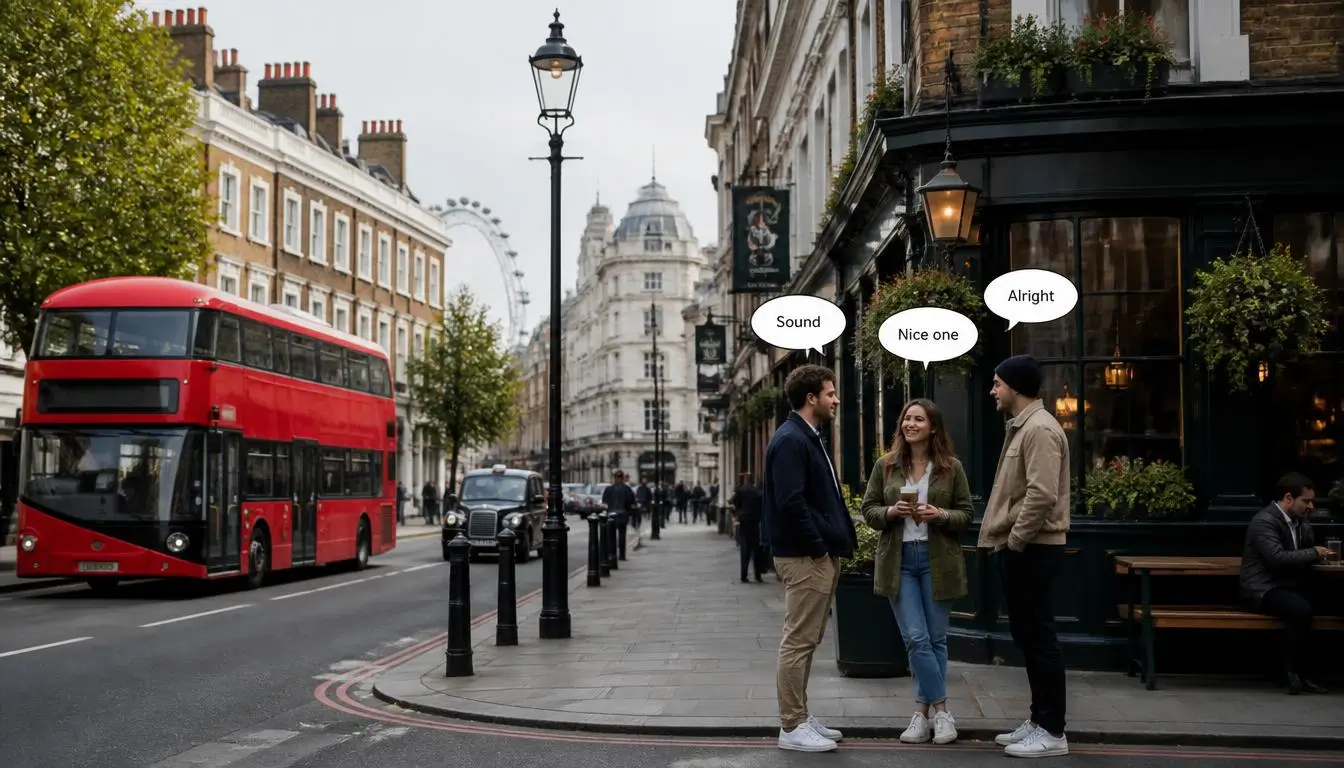
In the UK, “OK” is often said as “alright,” “sound,” “sweet,” or “cool,” depending on the region and age group. In London specifically, “say less” or “bless” sometimes gets used in a similar agreeing way, though they’re not exact one-to-one swaps for “OK”; they carry slightly different shades of meaning.
What are some funny UK slang words?
UK slang has plenty of words that make people laugh the first time they hear them, like “gobsmacked” (shocked), “knackered” (exhausted), “chinwag” (a chat), and “faff” (to waste time). These aren’t specifically London terms, but they’re widely used across the UK, including in London, and often surprise people outside Britain with how different they sound from American English.
Final Thoughts
London slang isn’t one fixed thing; it’s a living mix of old Cockney rhyming slang and constantly changing roadman terms, shaped by different neighborhoods and communities across the city.
Understanding it means understanding that context, area, and generation all change what a word means and how it’s used.
If you’re trying to keep up with a song lyric, a friend’s text, or just want to sound a bit more clued-up on a trip to London, the terms in this guide cover the core of what you’ll actually hear.
Slang moves fast, so treat this as a solid starting point rather than the final word; new terms will keep showing up as London’s culture keeps evolving.

Sarah Mitchell is a content writer at Slang Insight, passionate about internet culture, trending phrases, and the ever-changing world of digital communication. With a keen eye for spotting new slang before it goes viral, Sarah loves breaking down complex expressions into simple, relatable explanations for readers of all ages.