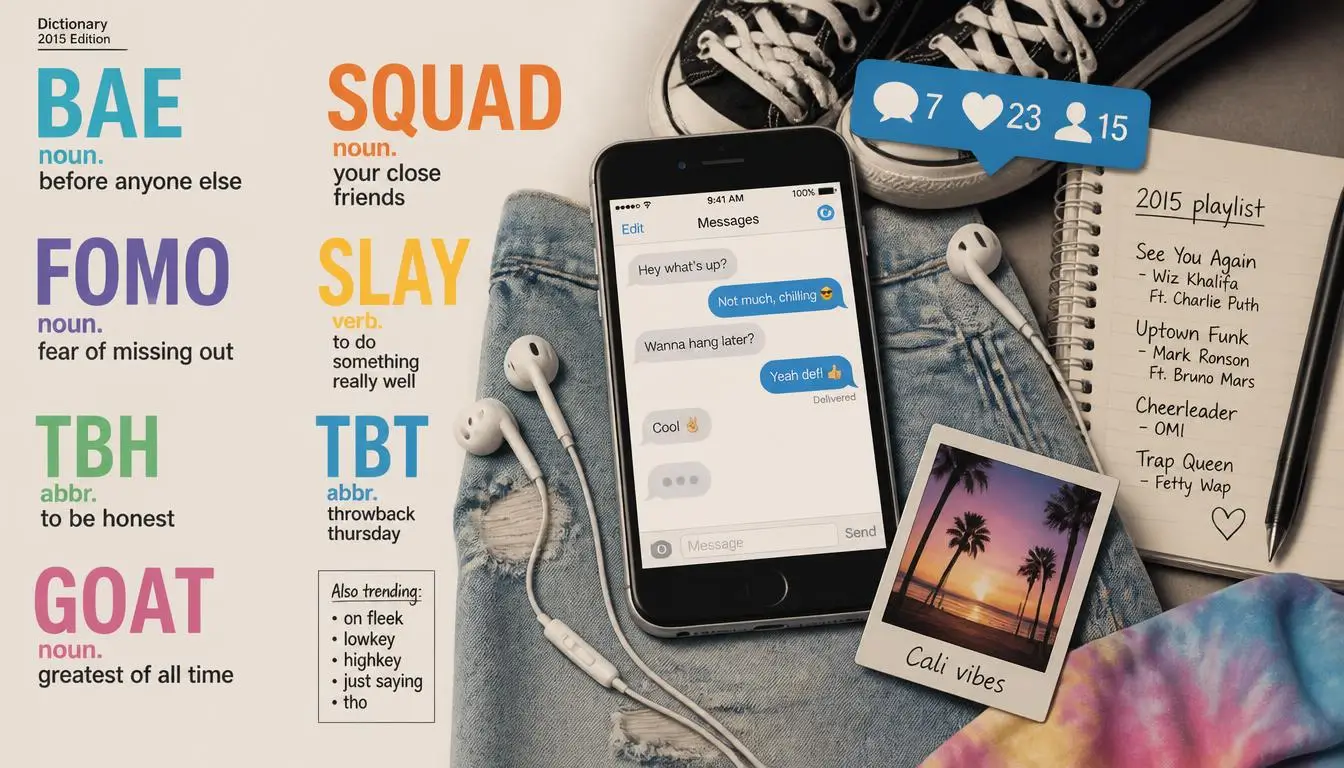
2015 slang decoded means breaking down the popular words and phrases people used that year, like “on fleek,” “bae,” “turnt,” and “squad goals,” into plain meanings anyone can understand.
Most of these terms came from social media and hip-hop culture, and a few, like “bae,” are still used today.
Key Takeaways
- 2015 was a huge year for internet-born slang, especially from Vine, Twitter, and Instagram.
- Many terms centered on friendship, appearance, and confidence (“on fleek,” “squad goals”).
- Black culture and AAVE shaped a large share of the year’s biggest slang.
- Some words faded fast, while others (“bae,” “lit,” “salty”) stuck around for years.
- Most 2015 slang was playful and positive, though a few terms could sound dismissive out of context.
- Tone ranges from affectionate to sarcastic depending on the word and how it’s said.
If you scroll through old tweets, texts, or captions from 2015, you’ll probably hit a word that stops you cold. Maybe it’s “on fleek.” Maybe it’s “turnt.” Someone called their friend group “squad goals” for the tenth time that week.
People search for 2015 slang decoded because that year sits in an odd spot. It’s not old enough to feel like ancient internet history, but it’s far enough back that plenty of the phrases have quietly disappeared from everyday texting.
Parents scrolling through their kid’s old posts, younger people discovering throwback memes, and writers working on 2010s nostalgia content all end up here looking for a plain-English guide.
You’ll run into this slang most often on old social media posts, meme compilations, “2015 vs now” videos, and nostalgia threads. A handful of these words, like bae and lit, never really left. Others, like “on fleek,” had their moment and then mostly became a punchline.
This guide walks through what these words meant, where they likely came from, and how people used them without guessing at facts that can’t be confirmed.
What Does 2015 Slang Decoded Mean?
2015 slang decoded simply means explaining the year’s most popular slang terms in clear, everyday language. It covers what each word meant, how it was used, and if people still say it now.
The phrase itself isn’t slang; it’s a descriptive label people search for when they want a translation guide. 2015 landed in the middle of a fast-moving stretch of internet culture, right as Vine and Instagram were shaping how teens and young adults talked online.
Words spread fast through short videos, memes, and viral tweets, then either stuck around or vanished within a year or two.
Some of the most talked-about terms from that year include on fleek, bae, squad goals, turnt, lit, basic, salty, and receipts. Each carried its own tone, from complimentary to teasing to outright shady, depending on context.
Quick Meaning Box
| Meaning | Simple Explanation |
| On fleek | Looking perfect, especially eyebrows or an outfit. |
| Bae | A romantic partner or someone you really care about. |
| Squad goals | A friend group that looks admirable or enviable. |
| Turnt | Excited, hyped up, or having a wild time. |
| Lit | Exciting, fun, or impressive. |
| Basic | Predictable or unoriginal, often about taste in trends. |
| Salty | Bitter or annoyed about something small. |
| Receipts | Proof or evidence, usually screenshots, backing up a claim. |
Pronunciation
Most 2015 slang uses everyday English pronunciation, so there’s little confusion there. A few worth noting:
- On fleek: “on fleek” (rhymes with “leek”)
- Bae: “bay”
- Turnt: “turnt,” rhymes with “burnt”
- Lit: pronounced just like the word “lit” (past tense of “light”)
Where Does 2015 Slang Decoded Come From?
Most of 2015’s defining slang grew out of Black culture and AAVE (African American Vernacular English), then spread through Vine, Twitter, and Instagram before reaching a much wider, mainstream audience.
The exact origin of individual terms is often unclear, since slang usually spreads informally before anyone tracks it.
“On fleek” is a good example. It’s widely believed to have taken off after a June 2014 Vine video, and it exploded further into mainstream use through 2015. The exact origin is unclear beyond that video’s role in popularizing it.
“Bae” had already been used for years in Black communities before it became a mainstream buzzword around 2013 to 2015, with some linking it loosely to “babe,” though that connection isn’t fully confirmed.
“Turnt” and “lit” both trace back to hip-hop and party culture, gaining wider traction as music and social media pushed them into general teen vocabulary.
Vine deserves particular credit here. The short-video app was a major slang incubator in 2013 through 2016, turning catchphrases into instant, repeatable memes.
History of the Term
Slang doesn’t arrive overnight, and 2015’s biggest words followed a familiar pattern: quiet growth in specific communities, a viral moment, mainstream adoption, then overuse and eventual decline for some terms.
By early 2015, “on fleek” and “squad goals” were everywhere, from Twitter jokes to brand marketing trying to sound relevant.
By 2016 and 2017, both terms had become so overused that using them sincerely started to feel dated, and they shifted into ironic or nostalgic use.
“Bae,” “lit,” and “salty” had more staying power. They didn’t disappear so much as blend into everyday casual English, especially in texting and social captions, where they’re still recognizable today even if they no longer feel new.
How People Use It Today
Today, most 2015 slang shows up ironically, nostalgically, or in throwback content rather than as fresh vocabulary. TikTok nostalgia videos, “tell me you’re a 2015 kid without telling me” trends, and old-photo captions are common places to spot it now.
Words like “bae,” “lit,” and “salty” are the exceptions; they’re still used casually in texts and captions on Instagram and X without feeling like a throwback.
“On fleek” and “squad goals,” on the other hand, mostly appear now as a joke or a deliberate callback to that era.
2015 Slang Meaning
The core meaning of most 2015 slang centered on confidence, friendship, and reaction, describing how something looked, felt, or hit emotionally.
Terms like “on fleek” praised appearance, “squad goals” praised friendship, and “lit” praised an experience or event.
Understanding the meaning behind each term matters because slang from this period often gets misused today by people trying to sound retro without knowing the original context, which can come across as forced or off.
2015 Slang
2015 slang refers to the specific set of words and phrases that gained popularity that year, largely through social media and hip-hop influence.
It’s considered part of the broader “2010s slang” era, sitting between early Twitter-driven slang and the TikTok-driven slang that came later.
This year is often treated as a turning point, since it marked one of the last major slang waves driven primarily by Vine and Twitter before Snapchat and, eventually, TikTok reshaped how slang spread.
2015 Text Slang
2015 text slang leaned heavily on abbreviations and short reactions built for fast typing, like “tbh” (to be honest), “ngl” (not gonna lie), and “fam” (close friend or friend group). These weren’t new in 2015, but they were extremely common in texting and comment sections that year.
Texting slang from this period tended to be shorter and more functional than caption-style slang like “on fleek,” since it was built for quick back-and-forth conversation rather than a single punchy statement.
2015 Slang Words
Beyond the words already covered, other notable 2015 slang words include “extra” (over-the-top or dramatic), “shade” (a subtle insult), “goals” used alone, and “af” (as f***, meaning “very”). Each of these added to the same general vocabulary of reaction, judgment, and hype that defined the year.
Together, these words gave people a shorthand for expressing strong opinions quickly, If that was admiration, annoyance, or excitement.
Common Slangs PDF
People searching for a “common slangs PDF” are usually looking for a downloadable, all-in-one slang reference sheet.
While this article doesn’t include a downloadable file, everything on this page meanings, pronunciation, examples, and opposites is written to work as a standalone reference you can screenshot or save for later.
If you’re building your own study sheet or slang glossary, the Quick Meaning Box and Similar Slang Words table further down are the easiest sections to save as a quick-reference list.
What Is Slang in Sociolinguistics
In sociolinguistics, slang is defined as informal, nonstandard vocabulary used by a specific group to signal identity, belonging, or attitude, often shifting quickly over time. 2015’s slang fits this definition closely, since terms like “on fleek” and “squad goals” functioned as identity markers for young, internet-savvy speakers.
Sociolinguists often study slang because it reveals how language spreads through social networks rather than formal institutions. The rapid rise and fall of 2015’s biggest terms is a clear real-world example of that pattern in action.
Examples in Everyday Conversation
- “Your eyebrows are on fleek today.”
- “He’s my bae, we’ve been together a year.”
- “This party is so turnt right now.”
- “That concert was lit.”
- “Don’t be salty just because you lost.”
- “Ugh, she’s so basic, always the same order.”
- “I’ve got receipts, check my messages.”
- “My squad goals are honestly unmatched.”
- “Tbh, I didn’t even like the movie.”
- “That outfit is extra, but I love it.”
Text Message Examples
- “omg your hair is on fleek.”
- “Bae, wyd tonight?”
- “party was mad turnt last night.”
- “ngl that test was lit hard.”
- “why u so salty lol.”
- “she’s basic, but she’s nice.”
- “got receipts, sending screenshots rn.”
- “us three = squad goals fr.”
- “tbh this show is boring.”
- “That’s extra af lol”
Social Media Caption Examples
- Instagram: “Brows on fleek, confidence higher.”
- TikTok: “POV: it’s 2015, and everything is lit.”
- X: “bae just surprised me, and I’m shook.”
- Instagram: “Squad goals, no cap.”
- Threads: “Feeling salty about this weather.”
- TikTok: “Tell me you’re basic without telling me.”
- X: “Got the receipts, don’t test me.”
- Facebook: “Turnt at my cousin’s wedding lol.”
- Instagram: “Extra but make it fashion.”
- TikTok: “2015 me would be shook rn.”
Is It Positive or Negative?
Most 2015 slang leans positive or playful, though a few terms can turn negative depending on tone and delivery. “On fleek,” “bae,” “lit,” and “squad goals” are usually compliments or hype words.
“Basic” and “salty” carry more bite. “Basic” gently mocks someone for being unoriginal, and “salty” pokes fun at someone for being bitter over something small. Neither is meant to be cruel, but both can sting if said seriously instead of jokingly. Misunderstandings usually happen when tone doesn’t come across clearly over text, since sarcasm is easy to miss without context.
Who Uses This Slang?
Teens and young adults were the primary users of 2015 slang, especially on Vine, Twitter, and early Instagram. It also spread into pop culture through music, celebrities, and brand marketing trying to reach younger audiences.
Today, usage splits by generation. Millennials and older Gen Z members who grew up with these terms sometimes still use them casually or nostalgically.
Younger Gen Z and Gen Alpha are more likely to encounter this slang through throwback memes than through everyday speech, since their own slang has since evolved.
Similar Slang Words
| Slang | Meaning |
| Fire | Excellent or impressive, similar to “lit.” |
| Bestie | Close friend, related to “squad” energy. |
| Shady | Suspicious or subtly insulting. |
| Snatched | Looking flawless, similar to “on fleek.” |
| Vibe | The overall feeling or mood of something. |
Opposite Words
- Mid > the opposite of “lit” or “fire,” meaning average or unimpressive
- Cringe > the opposite of “on fleek” or stylish, meaning embarrassing
- Chill > the opposite of “turnt,” meaning calm or low-key
- Sweet > the opposite of “salty,” meaning kind or easygoing
Common Mistakes
A frequent mistake is using “on fleek” for anything besides appearance; it was almost always about looks, especially eyebrows, not general quality. Another common error is confusing “basic” with “boring.” Basic specifically implies following predictable, mainstream trends, not simply being dull.
People also misuse “salty” to describe general sadness rather than annoyance or bitterness tied to losing or being embarrassed.
Spelling mistakes are rare since most of these are short, phonetic words, but “turnt” is sometimes incorrectly written as “turnup” or “turned,” which changes the meaning.
When NOT to Use It
Avoid 2015 slang in professional emails, school assignments, job interviews, and formal writing, since it reads as too casual and can come across as unprofessional or outdated.
Terms like “bae,” “lit,” or “extra” can also confuse readers unfamiliar with internet slang, including older colleagues, clients, or teachers grading academic work.
In formal settings, clarity and neutrality matter more than sounding current. Using slang like “salty” or “basic” to describe a coworker, for example, could also read as dismissive or unprofessional, even if meant as a joke.
Fun Facts
- “On fleek” is widely tied to a specific 2014 Vine video, though it exploded in popularity through 2015
- “Bae” is sometimes mistakenly claimed to stand for “before anyone else,” but that’s a backronym invented after the word was already popular, not its true origin.
- Several major brands used “on fleek” in marketing during 2015, which many considered a sign the term had peaked
- “Squad goals” extended beyond friendship and was also used for sports teams, celebrities, and even pets.s
- “Lit” has roots going back further than 2015, but that year marked one of its biggest mainstream spikes.
- Many 2015 slang terms overlapped with hashtag culture, since short, punchy phrases worked well as hashtags.
Frequently Asked Questions
What slang words were used in 2015?
Some of the most common 2015 slang words include on fleek, bae, squad goals, turnt, lit, basic, salty, receipts, extra, and shade. Most of these were short, expressive words tied to appearance, friendship, or reaction. They spread mainly through Vine, Twitter, and Instagram, and many crossed over from Black culture and AAVE into mainstream teen and young adult vocabulary that year.
What are some popular sayings from 2015?
Beyond single words, 2015 had popular full phrases too, like “on fleek,” “squad goals,” and “I can’t even.” These sayings worked as quick reactions people could drop into captions, tweets, or comments. Their popularity came from being short, quotable, and easy to repeat across different posts, which helped them spread quickly through memes and shared jokes online.
What was viral in 2015?
2015 had a mix of viral trends across memes, music, and social apps, with Vine videos playing a major role in spreading slang and catchphrases. Viral moments that year often combined humor with repeatable phrases, which is part of why words like “on fleek” spread so fast. Exact viral rankings vary by platform and aren’t something this article can confirm with certainty.
What slang words were popular in 2016?
2016 carried over several 2015 terms, like “bae” and “lit,” while introducing newer ones such as “woke,” “dreatful,” and “yeet,” gaining early traction. Slang from 2016 leaned slightly more toward attitude and self-assurance, building on the confident, reaction-based tone that 2015 had already established, rather than replacing it outright.
Final Thoughts
2015 slang decoded really comes down to one thing: a snapshot of how young people talked, joked, and hyped each other up during a specific moment online.
Words like “on fleek” and “squad goals” burned bright and faded fast, while others like “bae” and “lit” quietly became part of everyday casual English.
Looking back at this slang isn’t just nostalgia. It shows how quickly internet language moves, and how a single Vine video or viral tweet could shape how millions of people talked for a year or two.
If you’re reliving old memories or just trying to understand a caption from your camera roll, hopefully this guide filled in the gaps.

Emily Rodriguez is a content creator and editor at Slang Insight, specializing in Gen Z language trends and social media culture. Emily’s mission is to help readers stay updated with the latest slang so they never feel out of the loop in online conversations.