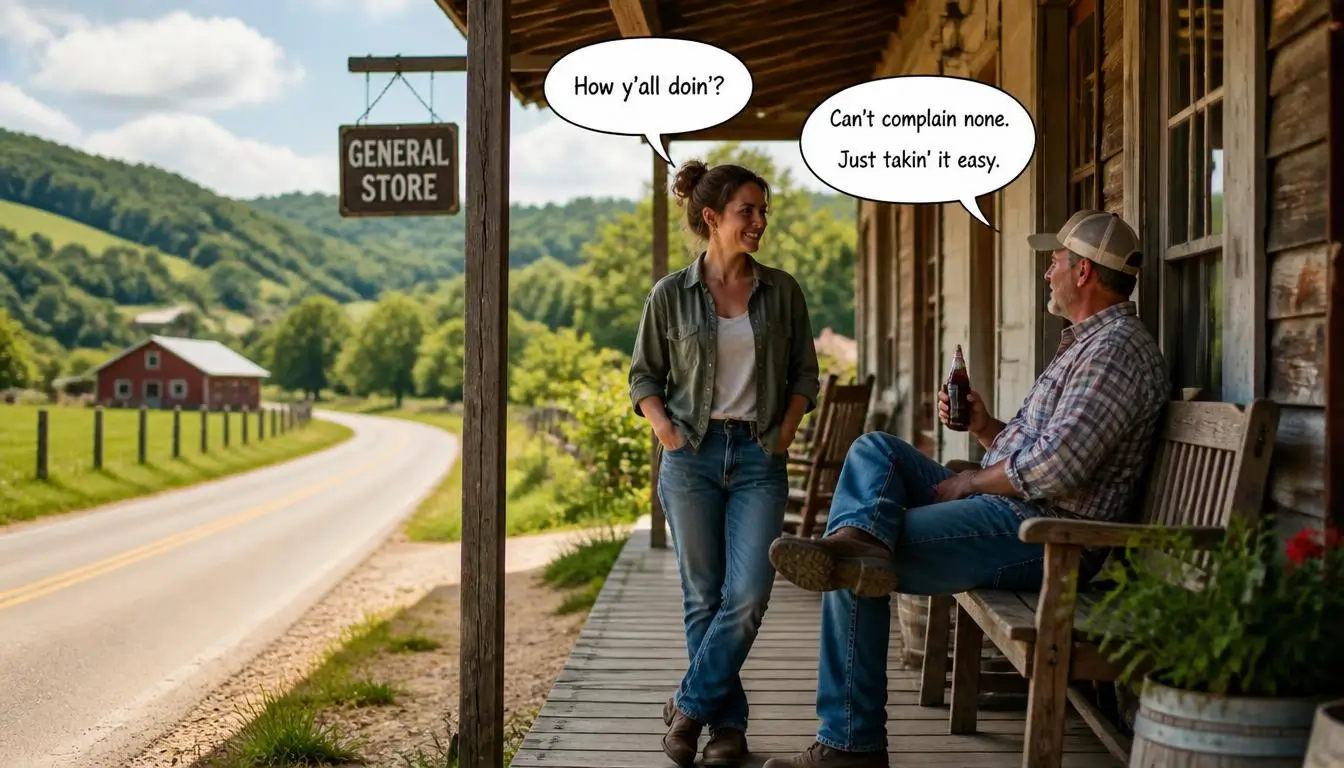
Kentucky slang refers to the informal words and phrases spoken by people from Kentucky, especially in Appalachian and rural parts of the state.
It blends Southern and Appalachian English, with words tied to farming, family, hollers, and hospitality. Some terms are only local, while others have spread through pop culture.
Key Takeaways
- Kentucky slang is a mix of Southern speech and Appalachian dialect, shaped by the state’s mountains, farms, and small towns.
- Many terms come from older Appalachian English brought by early settlers, so the exact origin of some words is unclear.
- The slang is still used today, especially in Eastern and rural Kentucky, and it shows up more in daily speech than online trends.
- Tone is usually warm and friendly, though some words double as playful insults among friends and family.
- Regional differences exist: Eastern, Western, Northern, and Louisville-area Kentucky each have their own flavor of slang.
Kentucky slang reflects the state’s Southern and Appalachian roots, with many expressions shaped by generations of everyday speech. Words such as “holler,” “reckon,” and “might could” remain familiar parts of local conversation, especially in rural communities.
These terms can sound unusual to visitors who hear them for the first time, but their meanings often become clear through context. Kentucky expressions commonly appear in family conversations, local gatherings, diners, churches, and other everyday settings.
Older generations have helped pass many of these phrases down, while younger speakers continue to use some of them alongside modern language. Kentucky slang also shares connections with broader Southern and Appalachian speech, although certain expressions carry a distinct local flavor.
Learning these words offers a simple way to understand Kentucky’s regional vocabulary, cultural background, and conversational style while recognizing how traditional expressions continue to fit into modern life.
What Does Kentucky Slang Mean?
Kentucky slang refers to the everyday, informal language used by people from Kentucky, especially those from Appalachian and rural areas.
It includes unique words, old-fashioned phrases, and a distinct accent-driven vocabulary.
This isn’t one single dialect. It’s a collection of words shaped by geography. Someone from the Appalachian Mountains in Eastern Kentucky may use different terms than someone from Louisville or the flatter farmland out west.
What ties it together is a shared Southern and Appalachian root, plus a friendly, storytelling way of talking.
Common features include:
- Dropped “g” sounds (“fishin'” instead of “fishing.”)
- Double modals like “might could” or “used to could.”
- Words for family, land, and community life, like “holler,” “kin,” and “younguns.”
- A slower, warmer speech rhythm often called a “drawl.”
Quick Meaning Box
| Meaning | Simple Explanation |
| Regional dialect | Words and phrases specific to Kentucky, especially Appalachian areas. |
| Cultural identity | A way locals show where they’re from and connect. |
| Everyday speech | Common in daily talk, not just internet slang. |
| Storytelling style | Often used with humor, exaggeration, or folksy sayings. |
Pronunciation
Kentucky slang itself isn’t one word, so there’s no single pronunciation. But many of the words inside it follow a soft Southern drawl.
For example, “holler” is said like “HOLL-er” (rhymes with “collar”), not like the verb “holler” meaning to shout, even though it’s spelled the same way.
Where Does Kentucky Slang Come From?
Kentucky slang comes mostly from Appalachian English, a dialect shaped by Scots-Irish, English, and German settlers who moved into the mountains hundreds of years ago.
Because these communities were isolated for a long time, older speech patterns stuck around longer than in other parts of the country.
The exact origin of many individual words is unclear. Language historians know the general roots: old British Isles dialects mixed with frontier life,e but pinning down exactly when or where a specific phrase started is hard.
Isolated mountain communities kept talking a certain way long after cities moved on, which is part of why so much of this slang still sounds old-fashioned today.
Farming, coal mining, and close-knit family life also shaped the vocabulary. Words about land, work, and family are common because those were the center of daily life for generations.
Origin of the Term
Appalachian and Kentucky speech patterns go back to early settlers in the 1700s and 1800s. Because the mountains kept some communities cut off from cities for long stretches, certain words and grammar rules from older English stuck around in Kentucky long after they faded elsewhere.
Through the 1900s, this way of speaking was sometimes mocked in movies and TV as “hillbilly talk,” which unfairly painted it as uneducated.
In recent years, that view has shifted. There’s more appreciation now for Appalachian speech as its own valid dialect with deep history, not just a stereotype.
Kentucky slang hasn’t really faded in and out of popularity the way viral internet slang does. It’s stayed fairly steady, passed down through families.
What has changed is visibility: more people outside the region hear it now through movies, YouTube, and social media clips of Kentuckians talking.
How People Use It Today
Kentucky slang today lives mainly in face-to-face conversation, but it also shows up in texts, social captions, and short videos. People use it to sound authentic, funny, or nostalgic for home.
On platforms like TikTok and Instagram, Kentuckians (and other Appalachian creators) sometimes post videos explaining or showing off local words, which has introduced terms like “holler” and “younguns” to a wider audience. On X and Facebook, it often shows up in jokes, memes about being from Kentucky, or nostalgic posts about home. In texting, it’s mostly just how people naturally write the way they talk.
Kentucky Slang Words
Kentucky slang words cover everything from greetings to weather to family life. Some common ones include “y’all” (you all), “fixin’ to” (about to), “reckon” (think or suppose), and “younguns” (young children).
Other everyday words include “poke” (a bag), “britches” (pants), “yonder” (over there), and “mash” (to press, like a button).
These words aren’t unique to Kentucky alone; many overlap with general Southern and Appalachian speech, but they’re a core part of how Kentuckians talk day to day.
Kentucky Slang Phrases
Kentucky slang phrases are short sayings that pack in a lot of meaning, often with humor or exaggeration. “I’m fixin’ to head out” means someone is about to leave. “Bless your heart” can be genuine sympathy or a polite way to say someone did something silly.
Other phrases include “over yonder” (in that general direction), “might could” (might be able to), and “he’s rough as a cob” (someone acting harsh or unpolished).
These phrases are less about single words and more about a whole rhythm of speaking that’s hard to translate word for word.
Eastern Kentucky Slang
Eastern Kentucky slang is the most distinctly Appalachian version of the dialect, shaped by the mountains and coal-mining towns of the region.
This is where words like “holler,” “poke,” and double modals like “might could” are heard most often.
Because this part of the state was historically more isolated, older speech patterns held on longer here than in cities.
The accent tends to be stronger too, with long vowels and dropped “g” sounds. Eastern Kentucky slang is often what people picture when they think of “hillbilly” or Appalachian talk in general.
Louisville Kentucky Slang
Louisville Kentucky slang is softer and more urban than the mountain dialect found further east. As Kentucky’s biggest city, Louisville mixes Southern speech with more standard American English, especially among younger residents.
Local terms tend to focus on the city itself, things like nicknames for neighborhoods, sports team slang around University of Louisville games, and Derby-season phrases (more on that below).
The strong Appalachian features, like double modals, are less common here than in rural Eastern Kentucky.
What Is a Holler in Kentucky Slang?
A holler in Kentucky slang is a small valley or hollow between hills, often home to just a few houses or one extended family. It’s pronounced “HOLL-er,” not like the word for shouting.
People say things like “I grew up back in the holler” to describe a rural, close-knit home area, often down a narrow road between mountains.
Hollers are common across Appalachia, and the word carries a sense of home, privacy, and tight family roots, not just a geography term.
Western Kentucky Slang
Western Kentucky slang leans more into flat farmland speech patterns, since the western part of the state is less mountainous than the east.
The accent is still Southern, but some of the strongest Appalachian features fade the further west you go.
Farming terms are common here, words tied to tobacco, corn, and livestock work. Western Kentucky sits close to Tennessee and southern Illinois, so its slang sometimes blends with speech patterns from those neighboring areas too.
Northern Kentucky Slang
Northern Kentucky slang sits right across the river from Cincinnati, Ohio, so it blends Southern Kentucky speech with a Midwestern accent. Locals sometimes joke that they don’t sound fully “Southern” or fully “Northern.”
This region uses fewer strong Appalachian markers than Eastern Kentucky. Instead, you’ll hear a mix of some Southern word choices, but a flatter, more neutral accent shaped by being so close to a major Midwestern city.
Kentucky Windage Slang Meaning
Kentucky windage is a marksmanship term that means adjusting your aim by eye, tilting the gun slightly instead of properly adjusting the sights to account for wind or distance. It’s a quick, rough fix rather than a precise one.
Outside of shooting, people sometimes use “Kentucky windage” more broadly to describe estimating or eyeballing a solution instead of measuring it exactly.
It’s a good example of how practical, hands-on Kentucky life shaped a phrase that spread well beyond the state.
Kentucky Derby Slang
Kentucky Derby slang covers the words and phrases tied to the state’s most famous event, held every May at Churchill Downs in Louisville.
Terms like “the backside” (where horses are stabled and trained), “post time” (when the race starts), and “the Twin Spires” (the track’s famous towers) are all part of Derby culture.
Fans also talk about “mint juleps” (the traditional Derby drink) and dressing “Derby fancy,” meaning dressing up with big hats and bold outfits for the occasion. While not everyday slang, Derby terms are a well-known part of Kentucky’s cultural vocabulary, especially each spring.
Kentucky Waterfall Slang
A Kentucky waterfall is another name for a mullet haircut, short on the top and sides, long in the back. The nickname plays off the idea of hair “flowing” down the back of the neck like water.
It’s used more as a joking nickname than formal slang, often said with a laugh rather than as an insult.
The term has spread well beyond Kentucky and is now a widely recognized nickname for the haircut across the country.
Examples in Everyday Conversation
- “You fixin’ to eat, or you want to wait a bit?”
- “I reckon it’ll rain before supper.”
- “She lives back in the holler past the old church.”
- “Bless your heart, you tried your best.”
- “I might could stop by after work.”
- “Grab that poke off the counter for me.”
- “The younguns are playing out back.”
- “He’s rough as a cob, but he means well.”
- “It’s over yonder, past the old barn.”
- “Mash that button so the door opens.”
Text Message Examples
- “Fixin to head your way, be there in 20”
- “Reckon we should just stay in tonight lol”
- “My cousins are coming up from the holler this weekend”
- “Might could swing by after work, not sure yet”
- “Grab me a poke of chips if you stop by the store”
- “Bless her heart, she tried lol”
- “Y’all coming to the cookout Saturday?”
- “It’s over yonder by the gas station, can’t miss it”
- “The younguns wore me out today lol”
- “He’s rough as a cob, but he’ll help you move furniture in a heartbeat”
Social Media Caption Examples
- Instagram: “Back in the holler for the weekend.”
- TikTok: “Explaining ‘might could’ to my non-Kentucky friends.”
- X: “Y’all, it’s fixin to storm again out here.”
- Threads: “Reckon I’ll just take a nap instead.”
- Facebook: “Nothing like Derby weekend in Louisville.”
- Instagram: “Kentucky waterfall szn is back.”
- TikTok: “POV: your grandma says ‘bless your heart,’ and you know you’re in trouble.”
- X: “Sipping a mint julep like it’s Derby Day.”
- Facebook: “Grew up saying ‘poke’ and didn’t know it wasn’t normal everywhere.”
- Threads: “Y’all ever just say ‘over yonder’ and expect people to know exactly where that is?”
Is It Positive or Negative?
Kentucky slang is mostly positive and friendly. Words like “y’all,” “reckon,” and “bless your heart” carry warmth and are meant to sound welcoming, not rude.
That said, tone matters. “Bless your heart” can be genuinely kind or a polite way to poke fun at someone, depending on how it’s said. Words like “rough as a cob” describe someone as blunt or unrefined, which can be teasing or mildly critical depending on context. Most of the time, though, this slang is used affectionately, especially among family and friends.
Who Uses This Slang?
Kentucky slang is used across generations, but it’s strongest among people from rural and Appalachian parts of the state.
Older residents tend to use it most naturally and consistently, while younger people mix it with more standard English, especially in writing.
It’s also used by anyone with Kentucky roots, even after they move away; it’s a way to stay connected to home.
Some words have spread through pop culture and are now recognized (even if not fully understood) by people outside the state entirely.
Similar Slang Words
| Slang | Meaning |
| Y’all | You all (Southern-wide, not Kentucky-only) |
| Reckon | Think or suppose. |
| Fixin’ to | About to do something. |
| Holler | Small valley or hollow community. |
| Poke | A bag or sack. |
| Yonder | Over there, in that direction. |
Opposite Words
- Formal English > standard, textbook phrasing with no regional slang, used the opposite way from casual Kentucky speech.
- “I’m going to” > the formal opposite of “fixin’ to,” said the same but without the informal tone.
- “I believe” or “I think” > the standard version of “I reckon,” used in more formal writing or speech.
Common Mistakes
People often misspell “holler” as “hollar” or mix it up with the verb meaning to shout. It’s the same spelling, but context tells you which meaning is meant.
Another common mistake is assuming all Kentucky slang is identical statewide. In reality, Eastern, Western, Northern, and Louisville-area speech all differ.
Outsiders also sometimes exaggerate or mock the accent in writing, turning normal words into overly cartoonish spellings that don’t reflect how people actually talk.
When NOT to Use It
Kentucky slang doesn’t belong in professional emails, school papers, job applications, or formal business writing. Words like “fixin’ to” or “might could” can come across as too casual or unclear to someone unfamiliar with the dialect.
In formal settings, stick to standard English. Save the slang for texts, casual chats, and conversations with people who’ll understand and appreciate it not a cover letter or a client email.
Fun Facts
- Kentucky is home to several distinct dialect regions within one state, not just one accent.
- Appalachian English, a big part of Kentucky slang, is recognized by linguists as its own dialect with deep historical roots.
- “Y’all” is common across the whole South, not unique to Kentucky, but Kentuckians use it just as much as anywhere else.
- Double modals like “might could” are a documented feature of Appalachian English, not just casual slang.
- The Kentucky Derby has its own mini-vocabulary that’s separate from everyday Appalachian slang.
- “Kentucky windage” is used by shooters and hunters well beyond Kentucky’s borders.
Frequently Asked Questions
What is Kentucky’s catchphrase?
Kentucky doesn’t have one single official catchphrase, but “My Old Kentucky Home” (the state song) and phrases tied to the Kentucky Derby, like “The Fastest Two Minutes in Sports,” are closely associated with the state. Casually, phrases like “y’all come back now,” or references to bourbon and horse country often stand in as unofficial ways people identify Kentucky in conversation and branding.
What are some hood slang words?
“Hood slang” usually refers to urban slang from city neighborhoods across the U.S., which is a separate category from rural Kentucky slang. It often includes words shaped by hip-hop culture and city life, like “fam” (close friend), “lowkey” (secretly or somewhat), and “no cap” (no lie). These terms are widely used across many U.S. cities and aren’t specific to Kentucky’s Appalachian dialect.
What are some hillbilly sayings?
“Hillbilly sayings” overlaps closely with Appalachian and Eastern Kentucky slang. Examples include “I reckon,” “might could,” “rough as a cob,” and “over yonder.” The term “hillbilly” was once used as an insult but has been reclaimed by many Appalachian people as a proud way to describe their mountain heritage and traditional way of speaking.
What is soda called in Kentucky?
In most of Kentucky, soda is commonly called “pop,” similar to much of the Midwest and parts of the South. In some areas, especially closer to the Deep South influence, people also say “coke” as a general word for any soft drink, then specify the brand afterward, like “what kind of coke you want.”
Final Thoughts
Kentucky slang isn’t just a list of funny words; it’s a living piece of the state’s history, shaped by mountains, farms, and generations of storytelling.
From “holler” to “reckon” to “might could,” these words carry warmth and a strong sense of place.
If you’re planning a trip, chatting with a Kentucky friend, or just curious about regional dialects, understanding this slang gives you a real window into Appalachian and Southern culture.
It’s still spoken every day, in kitchens, on porches, and now in texts and social captions too proof that this way of talking isn’t going anywhere.

James Carter is a slang researcher and writer at Slang Insight, dedicated to exploring the origins and meanings behind today’s most popular internet expressions. With a background in linguistics and a love for pop culture, James brings a unique perspective to every article, making slang easy to understand for everyone.