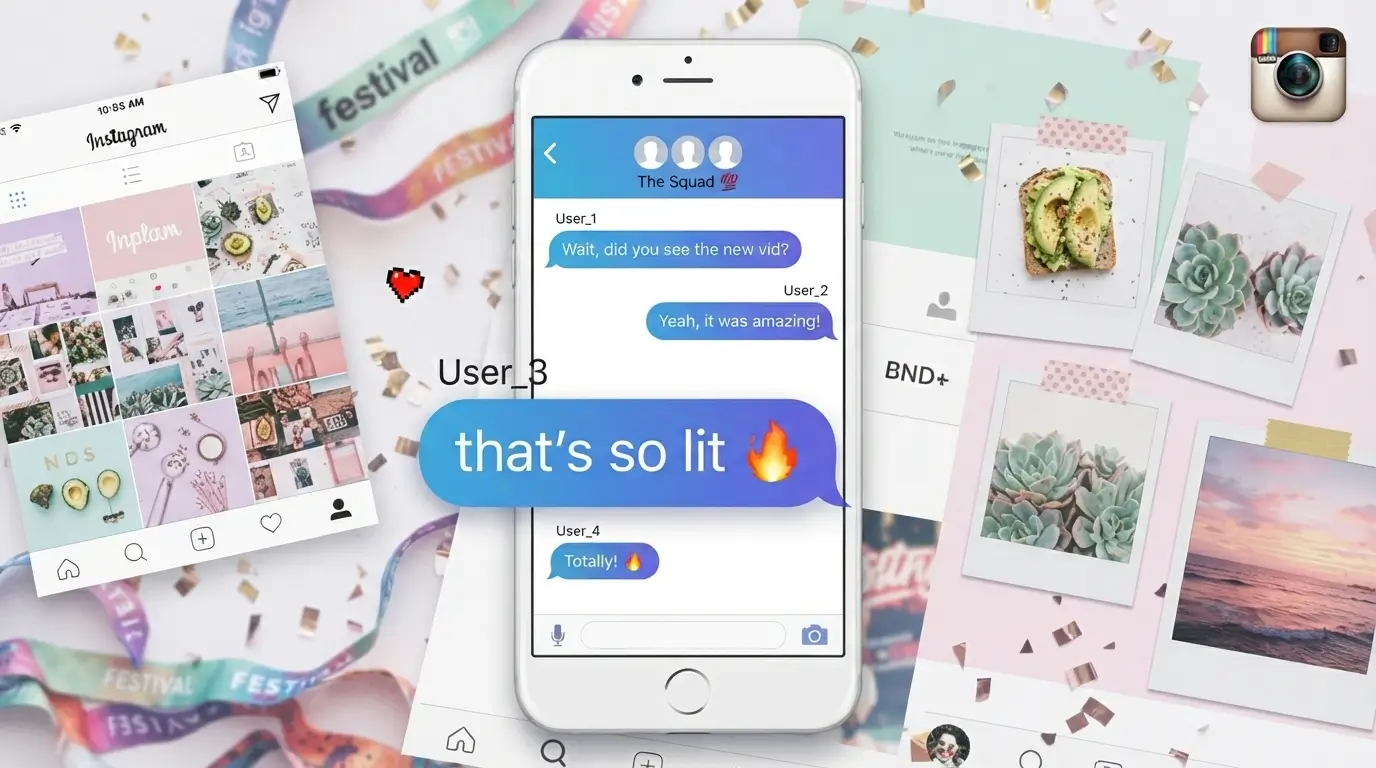
2017 slang refers to the words and phrases that were popular that year, mostly spread through texting, Twitter, Instagram, and Vine before it shut down. Terms like “lit,” “on fleek,” “salty,” “savage,” “extra,” and “mood” defined how teens and young adults talked online and in person during 2017.
Key Takeaways
- 2017 slang mostly grew out of Black culture, Vine, Twitter, and early Instagram
- Words like “lit,” “salty,” “savage,” and “extra” were everywhere that year
- Most of these terms are still understood today, even if a few feel dated now
- The tone ranges from playful and complimentary to sarcastic and shady
- Many 2017 terms crossed over from AAVE and hip-hop into mainstream teen speech
- Some words faded fast, while others (like “mood” and “lit”) stuck around for years
Introduction
If you’ve ever scrolled through an old group chat or rewatched a 2017 vlog and thought “wait, what does that even mean,” you’re not alone. 2017 slang shows up a lot in throwback memes, nostalgia posts, and “remember when we said this” TikToks.
People search for 2017 slang for a few reasons. Some want to relive their teen years. Others are trying to decode an old text or caption. Teachers, parents, and content creators also look it up to understand what their kids or younger coworkers grew up saying.
A lot of 2017 slang came from Black culture and Vine, then spread fast through Twitter and Instagram. Some of it, like “lit” and “mood,” is still used today. Other words, like “on fleek,” now feel like a time capsule.
This guide breaks down the biggest 2017 slang words, where they came from, how people used them, and whether they’re still around. By the end, you’ll be able to read an old 2017 text or caption and actually understand it.
What Does 2017 Slang Mean?
2017 slang means the specific set of informal words and phrases that were widely used during that calendar year, mostly by teens and young adults on social media and in texting. It’s not one single word, but a whole vocabulary tied to a moment in internet culture.
Some of the biggest examples from that year include “lit” (exciting or excellent), “salty” (bitter or annoyed), “savage” (bold or blunt, sometimes in a good way), “extra” (over the top or dramatic), and “mood” (a relatable feeling, often used as its own one-word reaction). Each of these had its own flavor, but they shared a common thread: quick, punchy words that could sum up a feeling or reaction in a text or caption without much explanation needed.
Quick Meaning Box
| Meaning | Simple Explanation |
| Lit | Exciting, fun, or excellent |
| Salty | Bitter, annoyed, or holding a grudge |
| Savage | Blunt, bold, or ruthless (often as a compliment) |
| Extra | Over the top or dramatic |
| Mood | A relatable feeling or reaction |
| Fam | A close friend or friend group |
| Snatched | Looking really good, sharp, or flawless |
| Woke | Aware of social or political issues |
Pronunciation
Most 2017 slang words are pronounced the same way as their regular English versions. “Lit” rhymes with “sit.” “Salty” sounds just like the seasoning. “Savage” is SAV-ij. “Extra” is EK-struh. None of these need special phonetic spelling since they’re everyday words used with a new meaning, not new made-up sounds.
Where Does 2017 Slang Come From?
Most 2017 slang traces back to Black American culture, especially African American Vernacular English (AAVE), and spread through Vine, Twitter, and Instagram before landing in everyday teen conversation. The exact origin of many individual words is hard to pin down to one person or moment, since slang usually spreads through communities long before it goes viral.
Vine played a huge role leading up to 2017, even though the app shut down in January of that year. Many of its short comedy clips and catchphrases kept circulating as memes and slang long after Vine itself was gone. Twitter and Instagram picked up where Vine left off, turning jokes and reaction words into slang that spread nationwide.
Politics also shaped the slang landscape in 2017. Words like “fake news” became part of everyday conversation after being used constantly in the news, and the term “covfefe” briefly went viral as an internet joke after a well-known typo appeared in a tweet from President Trump. These weren’t traditional youth slang, but they show how much of 2017’s language was shaped by what was trending online that year.
History of the Term
2017 sits right in the middle of the smartphone-and-social-media era, a few years after Instagram and Twitter became mainstream but before TikTok existed. Slang moved fast that year because so many teens were constantly online, texting, and posting.
Words like “on fleek” had actually started a couple of years earlier, around 2014, but were still common in 2017 before starting to fade. “Lit” had been around in music and party culture for a while too, but 2017 is often remembered as one of its peak years in everyday teen conversation. “Savage” got a boost partway through the decade and stayed strong through 2017, later getting another wave of popularity when a song of the same name came out years later.
Some 2017 slang has had a resurgence. “Mood” is still used constantly today, often paired with a photo or video that just captures a feeling. “Lit” also survived, though it’s used a little less than it was at its peak. Other words, like “on fleek,” mostly stayed behind in 2017, now used more as a throwback joke than serious slang.
How People Use It Today
Some 2017 slang is still active, especially on Instagram, Twitter/X, and in group texts, though usage has shifted since TikTok became the biggest driver of new slang. Words like “lit,” “mood,” “extra,” and “savage” show up regularly in captions, comments, and everyday conversation.
Other 2017-era terms are mostly used ironically now. Someone might say “that’s so on fleek” as a joke, poking fun at how dated it sounds. This kind of throwback usage is common on TikTok and Instagram, where people post “2017 vs now” comparisons for fun.
2017 Slang Words
The core list of 2017 slang words includes terms tied to excitement, attitude, and social reactions. “Lit,” “savage,” “extra,” “salty,” “fam,” “snatched,” “woke,” and “mood” were among the most repeated words that year across group chats and social media captions.
Each word served a slightly different purpose. “Lit” described anything exciting, from a party to a good song. “Salty” described someone being bitter after losing or getting rejected. “Snatched” described looking especially good, whether it was an outfit, makeup, or a whole look.
2017 Slang Urban Dictionary
Urban Dictionary was one of the main places people went to look up 2017 slang in real time, since it lets everyday users submit and vote on definitions. Because entries are crowdsourced, definitions for the same word can vary, and some entries include jokes or exaggerated meanings rather than strict definitions.
If you search a 2017 slang term there today, you’ll often see multiple entries from that exact year, since usage spiked right as people were searching to understand it. It’s a useful resource for casual reference, but it isn’t an official dictionary, so definitions should be treated as community explanations rather than confirmed facts.
2017 Slang Phrases
Beyond single words, 2017 also had full slang phrases that carried their own meaning. “I can’t even,” “no cap” (used earlier in some communities before spreading wider later), “throw shade,” “spill the tea,” and “I’m dead” (meaning something was extremely funny) were common examples.
These phrases worked like verbal shortcuts. Instead of explaining that something was funny, embarrassing, or dramatic, people could just drop a short phrase everyone already understood.
2017 Slang for Cool
The main word 2017 slang used for “cool” was “lit,” alongside “fire” and “savage” depending on context. “Lit” was the most flexible, describing anything from a great party to a good meal. “Fire” usually described something impressive, especially music, food, or an outfit.
“Savage” worked a little differently. It described someone being bold or blunt in a way that was still seen as impressive, rather than something simply being “cool” on its own.
Popular 2017 Slang
The most widely used 2017 slang words were the ones that crossed over from teen circles into mainstream adult use, mostly through news coverage and viral tweets. “Lit,” “salty,” “savage,” “extra,” “fam,” and “mood” all reached that level of popularity, showing up in ads, TV shows, and even news segments trying to explain “what the kids are saying.”
That crossover often marked the beginning of the end for a slang word’s coolness, since slang tends to lose its edge once it becomes too mainstream or used by people outside the group that made it popular.
What Generation Is 2017 Slang?
2017 slang was used mainly by younger Millennials and older Gen Z, since Gen Z is generally defined as people born from the late 1990s through the early 2010s. In 2017, the oldest Gen Z members were in college or just starting careers, while the bulk of Gen Z was still in middle school or high school, making them the main users and spreaders of that year’s slang.
Younger Millennials also used a lot of this slang, since platforms like Twitter and Instagram were popular across both age groups at the time.
Old 2017 Slang
Some 2017 slang now counts as “old” slang, meaning it’s recognized but rarely used seriously anymore. “On fleek,” “bae” (used heavily a bit earlier but still common in 2017), and “yeet” (which was gaining traction that year) fall into this category for a lot of people today.
These words haven’t disappeared completely. They just get used differently now, often as a joke or a deliberate throwback rather than a genuine reaction.
What Was the Most Popular Slang Word in 2017?
“Lit” is widely remembered as one of the most popular slang words of 2017, alongside “savage,” which had major staying power that year. Both words were flexible enough to use in almost any context, which helped them spread quickly across group chats, captions, and everyday conversation.
There’s no single official ranking of the single most popular slang word for that year, since slang popularity isn’t tracked the same way dictionary word-of-the-year lists are. But “lit” and “savage” are the two most commonly cited when people look back on 2017 slang.
2017 Internet Slang
Internet-specific slang in 2017 included terms tied directly to online behavior, like “shade” (a subtle insult), “receipts” (proof of something, usually screenshots), “clout” (online influence or attention), and “stan” (an intensely dedicated fan). These words were less about everyday conversation and more about describing online drama and fandom culture.
“Clout” in particular became a bigger topic that year, often discussed alongside “clout chasing,” meaning someone doing something specifically to get attention or followers online.
2017 Teen Slang
Teen slang in 2017 leaned heavily on reaction words and quick judgments, things like “extra,” “salty,” “savage,” “mood,” and “I can’t.” These words let teens react fast in texts and comments without writing full sentences.
A lot of this slang traveled straight from Black teen culture into wider teen use nationwide, partly through Vine, Twitter, and shared memes that got reposted across different friend groups and schools.
2017 Meme Slang
Meme culture in 2017 introduced its own vocabulary, including “covfefe,” which briefly became a huge joke after a viral presidential typo, and phrases tied to specific viral videos and Vine clips that kept getting referenced even after Vine shut down. Meme slang like this often only makes sense with context, since it’s tied to a specific joke or moment rather than a general feeling.
Unlike broader slang like “lit” or “mood,” meme slang from 2017 tends to fade faster once the original joke stops being relevant, since it depends on people remembering where it came from.
2017 High School Slang
High school slang in 2017 overlapped heavily with general teen slang, but leaned extra hard on group dynamics and social judgment. Words like “extra,” “salty,” “savage,” “shade,” and “clout” all described how someone acted around friends, exes, or classmates.
High schoolers in 2017 also used a lot of these words sarcastically, which made tone tricky over text. Something like “wow, savage” could be a compliment or a light callout depending on the situation.
2017 Roblox Slang
Roblox had its own smaller slang culture in 2017, though it overlapped a lot with general gaming slang like “GG” (good game), “noob,” and “OP” (overpowered). Roblox-specific slang wasn’t as widely documented or reported on as broader teen slang from that year, so exact usage inside the platform is harder to confirm with certainty.
What is clear is that gaming slang in general, including terms used on Roblox, tended to focus on skill level, fairness, and in-game behavior rather than personality or attitude like mainstream teen slang did.
2017 UK Slang
UK slang in 2017 had some overlap with US slang but also its own distinct terms, like “peng” (attractive), “bare” (meaning “a lot” or “very”), and “chirpsing” (flirting). While some American slang like “lit” and “savage” did reach UK teens through social media, British slang that year kept a lot of its own regional flavor, especially in London youth culture.
The exact spread of specific words between the UK and US in 2017 is hard to map precisely, since social media let slang cross borders faster than it used to, without a clear record of exactly which direction a word traveled first.
2017 Gen Z Slang
Gen Z slang in 2017 included some of the earliest widely used terms from that generation, like “no cap,” “sis” (used playfully, not just literally), and “lowkey”/”highkey” to describe how much someone did or didn’t want something known. Since the oldest Gen Z members were only just entering adulthood in 2017, a lot of their slang was still forming and would keep evolving heavily over the next few years.
Many terms that people now think of as classic Gen Z slang, like “no cap” and “bet,” were present in 2017 but became even more widespread in the years right after.
2017 Toronto Slang
Toronto slang in 2017 included terms shaped heavily by the city’s diverse communities and by artists from the area, like “man” used as a filler word, “wasteman” (someone acting foolish or unreliable), and “ting” (used to refer to a person or situation). This slang often blended influence from Caribbean, British, and North American English.
Because Toronto slang is tied closely to specific neighborhoods and communities, exact origins and timelines for individual words are hard to pin down with full certainty, and definitions can shift depending on who you ask.
2017 Kids Slang
Kids’ slang in 2017, especially among younger tweens, tended to be simpler versions of teen slang, things like “cool,” “epic,” and “savage” used more loosely and without as much sarcasm as older teens used it. Younger kids often picked up slang from older siblings, YouTube, or shows aimed at their age group, sometimes without fully understanding the original context or tone.
2017 Middle School Slang
Middle schoolers in 2017 often used a toned-down version of high school slang, relying heavily on words like “savage,” “extra,” and “salty,” but without as much of the shade or sarcasm older teens layered on top. Middle school slang that year was also shaped a lot by whatever was trending on YouTube and in mobile games, since middle schoolers in 2017 were spending a lot of time on tablets and phones outside of school.
Examples in Everyday Conversation
- “Did you see the game last night? That comeback was so lit.”
- “She didn’t even say bye, that’s kind of savage.”
- “Why are you being so salty about losing one round?”
- “He wore a full suit to a backyard barbecue, that’s so extra.”
- “That’s such a mood, honestly.”
- “My fam is coming over this weekend.”
- “You look snatched today, what’s the occasion?”
- “He’s been really woke since he started that class.”
- “Stop throwing shade, just say what you mean.”
- “I can’t even deal with this right now.”
Text Message Examples
- “omg that party was lit last night”
- “why r u being so salty lol”
- “he really said that to her face?? savage”
- “she wore heels to the beach, so extra”
- “big mood tbh”
- “coming thru with the fam later”
- “u look snatched in that pic”
- “spill the tea, what happened”
- “no shade but that was weird”
- “im dead 😂😂”
Social Media Caption Examples
- Instagram: “Lit night with the squad 🔥”
- TikTok: “POV: you’re extra and you know it”
- X/Twitter: “Why is everyone so salty today lol”
- Threads: “Big mood energy this week”
- Facebook: “Fam trip 2017, missing this already”
- Instagram: “Snatched and ready for the weekend”
- TikTok: “That’s so savage I’m crying”
- X/Twitter: “Fake news, don’t believe everything you read”
- Facebook: “Throwback to when this was our whole vocabulary”
- Instagram: “No shade, just facts”
Is It Positive or Negative?
Most 2017 slang can go either way depending on tone and context, which is part of why it caused so many mixed signals in texts. “Savage” is usually a compliment, describing someone being bold or blunt in an impressive way, but it can turn negative if someone’s being genuinely cruel. “Salty” almost always leans negative, describing someone being bitter or petty.
“Extra” sits in the middle. It can be a lighthearted joke about someone being dramatic, or a subtle criticism depending on how it’s said. Misunderstandings were common in text form specifically because these words rely so much on tone, which doesn’t always come through in a message.
Who Uses This Slang?
2017 slang was used mainly by teens and young adults, especially high schoolers and college students who were active on Twitter, Instagram, and group texts. It also spread into gaming communities, where some terms overlapped with existing gamer slang.
Parents, teachers, and older adults picked up some of this slang too, often after seeing it explained in news articles or hearing it repeated by their kids. Regional pop culture, especially hip-hop and artists from cities like Toronto, also shaped which words spread fastest and where.
Similar Slang Words
| Slang | Meaning |
| Fire | Excellent or impressive |
| Savage | Bold, blunt, or ruthless |
| Extra | Over the top or dramatic |
| Salty | Bitter or annoyed |
| Shade | A subtle insult |
| Clout | Online influence or attention |
| Snatched | Looking flawless or sharp |
| Woke | Aware of social issues |
Opposite Words
- Basic — the opposite of “extra,” describing someone plain or predictable instead of dramatic
- Chill — the opposite of “salty,” describing someone calm and not bothered
- Mid — describes something average, the opposite of “lit” or “fire”
- Asleep — used jokingly as the opposite of “woke,” meaning unaware of social issues
Common Mistakes
People often misuse “savage” as always meaning something cruel, when in 2017 it was mostly used as a compliment for boldness. Another common mistake is spelling “on fleek” as “on fleak” or assuming it means the same as “flawless,” when it specifically described something looking sharp or well-groomed, especially eyebrows.
“Woke” is also frequently misunderstood outside its original context. In 2017, it specifically meant being aware of social and racial issues, not just being generally informed or awake in the literal sense.
When NOT to Use It
2017 slang doesn’t belong in professional emails, school assignments, resumes, or formal writing, since it can come across as unprofessional or unclear to readers who don’t know the terms. Words like “lit,” “savage,” or “extra” don’t translate well in a business context and can make writing seem less credible.
It’s also risky to use in mixed-age settings without context, since older readers or non-native English speakers might misread the tone entirely. Sticking to plain, standard English is safer for job applications, teacher-graded work, and any formal communication.
Fun Facts
- Vine shut down in January 2017, but many of its catchphrases kept spreading as slang and memes for years after.
- Merriam-Webster’s official word of the year for 2017 was “feminism,” reflecting how political language shaped the year alongside slang.
- Dictionary.com chose “complicit” as its 2017 word of the year.
- “Covfefe” went viral in 2017 after a well-known presidential tweet contained the typo, and it briefly became an internet-wide joke.
- “Savage” got another huge wave of popularity years later when a song by the same name became a hit.
- Urban Dictionary saw spikes in searches for slang terms right as they were trending in 2017, since people used it as a real-time slang reference.
Frequently Asked Questions
What slang did people use in 2016?
2016 slang leaned heavily on words like “on fleek” (still going strong that year), “bae,” “squad goals,” “on point,” and “I can’t.” Vine was still active in 2016, so a lot of slang that year came directly from Vine clips and catchphrases. Some 2016 terms carried straight into 2017, while others, like certain one-off Vine references, faded once the app’s peak popularity passed. Compared to 2017, 2016 slang leaned a bit more on friendship and appearance-based phrases rather than the sharper, more sarcastic tone that took over in 2017.
What are Gen Z slang words?
Gen Z slang includes terms like “no cap” (meaning “no lie”), “bet” (meaning “okay” or “for sure”), “rizz” (charisma, especially with romantic interest), and “mid” (meaning average or mediocre). Many of these words came after 2017, as Gen Z got older and TikTok became the main place slang spread from. Some 2017 terms, like “mood” and “lit,” got absorbed into Gen Z slang too, showing how slang from one year can carry forward instead of disappearing completely.
What does 17 mean in slang?
On its own, “17” isn’t a major standalone slang term from 2017 the way words like “lit” or “savage” are. It mostly shows up as a reference to someone’s age, a date, or shorthand for the year 2017 itself in captions and hashtags, like “#2017vibes” or “throwback to 17.” There isn’t strong evidence of “17” carrying a separate, widely recognized slang meaning on its own outside of these contexts.
What does six seven mean in slang?
“Six seven” is not part of 2017-era slang and became popular as its own separate internet phrase years later, tied to a specific song lyric and meme trend rather than anything from 2017. It’s a good example of how slang keeps evolving long after any single year’s trends fade, with newer generations creating fresh phrases that have nothing to do with older slang cycles like the one from 2017.
Final Thoughts
2017 slang captures a specific moment right after Vine, when Twitter and Instagram were shaping how teens talked both online and in person. Words like “lit,” “savage,” “salty,” and “mood” gave people quick, expressive ways to react to everything from parties to petty drama.
Some of these words are still part of everyday conversation. Others now feel like a nostalgic time capsule, the kind of thing that pops up in a “remember when we said this” post. Either way, 2017 slang is a solid snapshot of how fast internet language moves, and how much a single year can shape the way people talk for years afterward.

Emily Rodriguez is a content creator and editor at Slang Insight, specializing in Gen Z language trends and social media culture. Emily’s mission is to help readers stay updated with the latest slang so they never feel out of the loop in online conversations.